Search

Materials Science
Hot Stage Microscopy
An SEM heating stage offers high quality in situ imaging and analysis at high temperatures.
Join the conversation
Hot stage microscopy
Real-world materials applications often take place under variable environmental conditions, including high temperatures. The behavior of your heated material as it recrystallizes, melts, and deforms can inform critical macro- and microscopic observations, such as how a manufactured part might respond to stress or how feed materials behave during production. As a sample’s response to heat is a dynamic process, it must be paired with dynamic observation for accurate insight. Modern heating stages in electron microscopes allow for in situ experiments for high-resolution observation of heated materials. These demanding experiments are capable of linking sample morphology, environment, and thermodynamics, and can help you control the corresponding behavior of the bulk material.
SEM heating stages
There are many considerations when operating electron microscopes at elevated temperatures, such as the desired temperature range, sample size, and chemical environment. The following table shows what is possible with Thermo Scientific temperature stages.
Hoja de estilo para las especificaciones de la tabla de productos
Name | Application | Temperature | Max. Sample Size | Environment |
High vacuum heating stage | General-purpose heating, high resolution imaging, in-column detection, fast processes, electron-backscatter diffraction (EBSD) | Up to 1100°C (EBSD up to 900°C) | 10 mm | High vacuum |
Environmental SEM (ESEM) stage | Heating in gaseous environment: oxidation or other chemical reactions | Up to 1000°C or 1400°C, depending on the model | 5 mm | ESEM |
µHeater | Powder heating, chunk lift-out studies (DualBeam), STEM imaging, high-temperature EBSD and EDS, ramp rate of 10,000°C/s | Up to 1200°C | 50 µm | Any |
Cooling stage, WetSTEM | Precise control over humidity, wetting studies, modest heating | -20°C to +60°C | 3 mm | ESEM |

Gold on a silicon substrate at approximately 1080°C. The High Vacuum Heating Stage allows all in-lens detectors and imaging modes to be used to image the sample with excellent resolution and contrast.


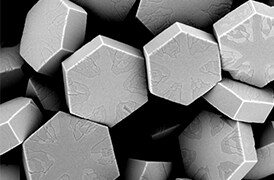
Mixture of magnetite and hematite nanoparticles heated at 1030 °C.
Backscattered electron image (left) and EDS maps of iron and oxygen (right) acquired simultaneously.


Texture development on implant material. As the temperature increases from 700 °C to 1300 °C
we can observe a completely different surface structure. Pressure: 120 Pa.


Two-phase Co-Sb alloy during heating to 700°C on the High Vacuum Heating Stage. The antimony-rich
phase sublimated during heating, causing exposure of the second phase.
Documents
Mixture of magnetite and hematite nanoparticles heated at 1030 °C.
Backscattered electron image (left) and EDS maps of iron and oxygen (right) acquired simultaneously.
Texture development on implant material. As the temperature increases from 700 °C to 1300 °C
we can observe a completely different surface structure. Pressure: 120 Pa.
Two-phase Co-Sb alloy during heating to 700°C on the High Vacuum Heating Stage. The antimony-rich
phase sublimated during heating, causing exposure of the second phase.
Documents
Investigación sobre materiales fundamentales
Se investigan nuevos materiales a escalas cada vez más pequeñas para lograr el máximo control de sus propiedades físicas y químicas. La microscopía electrónica proporciona a los investigadores información clave sobre una amplia variedad de características materiales a escala nanométrica.

Investigación de baterías
El desarrollo de baterías se realiza mediante análisis multiescala con microCT, SEM y TEM, espectroscopía Raman, XPS y visualización y análisis 3D digital. Aprenda cómo este enfoque proporciona la información estructural y química necesaria para crear mejores baterías.

Investigación sobre metales
La producción eficaz de metales requiere un control preciso de las inclusiones y precipitados. Nuestras herramientas automatizadas pueden realizar varias tareas cruciales para el análisis de metales, incluyendo el recuento de nanopartículas, el análisis químico EDS y la preparación de muestras de TEM.

Investigación sobre polímeros
La microestructura polimérica determina las características y el rendimiento del material a granel. La microscopía electrónica permite un análisis exhaustivo en microescala de la morfología y composición de los polímeros para aplicaciones de control de calidad e I+D.

Nanopartículas
Los materiales tienen propiedades sustancialmente diferentes en la nanoescala y en la macroescala. Para estudiarlos, la instrumentación S/TEM se puede combinar con la espectroscopia de rayos X por dispersión de energía para obtener datos de resolución nanométrica, o incluso subnanométrica.

Estudios forenses
Los microrastros de las pruebas de las escenas del crimen se pueden analizar y comparar usando microscopía electrónica como parte de una investigación forense. Las muestras compatibles incluyen fragmentos de vidrio y pintura, marcas de herramientas, drogas, explosivos y residuos de armas de fuego.

Investigación sobre catálisis
Los catalizadores son cruciales para la mayoría de los procesos industriales modernos. Su eficacia depende de la composición microscópica y la morfología de las partículas catalíticas; EM con EDS es ideal para estudiar estas propiedades.

Pruebas de materiales para automóviles
Todos los componentes de un vehículo moderno están diseñados para garantizar la máxima seguridad, eficacia y rendimiento. La caracterización detallada de materiales de automoción con microscopía electrónica y espectroscopía informa sobre decisiones cruciales sobre procesos, mejoras de productos y nuevos materiales.

Fibras y filtros
El diámetro, la morfología y la densidad de las fibras sintéticas son parámetros clave que determinan la vida útil y la funcionalidad de un filtro. La microscopía electrónica de barrido (SEM) es la técnica ideal para investigar rápida y fácilmente estas características.
Style Sheet for Komodo Tabs


Hoja de estilo para tarjetas originales instrumentos
Style Sheet to change H2 style to p with em-h2-header class