Search

Materials Science
Electron Energy Loss Spectroscopy
High resolution electron energy loss spectroscopy for high signal-to-noise ratio elemental mapping and oxidation state probing.
Join the conversation
48ab - Appl/Samples/Products/Resources/Contact
Electron Energy Loss Spectroscopy
Over the last three decades, electron energy loss spectroscopy (EELS) has become a formidable characterization technique. Used in combination with a transmission electron microscope (TEM), it can provide atomic-level chemical and structural characterization. This includes information about elemental composition, chemical bonding, oxidation states, valence and conduction band electronic properties, and surface properties. It can also be used in conjunction with other techniques, such as electron tomography, to provide advanced 3D mapping of elements and oxidation states.
As materials characterization becomes increasingly more demanding, there is a growing need for highly localized characterization of increasingly complex structures with ever smaller features. Fortunately, improvements in EELS and S/TEM instrumentation have kept pace with these demands, with advances including spherical aberration correction of the S/TEM lenses, as well as the use of monochromators to improve energy resolution, providing sub-angstrom spatial resolution and a higher probe current.
EELS TEM
With our X-FEG/Mono, X-FEG/UltiMono and X-CFEG guns on the Thermo Scientific Spectra and X-FEG on the Thermo Scientific Talos S/TEM platforms, Thermo Fisher Scientific has all your EELS applications covered. These systems allow you to perform ultra-high resolution EELS analysis to obtain valuable structural, elemental, and chemical information at the atomic scale.

Core-loss EELS atomic-resolution elemental map of a BaTiO₃/SrTiO₃ interface. Barium in blue, strontium in red and titanium in green. Imaged at 80 kV (60 pA) with a 1 eV full width at half maximum (FWHM) electron probe (49x49 pixels, <90 seconds).

Mapping of surface phonon modes in a magnesium oxide crystal at 60 kV using a monochromated electron probe with a full width at half maximum (FWHM) electron probe of <30 meV. Specimen and analysis courtesy of Isobel Bicket and Prof. Gianluigi Botton, The Canadian Centre for Electron Microscopy, McMaster University.
OptiMono+ exciting an X-FEG/UltiMono from the monochromator off state (with 1 eV energy resolution) to the monochromator fully excited state (<30 meV) at 60 kV.
Localized positions of plasmon excitations along a gold nanowire as a function of their excitation energy (between 0.18 – 1.2 eV), investigated with an electron probe of <0.2 eV energy resolution.
Core-loss EELS atomic-resolution elemental map of a BaTiO₃/SrTiO₃ interface. Barium in blue, strontium in red and titanium in green. Imaged at 80 kV (60 pA) with a 1 eV full width at half maximum (FWHM) electron probe (49x49 pixels, <90 seconds).
Mapping of surface phonon modes in a magnesium oxide crystal at 60 kV using a monochromated electron probe with a full width at half maximum (FWHM) electron probe of <30 meV. Specimen and analysis courtesy of Isobel Bicket and Prof. Gianluigi Botton, The Canadian Centre for Electron Microscopy, McMaster University.
OptiMono+ exciting an X-FEG/UltiMono from the monochromator off state (with 1 eV energy resolution) to the monochromator fully excited state (<30 meV) at 60 kV.
Localized positions of plasmon excitations along a gold nanowire as a function of their excitation energy (between 0.18 – 1.2 eV), investigated with an electron probe of <0.2 eV energy resolution.
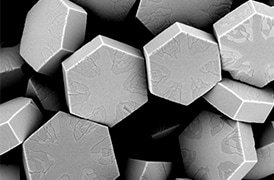
Fundamental Materials Research
Novel materials are investigated at increasingly smaller scales for maximum control of their physical and chemical properties. Electron microscopy provides researchers with key insight into a wide variety of material characteristics at the micro- to nano-scale.
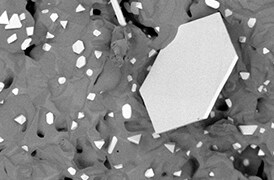
Quality control and failure analysis
Quality control and assurance are essential in modern industry. We offer a range of EM and spectroscopy tools for multi-scale and multi-modal analysis of defects, allowing you to make reliable and informed decisions for process control and improvement.

Battery Research
Battery development is enabled by multi-scale analysis with microCT, SEM and TEM, Raman spectroscopy, XPS, and digital 3D visualization and analysis. Learn how this approach provides the structural and chemical information needed to build better batteries.

Polymers Research
Polymer microstructure dictates the material’s bulk characteristics and performance. Electron microscopy enables comprehensive microscale analysis of polymer morphology and composition for R&D and quality control applications.

Metals Research and Characterization
Effective production of metals requires precise control of inclusions and precipitates. Our automated tools can perform a variety of tasks critical for metal analysis including; nanoparticle counting, EDS chemical analysis and TEM sample preparation.

Fibers and Filters
The diameter, morphology and density of synthetic fibers are key parameters that determine the lifetime and functionality of a filter. Scanning electron microscopy (SEM) is the ideal technique for quickly and easily investigating these features.

Forensics
Micro-traces of crime scene evidence can be analyzed and compared using electron microscopy as part of a forensic investigation. Compatible samples include glass and paint fragments, tool marks, drugs, explosives, and GSR (gunshot residue).

Geological Research
Geoscience relies on consistent and accurate multi-scale observation of features within rock samples. SEM-EDS, combined with automation software, enables direct, large-scale analysis of texture and mineral composition for petrology and mineralogy research.

Catalysis Research
Catalysts are critical for a majority of modern industrial processes. Their efficiency depends on the microscopic composition and morphology of the catalytic particles; EM with EDS is ideally suited for studying these properties.

2D Materials
Novel materials research is increasingly interested in the structure of low-dimensional materials. Scanning transmission electron microscopy with probe correction and monochromation allows for high-resolution two-dimensional materials imaging.

Automotive Materials Testing
Every component in a modern vehicle is designed for safety, efficiency, and performance. Detailed characterization of automotive materials with electron microscopy and spectroscopy informs critical process decisions, product improvements, and new materials.
Style Sheet for Komodo Tabs
Style Sheet for Instrument Cards Original


Style Sheet to change H2 style to p with em-h2-header class