 To assure consistently great-tasting beers that consumers will enjoy, precise flavor profiling is essential. However, quantifying specific analytes of interest in this complex sample matrix can be challenging due to the large number of fermentation products present. Fortunately, ongoing improvements in high-pressure anion exchange chromatography are helping brewers more accurately determine organic acids to ensure every beer tastes great.
Organic acid determination in beer using anion exchange chromatography
Anion exchange chromatography is a well-established technique for the determination of organic acids in food and beverage products, routinely providing highly efficient separations in complex sample matrices. Nonetheless, recent advances in high-pressure ion chromatography (HPIC) instrumentation and columns are pushing this high-resolution performance even further.
The Thermo Scientific Dionex ICS-5000+ HPIC system, and more recently, the Thermo Scientific Dionex ICS-6000 HPIC system, are high-pressure modular ion chromatography (IC) systems that can operate at up to 5000 psi. The systems’ high-pressure capabilities support the use of small particle size columns that deliver significant improvements in peak resolution, smaller peak widths, and as a result, higher signal-to-noise ratios compared with conventional columns. Furthermore, the higher flow rates that can be achieved using 5000-psi capable IC systems enable faster run times without sacrificing performance. Other design features, such as reagent-free eluent generation, replace the need for manual eluent preparation, improving method precision by ensuring the consistent production of high-purity mobile phase (eluent).
High-resolution organic acid separations using small particle size columns
We put the performance of the latest HPIC systems and anion exchange columns to the test, as reported in a recent
The Thermo Scientific Dionex IonPac AS11-HC anion exchange column is a high-capacity column optimized for organic acid separations in complex matrices, making it ideal for beer analysis. Using the Dionex ICS-5000+ HPIC system, we compared the 4 μm and 9 μm resin particle size versions of this column for the separation of a standard solution of organic acids and inorganic anions commonly found in beer.
Figure 1 shows chromatograms containing 29 analytes separated using the 4 μm and 9 μm columns. The 4 μm particle size column resulted in a 40–50% improvement in critical peak pair resolution, and higher signal-to-noise ratios compared with the 9 μm column. Given the elevated backpressures encountered when working with small particle size columns, the high-pressure capability of the Dionex ICS-5000+ HPIC system was critical for achieving these superior results.
Determination of organic acids in beer samples by anion exchange chromatography
After demonstrating highly efficient organic acid and inorganic anion separations using this experimental set-up, the approach was used to analyze three US beer samples.
Using a 4 μm particle size Dionex IonPac AS11-HC column (4 mm i.d.), and working with an electrolytically generated potassium hydroxide gradient and system backpressure of ~4000 psi, the method achieved clean separation of at least 14 analytes in each beer. Key differences in chloride, phosphate and citrate content between the samples could be identified.
To further improve the resolution of critical peak pairs, including succinate, malate, butyrate and tartrate components, methanol was added as an organic modifier. This hydroxide–methanol gradient resulted in changes to the elution order, resolving previously co-eluting peaks. Utilizing a narrower 2 mm i.d. column and the hydroxide–methanol gradient, these peaks could be clearly resolved, allowing, for example, the analysis of butyrate – an important indicator of beer spoilage.
Optimizing peak resolution in food and beverage analysis using high-pressure ion chromatography
Advances in HPIC have led to the development of small particle size anion exchange columns capable of highly efficient analyte separation. The latest high-resolution, high-capacity anion exchange columns optimized for organic acid analysis in challenging sample matrices are helping beer manufacturers produce consistently great-tasting products.
You can read more about the use of high-resolution, high-capacity anion exchange columns for organic acid determination in beer in this app note.
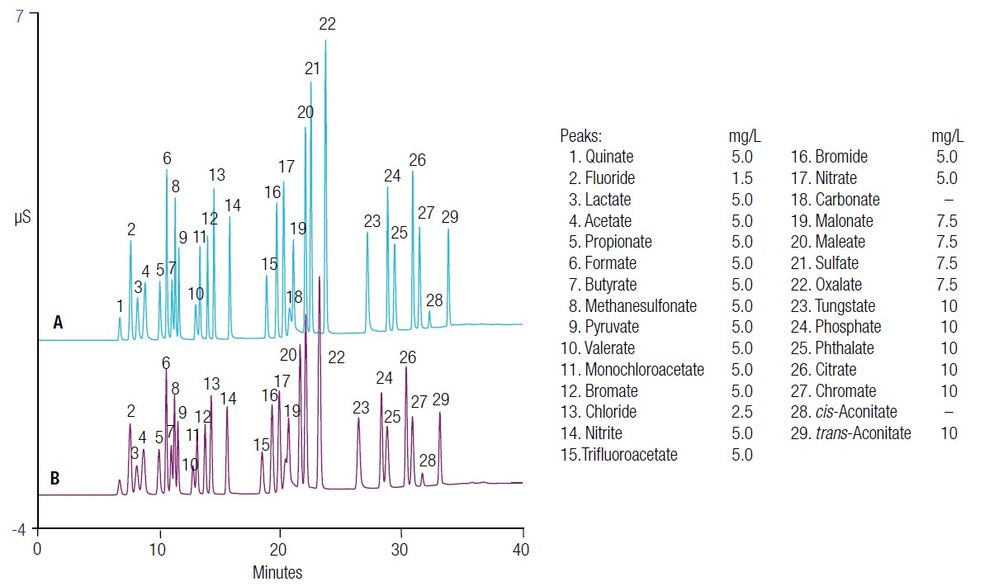
Figure 1. Comparison of (A) 4 μm and (B) 9 μm Dionex IonPac 4 mm i.d. columns

Enhancing PFAS Analysis in Food Contact Materials Using Combustion Ion Chromatography
Per- and polyfluoroalkyl substances (PFAS) have been used in...
Read More
Understanding PFAS and Combustion-Ion Chromatography
Per- and polyfluoroalkyl substances (PFAS) comprise more tha...
Read More
What is the Ion Chromatography Golden Jubilee? Celebrating 50 Years of IC Innovation
The year 2025 marks the golden jubilee of ion chromatography...
Read More
New Column for Fast Analysis of Haloacetic Acids, Bromate and Dalapon Using Ion Chromatography Coupled with Mass Spectrometry
Haloacetic acids (HAAs) are disinfection byproducts (DBPs) f...
Read More