
Thermo Fisher Scientific

Your educational resource for biopharma, pharma, environmental, food and agriculture, industrial, and clinical labs

  • Categories
    • Advancing Materials
    • Advancing Mining
    • AnalyteGuru
    • Analyzing Metals
    • Ask a Scientist
    • Behind the Bench
    • Biotech at Scale
    • Clinical Conversations
    • Examining Food
    • Identifying Threats
    • Illuminating Semiconductors
    • Life in Atomic Resolution
    • Life in the Lab
    • OEMpowered
    • The Connected Lab
  • About Us
  • Contact
Accelerating ScienceAnalyteGuru / Biopharmaceutical / Peptide Mapping: Piecing Together the Puzzle

Peptide Mapping: Piecing Together the Puzzle

By AnalyteGuru Staff, 10.21.2020

The Importance of Peptide Mapping

Peptide mapping is a critical analytical workflow in biotherapeutic characterization. It is the most frequently used analytical method that provides information for the complete sequence of a protein and so confirms protein identity. With peptide mapping methods, the peptides generated by enzymatically digesting the protein into these smaller puzzle pieces are analyzed. By completely mapping these pieces, any modifications taking place along the protein sequence can be located and the affected peptides quantified, and with that modification levels monitored. These post-translational modifications (PTMs) are product quality attributes and sometimes found to be critical in terms of quality and need to be accurately, reliably, and reproducibly monitored. This is often performed with liquid chromatography (LC) coupled to high-resolution accurate mass (HRAM) mass spectrometry (MS).

To see all the pieces of the puzzle, of which some may be hidden for one reason or another, one needs to go and seek out the right tools, the right enzymes to use to cut up the protein puzzle board to those detectable puzzle pieces.

Scientists at Symphogen are working to bring novel monoclonal antibody (mAb) based therapeutic products to market, as individual protein therapeutics or as a mixture of mAbs.

They noticed that in some of their molecules, due to the hydrophobic properties of areas of the protein sequence, commonly used proteases (such as trypsin) did not deliver detectable peptides for LC-MS analysis. It was clear that alternative sample preparation strategies were needed, or alternative proteases, cleaving after different amino acids, to be used, assuring the production of detectable proteolytic peptides for all regions of the protein sequence.

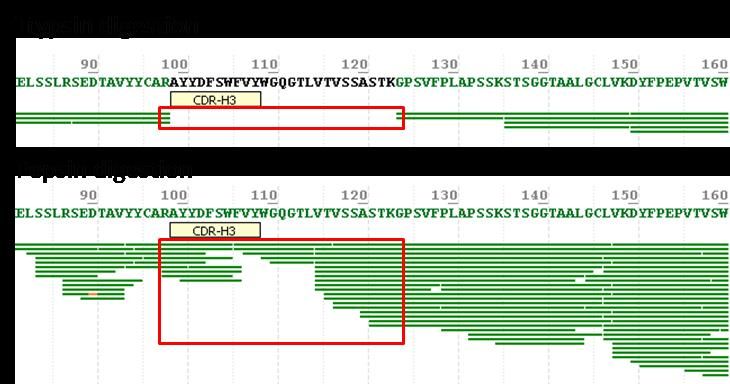
With some of their previous challenging mAbs, they have tested combinations of the different enzymes, so performing tryptic and chymotryptic digestion, but that is more complex than using just one enzyme. Therefore, they tested pepsin. You can read more about how this sample preparation strategy helped them in the recently published application note. For example, on the mAb1 they produced many peptides with pepsin for regions where they did not have any tryptic peptides. (Figure 1)

Figure 1. Results of peptide coverage for CDR3 region of mAb1.

Read the application note: “Peptide mapping of challenging monoclonal antibodies”

They compared peptide mapping data acquired using Thermo Scientific™ SMART Digest™ Trypsin kits and Thermo Scientific™ SMART Digest™ Pepsin kits in Magnetic Bulk Resin options. The study focused on protein sequence coverage and the identification of PTMs. Combining the Thermo Scientific SMART Digest magnetic kits with the Thermo Scientific™ KingFisher™ Duo Prime purification system allowed them to leverage an automated approach to optimize protein digestion methods. Automation is also a very important requirement in the fast-paced modern analytical laboratory.

Watch the on-demand webinar to learn more: “Alternative strategies for peptide mapping of challenging monoclonal antibodies in clinical development”

You can learn more about Symphogen’s work here: www.thermofisher.com/Symphogen

The KingFisher Duo Prime system has become Symphogen’s sample preparation aid and they have used it for other analytical workflows to help to automate those initial key steps of sample handling needed for analyzing their antibody samples.

You can hear more about these in our on-demand webinar: “Automated Sample Preparation Strategies for Comprehensive Therapeutic Protein Characterization”

If you watch our webinar, you can:

    • Learn about flexible and fast sample preparation options and how new automated technologies compare to existing practices
    • Learn how to overcome issues with automation of peptide mapping, high-level structural information collection at the subunit level
    • Learn about how automated sample preparation saves times and frees up analyst time

Additional information

Blog: Rapid Automated Peptide Mapping

Website: Peptide Mapping Information

Excedion Pro Banner

Discover. Innovate. Exceed. — Introducing the Thermo Scientific Orbitrap Excedion Pro Mass Spectrometer

Mass spectrometry is entering a new era of precision, perfor...

Read More

freedom to fragment

Radical-based Ion Activation and Dissociation

Electron Transfer Dissociation (ETD) has been commercialized...

Read More

freedom to fragment

Freedom to Fragment: Introduction

The importance of fragmentation in mass spectrometry 1. What...

Read More

Benefits of Automating Your Antibody QC Analytical Workflows

Want a less stressed QC lab?  Discover how automation c...

Read More

AnalyteGuru Staff

Thermo Scientific™ Dionex™ Ion Chromatography (IC) – A Precision Instrument
How to Keep Moving Forward in Challenging Times

Privacy StatementTerms & ConditionsLocationsSitemap

© 2025 Thermo Fisher Scientific. All Rights Reserved.

Talk to us