Electron Transfer Dissociation (ETD) has been commercialized for over 20 years, starting on the Thermo Scientific Orbitrap-Ion Trap hybrid mass spectrometers and undergoing major architectural and hardware changes on the Thermo Scientific Orbitrap Tribrid mass spectrometers 10 years later. It continues to evolve and be improved upon.

Process: ETD involves the transfer of electrons to cause radical formation on the molecules of interest, leading to fragmentation. For peptides and proteins, ETD favors c- and z-ion formation [Figure 1].
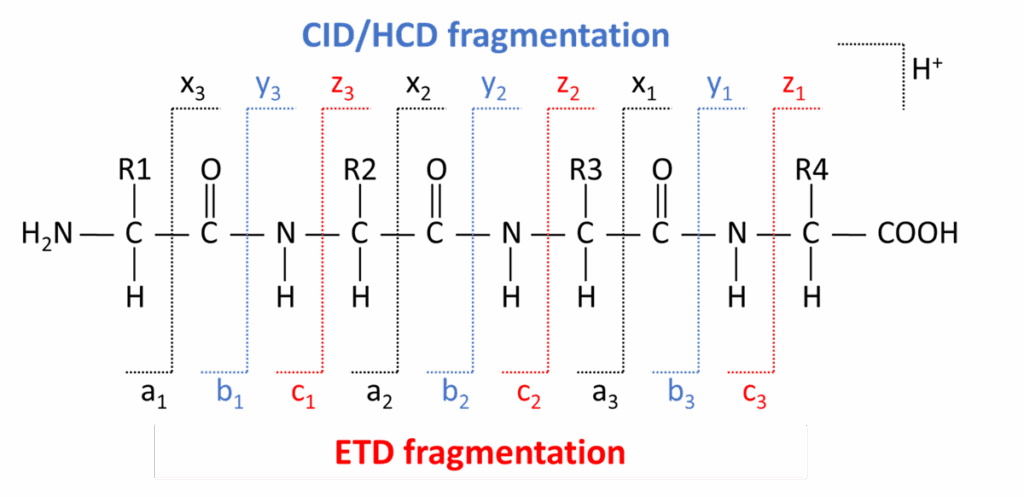
Figure 1: Location of peptide/protein backbone cleavage and its nomenclature. Representative here is a 4 amino acid peptide with sidechains labeled R1-4.
Applications: Due to its gentle nature, ETD is used for labile post-translational modification (PTM) analysis, like glycosylation. As a complementary technique to collision-based fragmentation, it is also very useful for immunopeptidomics and sequence verification (IE for peptide mapping and de novo type experiments). The rapid transfer of electrons at high charges and the different fragmentation pathways, complementary to collision techniques, make ETD ideal for top-down proteomics. By using EThcD (the combination of ETD followed by HCD on the same packet of ions), it is possible to get diagnostic ions to differentiate leucine and isoleucine for immunopeptidomics and de novo experiments.
Considerations: ETD involves the permanent transfer of an electron to the cation precursor of interest; this means that the charge state will be lowered by 1. For lower charge state precursors, this means the product ion signal may be limited because precursor charges must be sacrificed to achieve fragmentation. Furthermore, the ETD reaction rate increases as the precursor charge state increases. Highly charged intact proteins will react quite fast. However, lowly charged precursor ions require 10s of milliseconds to react.
ETD fragmentation is so gentle, as is the ion transfer within most Thermo Scientific mass spectrometers, that non-covalent interactions within the cation precursors can be maintained through Van der Waals forces. This means that after electron transfer and fragmentation, the c- and z-ions may not be visible due to those weak bonds within the molecule itself holding the structure together. We call this ETnoD (electron transfer no dissociation). [Figure 2] In these cases, we have a supplementary technique where, immediately following the ETD reaction, the charge-reduced precursor can be fragmented by collisions, either HCD or CID, though HCD is more common. This is called EThcD (or ETciD) and is, in fact, the most common way to perform ETD experiments. This supplemental energy is usually a small normalized collisional energy (NCE) relative to what would be used for intact peptides/proteins, but it has been recently applied at higher NCE to implement both ETD and HCD based fragments to much success.1
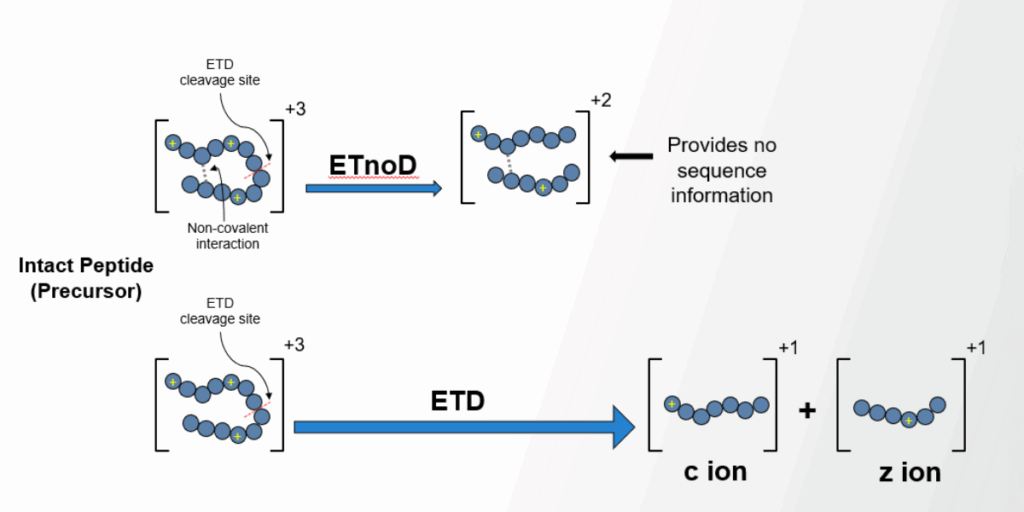
Figure 2: Two potential +3 charged peptides are shown before electron transfer [right]. The top one has a preserved non-covalent interaction, whereas the bottom has none. In the event of electron transfer, the top peptide’s resulting m/z would be a charge reduction of the precursor, not displaying the fragmentation information. Whereas the bottom peptide releases c- and z-ions.
References:
- Veth TS, Sutherland E, Markuson KA, Zhang R, Duboff AG, Huang J, et al. Improvements in glycoproteomics through architecture changes to the Orbitrap Tribrid MS platform. ChemRxiv. 2024; doi:10.26434/chemrxiv-2024-4sqd3-v2 This content is a preprint and has not been peer-reviewed.
Learn more about radical-based ion activation and electron transfer dissociation (ETD)
Visit us on LinkedIn: #ETD #MassSpec #Biopharma

Fragment Smarter, See Deeper: How the Orbitrap Excedion Pro Unlocks EASY-ETD and HCD Fragmentation
When every peptide bond matters, fragmentation is where disc...
Read More
Discover. Innovate. Exceed. — Introducing the Thermo Scientific Orbitrap Excedion Pro Mass Spectrometer
Mass spectrometry is entering a new era of precision, perfor...
Read More
Scaling Up Biopharmaceutical Characterization with the Orbitrap Ascend BioPharma Tribrid Mass Spectrometer
Biopharmaceutical pipelines are expanding rapidly, with incr...
Read More
Collision-Based Ion-activation and Dissociation
Introduced nearly 80 years ago, collision-based ion-activati...
Read More