The importance of microeukaryotes in the ocean
The exploration of microeukaryotes in the ocean is of paramount importance due to their significant roles in marine ecosystems and global ecological processes. These microorganisms are essential in nutrient cycling and energy flow, and they serve as fundamental components of the marine food web.1 Delving into their diversity, distribution, and functionalities, including aspects such as mitochondrial morphology and endomembrane organelles, can lead to transformative advancements in marine biology, ecology, and environmental sciences.
Whole 3D cell model discovered
In a recent study,2 researchers from the Czech Academy of Sciences and the University of South Bohemia (Czech Republic) investigated the diplonemid microeukaryote Lacrimia vacuolate. The usage of fluorescence and electron microscopy technologies combined with image processing software allowed them to reveal the three-dimensional whole-cell model of this newly discovered diplonemid organism. Significantly, the findings include the identification of a new organelle termed colv (Center for Organization of Layered Vesicles) and a complex endomembrane system consisting of diverse vesicles and vacuoles.
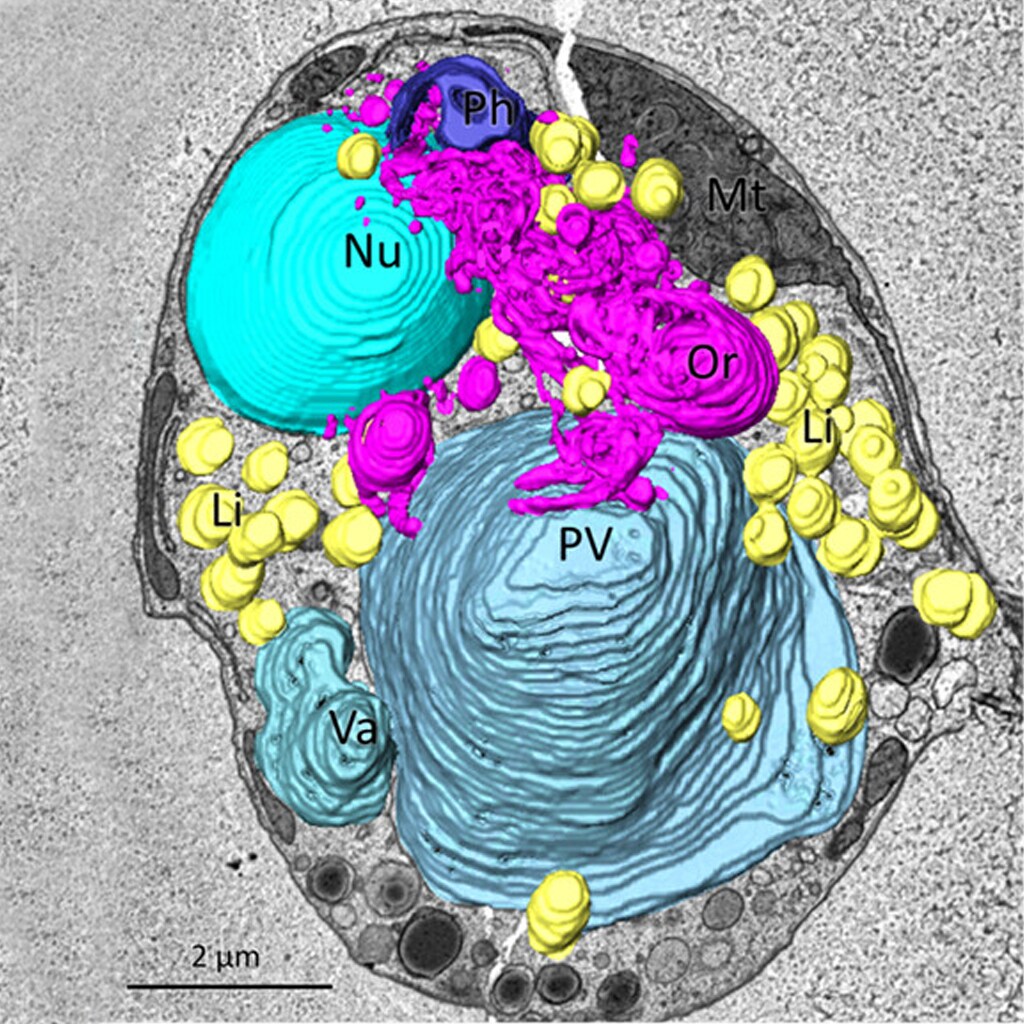
Three dimensional structures of organelles, vacuoles and vesicles. 3D reconstruction of 2 μm-thick slice from array tomography data set shows different organelles vacuoles and vesicles. Nucleus (Nu), mitochondrion (Mt), lipid droplets (Li), posterior vacuole(PV), cytopharynx (Ph) Colv organelle (Or) and smaller vacuole (Va). Image credit doi: 10.1128/mbio.01921-23
The observation of the cells at different orientations enabled researchers to reveal a single unbranched mitochondrion connected with the cytopharynx structure.
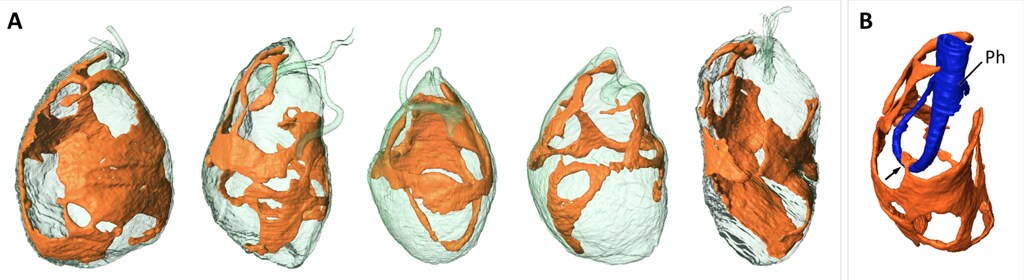
Shape and detailed structure of the mitochondrion. A) Surface rendering of five cells reconstructed from SBF-SEM data, each showing a single interconnected mitochondrion (orange). B) Connection point between the mitochondrion and the cytopharynx (Ph). Image credit doi: 10.1128/mbio.01921-23
Despite the mitochondrion spanning a large area, it frequently tapers into thin segments where closely aligned membranes are devoid of visible cristae or matrices. These slender sections connect to thicker regions that feature a dense matrix, prominent DNA aggregates, and cristae structures. The cristae exhibit diverse shapes, such as long parallel layers, short straight or curved layers, and blob-like forms.
Thermo Scientific Amira Software plays a crucial role in this research by offering sophisticated visualization and analysis tools. Specifically, it supports the detailed examination and interpretation of complex datasets. Amira Software allows researchers to construct intricate 3D reconstructions, perform quantitative analyses, and derive deeper insights into the structural and functional aspects of microeukaryotes, including their mitochondrial morphology and endomembrane organelles. The software’s ability to handle extensive datasets and produce precise 3D reconstructions significantly advanced the research efforts, enabling more accurate and comprehensive findings.
Understanding the cell biology of microeukaryotes
This research has led to a deeper understanding of microeukaryotic diplonemid structure and their ecological functions. This enhanced knowledge contributes to the broader scientific understanding of marine ecosystems, potentially leading to novel discoveries in marine biology and environmental science. Furthermore, it underscores the importance of advanced and flexible image processing software like Amira Software in conducting innovative scientific research.
References and further reading
1 – Worden, AZ, et al. Rethinking the marine carbon cycle: Factoring in the multifarious lifestyles of microbes. Science 347:6223 (2015). doi: 10.1126/science.1257594
2 – Tashyreva, D, et al. Ultrastructure and 3D reconstruction of a diplonemid protist (Diplonemea) and its novel membranous organelle. mBio 14:e01921-23 (2023). doi: 10.1128/mbio.01921-23
3 – Amira Software for cell biology
Leave a Reply