Biomanufacturing: an introduction
Biomanufacturing is the use of biological systems, like microorganisms or cells, to produce commercially valuable products. These products can include pharmaceuticals, food ingredients, biofuels, and more. Biomanufacturing intentionally applies biological processes (for example, fermentation) to transform raw materials into desired outputs (for example, to convert malt extract into beer). This often requires very specific conditions in order to be efficient and effective (to continue the example, strict temperature control and venting of unwanted gaseous by-products are essential to an acceptable final product).
In biomanufacturing, robust control strategies are essential to maintain desired performance and prevent instability or failure. Dynamic systems, such as bioreactors and ultrafiltration/diafiltration (UF/DF) systems, must be able to adapt to internal and external changes while continuing to produce optimal results. These bioprocess control strategies are particularly critical in high-stakes industries like biopharmaceuticals, aerospace, and chemical processing. They help ensure stability across varying conditions, maintain accuracy despite noise and disturbances, enable real-time decision-making, and optimize resource use.
Automation can greatly enhance the effectiveness of biomanufacturing process control. Automated feedback from an analytical technique utilizing a process Raman analyzer helps enable rapid adjustments to keep bioprocesses under control and within desired parameters. Various aspects of biomanufacturing processes and the use of Raman spectroscopy to enhance them are discussed here.
Biomanufacturing quality control strategies
Control strategies are divided into two broad categories, passive control and active control.
Passive control relies on fixed parameters and assumes stable environments—colloquially this might be called “set it and forget it.” Passive control strategies do not implement sensors in-line or at-line for monitoring or adjustments. As the name implies, passive control simply sets in place process parameters that were previously determined and trusts those settings to keep bioprocess conditions where they need to be without further intervention.
Active control, on the other hand, dynamically adjusts system behavior using sensors, actuators, and controllers. There are two main types of active control strategies: open-loop and closed-loop (feedback) control. Open-loop systems execute predefined actions without making use of feedback, assuming predictable knowledge about the system model. Closed-loop systems continuously monitor outputs and, based on real-time feedback from various sensors, adjusts inputs as necessary to achieve the desired outputs.
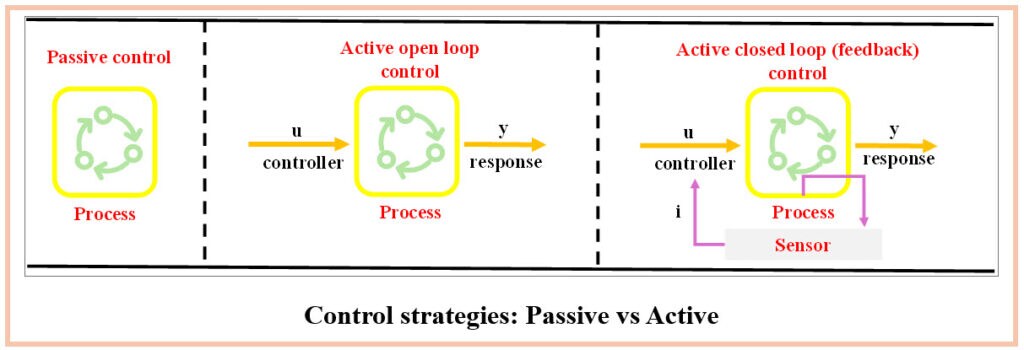
Active closed-loop feedback control
Active closed-loop feedback control is necessary when handling complex, dynamic systems. It allows for adaptation to uncertainties and optimizes operational efficiency, while also ensuring stability and minimizing the effects of any external disturbances. These characteristics makes closed-loop feedback essential for robust and adaptive automation.
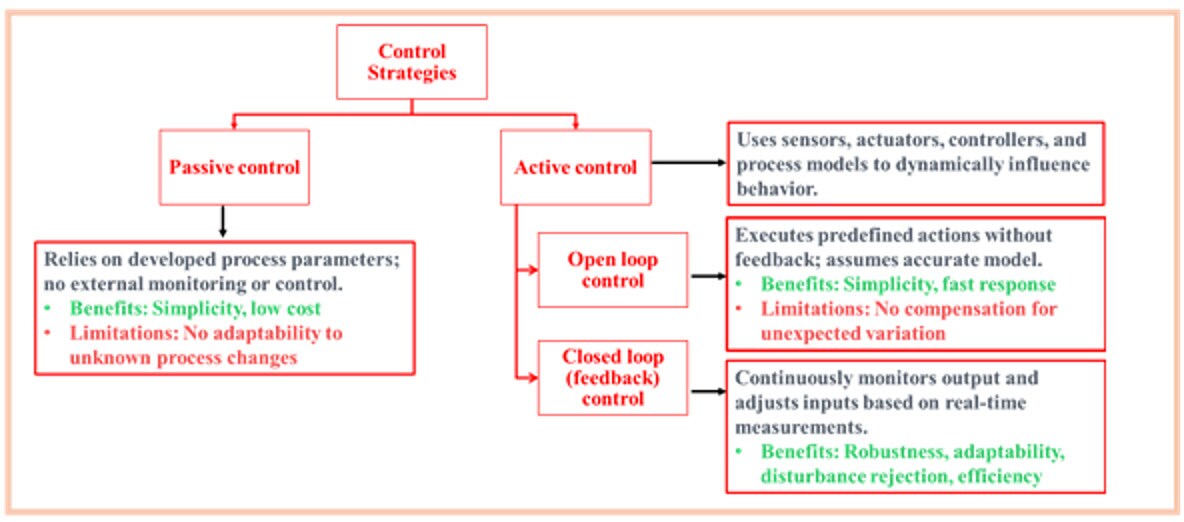
Process Raman spectroscopy for bioprocess monitoring and control
Raman spectroscopy is an analytical technique that makes use of a laser light’s interaction with a sample to provide molecular-level information. Raman spectroscopy is a non-destructive optical technique with unique advantages that make it ideal for active feedback control in bioprocessing:
- Rapid, data-rich measurements: With the ability to acquire spectra in seconds or even milliseconds, Raman spectroscopy provides robust real-time data that enables immediate corrective actions necessary to ensure process stability.
- Molecular specificity: Raman spectroscopy recognizes unique molecular “fingerprints” and enables selective monitoring of analytes in complex mixtures.
- Simultaneous multi-component feedback control: A single Raman spectrum can capture multiple analytes, providing both qualitative and quantitative information, thus supporting multi-component feedback control.
- No sample preparation: Analyzing samples in their native state helps ensure continuous, real-time feedback.
- Non-destructive measurements: Because Raman spectroscopy does not harm or consume the analyte, it preserves product integrity and generates reliable feedback without compromising sample quality.
- In-line monitoring: Available Raman accessories like fiber-optic probes enable real-time, in-line monitoring, providing continuous feedback.
- Water compatibility: Raman spectroscopy is minimally affected by the presence of water, which means that it provides accurate measurements and reliable feedback on samples in aqueous systems.
This combination of attributes is unique to Raman spectroscopy. Taking advantage of these features, scientists can use Raman spectroscopy to monitor bioprocesses and control critical attributes in real time, to help make sure they achieve the high-quality outputs they seek.
Raman spectroscopy applications in bioprocessing
Process Raman spectroscopy has proven effective in a number of bioprocessing applications, including but not limited to the following:
- Cell culture monitoring: Raman spectroscopy can monitor parameters like cell density, viability, and metabolic activity in real time, allowing for adjustments to feed rates and other parameters to optimize cell growth and productivity.
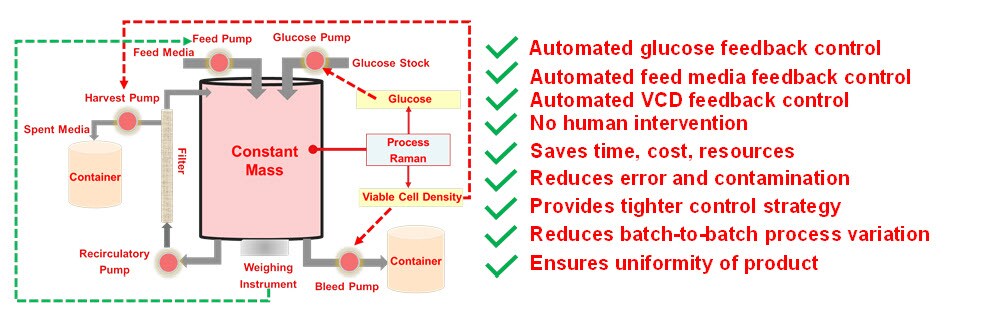
- Monoclonal antibodies production: Raman spectroscopy can by implemented to achieve automated control of glucose feeding, media addition, and cell bleeding in perfusion bioreactors.
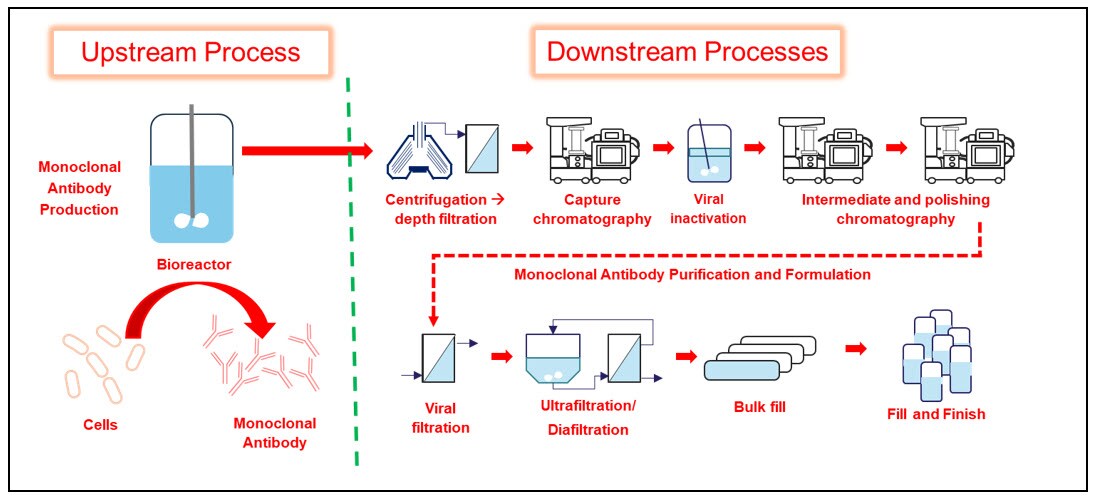
- Nucleic acid therapeutics: Identification and quantification of components in in-vitro transcription reactions for mRNA manufacturing is made possible with Raman analysis.
Conclusion
Process Raman spectroscopy is indispensable for active feedback control in bioprocessing. Its rapid, non-destructive, and specific molecular analysis enables real-time monitoring of multiple critical process parameters. These features can be applied to support process automation, enhance product yield, reduce variability, and assure high-quality results. Its integrability and compatibility with complex matrices make it a cornerstone of modern biomanufacturing, paving the way for AI-driven, intelligent automation.
Additional Resources
- Application note: Process Raman as platform solution for automated glucose feeding in fed-batch bioreactors
- Application note compendium: PAT-enabled scaling and optimization of upstream Bioprocesses: Process Raman spectroscopy and bioreactor application note compendium
- All-In-One Process Raman Analyzer

Designing for Predictable Scale-Up in Pharmaceutical Extrusion
Overview Predictable scale-up in pharmaceutical extrusion ... Dirk Leister
Read More
Scale-Up vs. Scale-Out Strategies for Continuous Pharma Manufacturing
As pharmaceutical pipelines evolve, manufacturing strategies... Dirk Leister
Read More
Innovations in qPCR Technology: What Researchers Need to Know
Real-time PCR, also known as quantitative polymerase chain r... Kevin He
Read More
Understanding DNA Melting Analysis Using UV-Visible Spectroscopy
DNA melting analysis is a vital molecular biology technique ... Jennifer Empey-Kohl
Read More
Leave a Reply