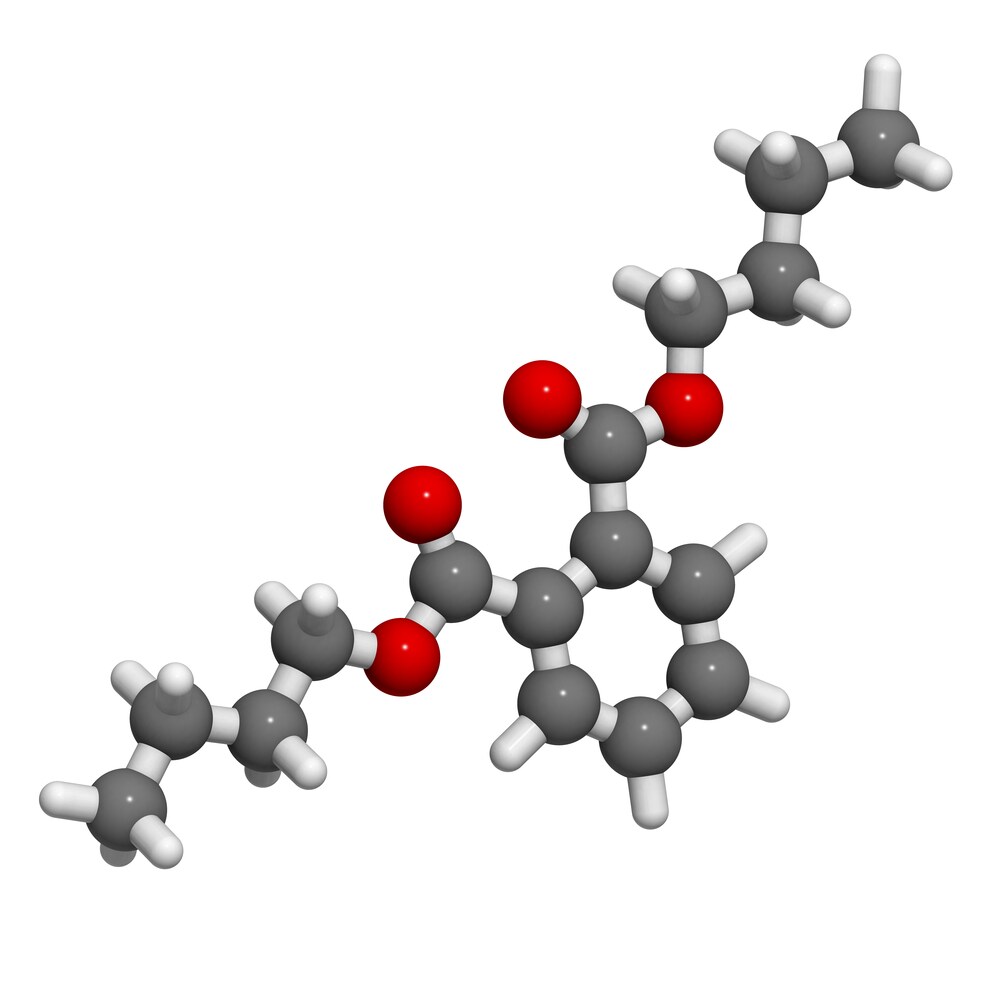
 Plastics manufacturers use phthalate esters to add flexibility and durability to their products, including components used for food packaging. The U.S. Food and Drug Administration has recorded high levels of these compounds in foods and beverages, including inadvertent contamination of fruit juices and intentional adulteration of soft drinks. Since these chemicals are known endocrine disruptors that can deliver reproductive toxicity with exposure, the food testing industry has an interest in rapid, sensitive protocols for quantitative analysis of these compounds in food products.
Khan1 and team report on a method that uses liquid-liquid extraction coupled with gas chromatography (GC) to quantify 15 phthalate esters in spiked drink samples over a concentration range of 100 to 5000 ng/mL. To do this, they prepared a stock standard solution of phthalate esters (1000 µg/mL) in hexane/acetone (8:2 v/v) and used this to make standard solutions in hexane in the following concentrations: 5000, 3000, 1000, 500, 300, and 100 ng/mL. For the creation of a calibration curve, they added internal standard benzyl benzoate (1000 ng/mL). The team was careful to use only meticulously cleaned glassware to avoid inadvertent contamination by plastic equipment. For pipetting, they relied upon an eVol dispensing system (Thermo Scientific) that uses a glass syringe barrel and stainless steel dispensing tip.
They spiked 5 mL soft drink samples with phthalate esters (300 and 1000 ng/mL) before adding internal standard dichloromethane (5 mL). After vortexing the mixture, they dispensed an aliquot of the organic layer into a GC vial, using a high injection temperature (320 °C) to assist in the release of high molecular weight phthalates and lingering phthalates adhered to the injector tip. The team used a TRACE GC Ultra gas chromatograph with a TraceGOLD TG-5MS column (30 m × 0.25 mm × 0.25 μm, 1.0 mL/min constant flow rate) for separation and an ISQ series single quadrupole mass spectrometer for detection (Thermo Scientific). They used Xcalibur software (Thermo Scientific) for data processing.
The 15 detected compounds and retention times (m/z) were: Dimethylphthalate (9.91 min), Diethylphthalate (11.60 min), internal standard Benzyl benzoate (13.60 min), Diisobutyl ester phthalic acid (14.58 min), Di-n-butyl phthalate (15.52 min), Bis(2-methoxyethyl) phthalate (15.90 min), Bis(4-methyl-2-pentyl) phthalate (16.6, 16.68 min), Bis(2-ethoxyethyl) phthalate (16.98 min), Dipentylphthalate (17.31 min), Di-n-hexyl phthalate (18.98 min), Benzyl butyl phthalate (19.09 min), Bis(2-n-butoxyethyl) phthalate (20.03 min), Dicyclohexylester Phthalic acid (20.50 min), Dioctyl Bis(2-ethylhexyl) phthalate (20.60 min), Di-n-octyl phthalate (21.99 min), and Di-nonyl Phthalate (23.37 min).
Khan demonstrated excellent linearity (R2>0.99) and recoveries in the ranges of 66–111% and 71–118% at low (300 ng/mL) and high (1000 ng/mL) concentration values, respectively. Any lower recoveries result from the adsorption of longer chain phthalate esters by the glassware. Of specific note, the scientists highlight the ultra low bleed function of the column itself, which allowed for the detection of even low level compounds. Overall, Khan offers a much-needed, sensitive extraction method for the detection and quantitative analysis of this food contaminant.
Reference:
1 Khan, A. (2013) ‘Determination of Phthalate Esters in Soft Drinks By GC-MS,’ Thermo Fisher Application Note 20735.

Natural Colorants: Unlocking the Future Through Fungal Innovation and Mass Spectrometry
As consumer demand continues to shift toward clean-label, pl... Daniel Merriman
Read More
What to Keep in Mind When Analyzing Chlorophyll Samples using UV-Vis Spectrometry
In some food industries, it can be important to determine th... Jennifer Empey-Kohl
Read More
Can UV-Vis Spectrometry Be Used to Analyze Chlorophyll in Canola Oil?
Canola oil is a type of vegetable oil derived from the seeds...
Read More
Changing Texture and Taste of Plant-Based Meats with Added Oils
Consumers are increasingly choosing plant-based foods becaus... Jill Staggert
Read More

Leave a Reply