The revolution away from fossil fuel reliance for energy and towards renewably generated energy has been well underway for some time. As Northwestern University’s Dr. Sanjeev Mukerjee notes in this video, “The cost of renewable electrons have gone down dramatically, both in solar and wind,” enough that the price is now “at par or below” traditional energy generation costs. “The main thing is that we need energy storage.”
Lithium-Ion Battery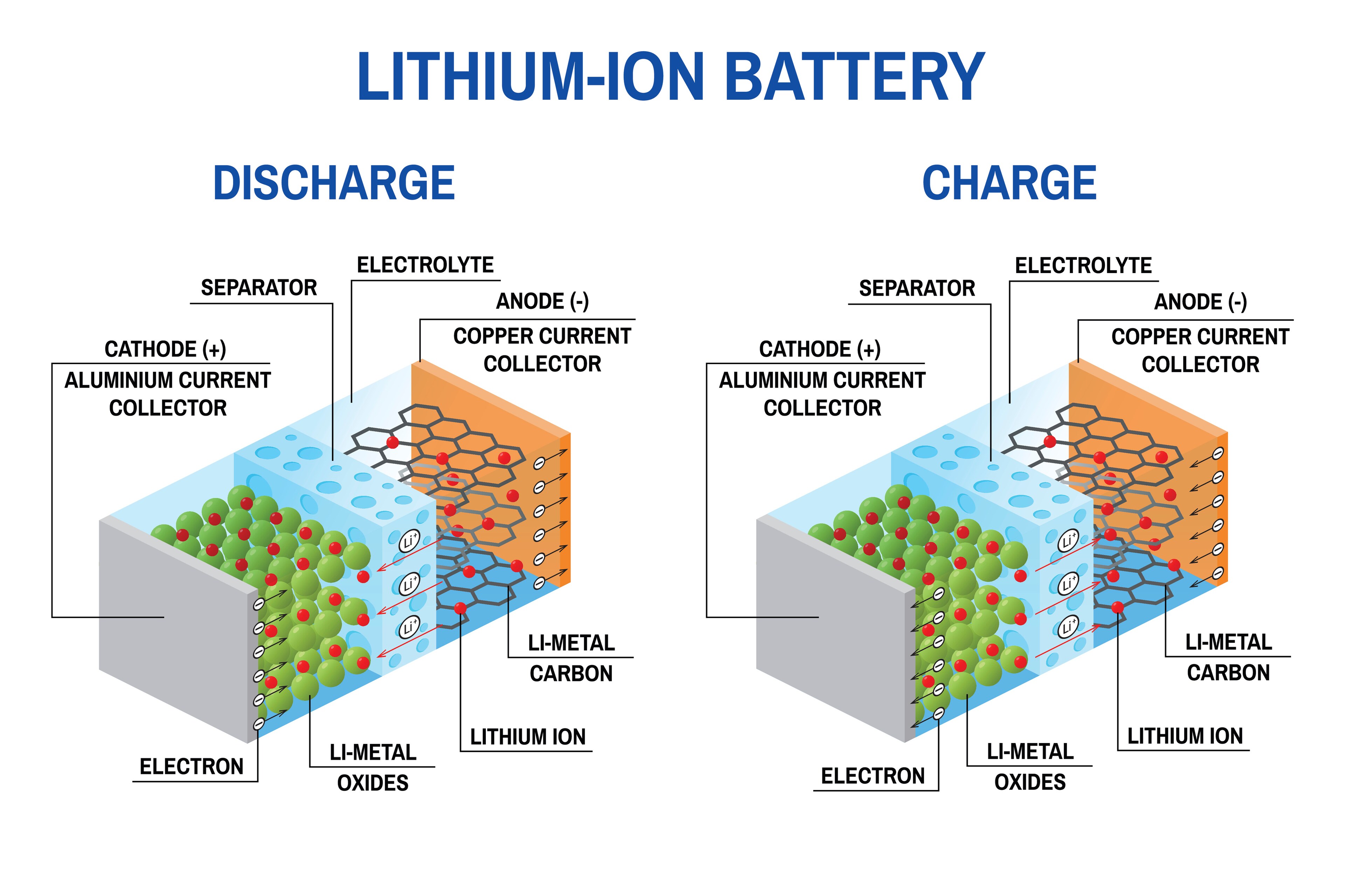
This is a quiet revolution, compared to the visibly loud solar panels on houses or gigantic wind turbines in fields. Energy storage must be “reliable, scalable and affordable,” continues Mukerjee, and “this is where electrochemistry can offer really good solutions.”
Participating in this revolution requires advanced techniques. “The use of a spectrometer like Raman is very effective” in studying all aspects of energy storage, he notes. Other spectroscopy methods, such as FTIR, would not be as effective. “Most of the time, “ Dr. Mukerjee observes, “FTIR has too many interfering peaks in the range of materials that we use.“ Therefore, “Raman is much more useful for us.”
His research team uses Raman analysis extensively, from looking at transition metal oxides to the broad goal of understanding how the electrolyte degrades as a function of cycling – all of that can be studied with Raman spectroscopy. Looking at the Solid Electrolyte Interface (SEI) layer in situ is also extremely important, since the SEI layer is the passivation layer and, if successful, keeps the fuel cell from going, “haywire”.
The ability to study the materials in situ is especially important for addressing rate capability. The rate at how fast an energy storage device can charge is especially important to consumers, especially in the automotive applications. Increasing that rate is both a materials and a design issue. Being able to use in-situ operating conditions during Raman spectroscopy is very critical.
The partnerships developed between researchers and engineers’ enables critical features such as in situ capabilities of the Raman instrument, and “that’s where our partnership is so effective,” Mukerjee concludes.
Watch the video to see Dr. Mukerjee discuss his work on battery and fuel cell research, and how Raman Spectroscopy is used to advance these energy storage solutions.

K 2025: Showcasing the Future of Sustainable, Smart, and Responsible Plastics Production
This week, more than 3,000 exhibitors and 177,000 visitors f... Keith Cornell Nimesh Khadka, PhD
Read More
Monitoring the UV Cure Process of a Polymer Based Ink by FT-IR
Can the degree of cure of a polymer-based ink applied to a M...
Read More
Advances in Analytical Technologies for Battery Manufacturing
Introduction Recent advancements in analytical technologies ... Kyle D'Silva
Read More
Battery Professionals Organization Hosts Webinar on Advanced Analytical Technologies. Here’s a Recap.
Editor’s Note: A recent webinar hosted by the Volta Fo... Kyle D'Silva
Read More
Leave a Reply