SEM analysis of René N5, a nickel-based superalloy for high-performance aircraft engines
The aerospace and defense industry continually seeks materials that can withstand extreme conditions while maintaining exceptional performance. Nickel-based superalloys, such as René N5, are at the forefront of this quest due to their remarkable mechanical properties, even at high temperatures. This blog post explores the properties and behavior of the single-crystal René N5 superalloy, particularly its corrosion and damage mechanisms during high-temperature creep, and how advanced analysis techniques can optimize its performance.
Addressing high-temperature degradation in aircraft engine materials
Aircraft engines operate in some of the most demanding environments, with components like turbine blades exposed to extreme temperatures and stresses. The René N5 superalloy often used in these turbine blades must resist high-temperature corrosion, oxidation, and creep. Understanding the degradation mechanisms of this alloy under such conditions is crucial for improving its performance and longevity.

Advanced SEM and surface analysis techniques for superalloy characterization
To address these challenges, comprehensive analyses of René N5 were conducted using scanning electron microscopy (SEM) with integrated energy-dispersive X-ray spectroscopy (EDS) and particle analysis to provide a detailed understanding of the alloy’s behavior under high-temperature conditions. The detailed characterization of René N5 superalloy provided several key insights that directly address this need:
- High-temperature performance: The identification of γ and γ’ phases and their behavior under high temperatures helped in understanding the alloy’s strength and creep resistance. This knowledge is essential for optimizing the alloy’s composition and heat treatment processes.
- Corrosion and oxidation resistance: Phase analysis revealed the formation of aluminum oxides and nitrides on the alloy’s surface. Understanding these corrosion products and their impact on the alloy’s performance is crucial for developing protective coatings or treatments.
- Damage mechanisms: Particle analysis identified damage-based pores and their distribution within the alloy. This information is vital for predicting the alloy’s lifespan and improving its resistance to high-temperature creep.

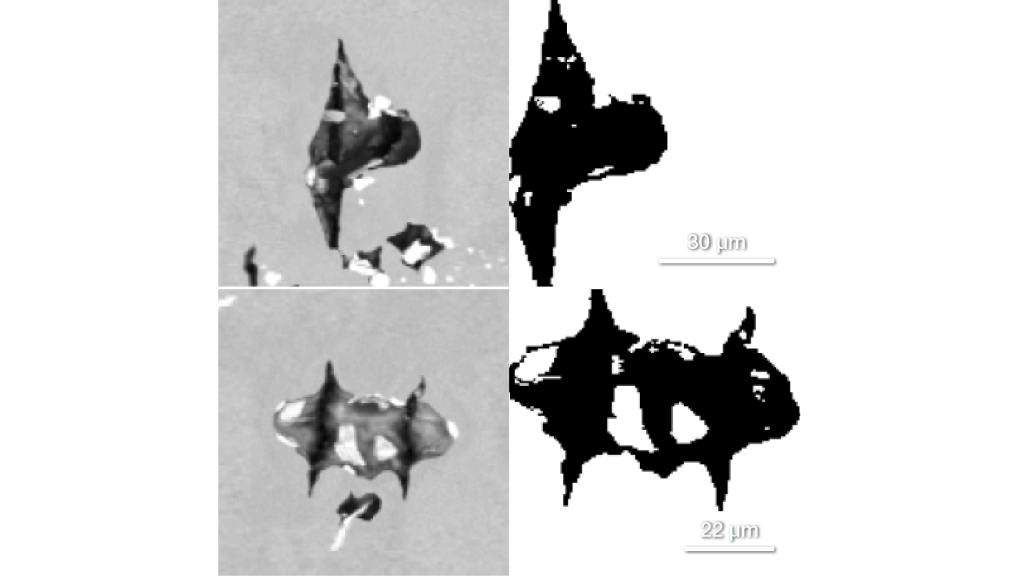
Microstructural insights from SEM analysis of René N5 superalloy
Comprehensive characterization of the René N5 superalloy provided invaluable insights into its behavior under extreme conditions. These findings led to adjustments in the alloy’s production and treatment processes, enhancing its performance and durability. The study confirmed that René N5 is a robust material for use in aircraft engines, capable of withstanding high temperatures and stresses without significant degradation.
Enhancing next-generation aircraft engines with superalloy innovation
The adoption of advanced characterization techniques, such as those provided by scanning electron microscopy with elemental analysis, marks a significant step toward optimizing high-performance materials in the aerospace and defense industry. As the industry continues to innovate, the focus on understanding and improving material properties will drive further advancements, ensuring that safety and performance are not compromised.
Learn how advanced analysis can support your work
Get the latest updates on materials analysis

Revolutionizing Aerospace and Defense with Electron Microscopy and Surface Analysis of Passivated Stainless Steel Landing Gear
The aerospace and defense industry is constantly evolving, d...
Read More
How advanced materials analysis supports the aerospace and defense industry
The aerospace and defense industry operates under some of th...
Read More
Analyzing Non-Conductive Material with Low-Vacuum SEM Imaging
Challenges of non-conductive sample imaging Electron microsc... Alice Scarpellini
Read More
Phenom Desktop SEM for Industrial Quality Control: How Vesuvius Foseco Improved Aluminum Cleanliness Testing
By upgrading their scanning electron microscope (SEM), the V...
Read More
Leave a Reply