 The global market for tires is projected to reach 2.5 billion units by 2020, according to the latest Global Industry Analysts report on the tires industry, which is heavily dependent on the automotive industry.
Rubber is the main raw material used in manufacturing tires, with both natural and synthetic rubber being used. Rigorous quality control begins with the suppliers of the raw materials. A tire manufacturer requires the raw materials to be quality tested before they are delivered to the tire plant.
One of the tests used in the production process is the determination of the elemental composition of rubber, which is periodically monitored for the characterization of this material. Sulfur content is one of the most important parameters in the quality control of rubber products, as is measuring the loss of sulfur from the tire surface (sulfur blooming phenomena).
Crude rubber is primarily hydrocarbon in nature and is a thermoplastic. To eliminate undesirable properties such as malodorousness, rubber is treated with sulfur, accelerators, and also antioxidants which prolong the life of rubber products by reducing the deterioration caused by atmospheric oxygen (or ozone). The other primary ingredient in tire rubber is carbon black, used to increase stiffness, tensile strength, and resistance to abrasion.
Due to the prolific use of rubber products and the resultant high productivity of rubber manufacturing, it is important to have an automatic and fast QA/QC analysis, with an excellent reproducibility to ensure no delay in delivering quality rubber products to the production plants.
We performed analysis on different rubber and tire samples with a CHNS/O analyzer, which uses dynamic combustion of the sample, provides quantitative and automated simultaneous Carbon, Hydrogen, Nitrogen, and Sulfur (CHNS) determination and also Oxygen determination by pyrolysis.
For CHNS determination the analyzer operates according to the dynamic flash combustion of the sample. Samples are weighed in a tin capsule and introduced into the combustion reactor via an autosampler together with a suitable amount of oxygen. After combustion the resultant gases are carried by a helium flow to a layer filled with copper, then swept through a GC column that provides the separation of the combustion gases, and finally, detected by a thermal conductivity detector (TCD). Total run time is 10 minutes. When using the NCS configuration, a trap filled with anhydrone is installed between the reactor and the GC column.
For oxygen determination, the system operates in pyrolysis mode. Samples are weighed in silver capsules and introduced into the pyrolysis chamber via the MAS 200R autosampler. The reactor contains nickel coated carbon maintained at 1060 °C. The oxygen present in the sample, combined with the carbon, forms carbon monoxide which is then chromatographically separated from other products and detected by the TCD detector. Total run time is 5 minutes.
Here is a table of CHNS/O determination of rubber and tire samples as a result of the anlaysis:
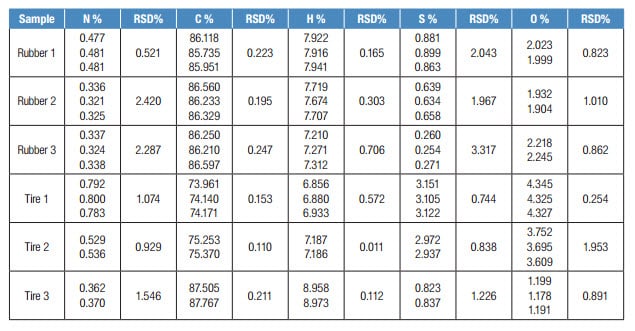
You can read about other specifics of this analysis, including methods used, the layout of CHNS/O determination, charts of the reproducibility of rubber samples analyzed using nitrogen, carbon and sulfur (NCS) configuration, tables of the sulfur values and sulfur blooming phenomena, chromatogram of oxygen determination, and other results in this application note, Rubbers and Tires Characterization by the Thermo Scientific FLASH 2000 CHNS/O Elemental Analyzer.
Editor’s Note: According to the Tire Industry Association, “Almost all of the [blow-outs and] tire debris on our nation’s roads and highways could be avoided if drivers paid attention to the inflation pressure in their tires.” So check your tire pressure today.
How Parts-Per-Trillion Gas Analysis Protects Semiconductor Wafer Production
Ultra-high-purity gases are essential to semiconductor manuf... Daniel Merriman
Read More
Can Plastic Beads Cause Mardi Gras Misfortune? Investigating Toxic Metals and Materials
Plastic beads—an iconic part of Mardi Gras celebrations—... Marlene Gasdia-Cochrane, Editor
Read More
K 2025: Showcasing the Future of Sustainable, Smart, and Responsible Plastics Production
This week, more than 3,000 exhibitors and 177,000 visitors f... Keith Cornell Nimesh Khadka, PhD
Read More
Monitoring the UV Cure Process of a Polymer Based Ink by FT-IR
Can the degree of cure of a polymer-based ink applied to a M... Michael Bradley
Read More
Leave a Reply