In this blog, we’ll break down what a hazardous location is, how these environments are classified, and what to consider when installing a Raman analyzer for safe, real-time process monitoring in these settings.
What is a hazardous location?
A hazardous location is any area where flammable gases, vapors, dusts, or fibers may be present in sufficient quantities to create a risk of fire or explosion. These environments are common in industries such as:
- Oil and gas (midstream and downstream)
- Petrochemical processing
- Pharmaceuticals
- Chemical production
The risk is typically introduced by the presence of flammable substances combined with oxygen and a potential ignition source. For any measurement device to operate safely in such settings, it must be specifically designed and certified for the environment.
Understanding hazardous location classifications
Hazardous environments are regulated to prevent ignition of flammable substances due to electrical or mechanical equipment. Several international classification systems define the nature and severity of these risks, guiding what equipment can be safely used and how it must be certified.
NEC / CEC (North America
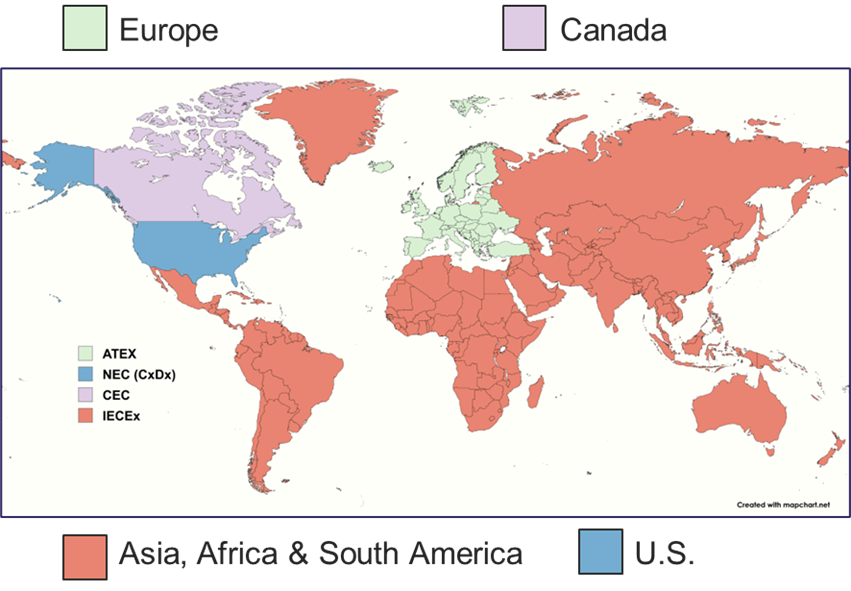
In the U.S. and Canada, hazardous locations are classified using the Class/Division system defined by the National Electrical Code (NEC) and Canadian Electrical Code (CEC).
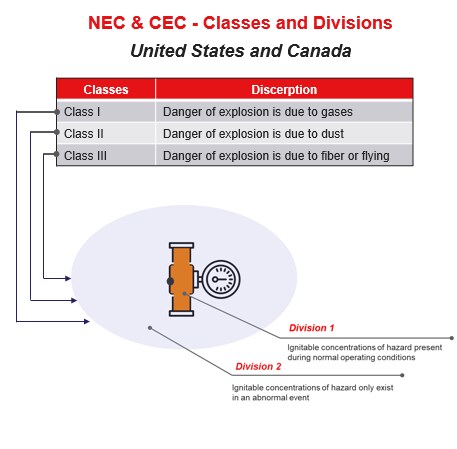
- Classes
- Class I – Locations where flammable gases or vapors are present in the air in sufficient quantities to produce explosive or ignitable mixtures
- Class II – Locations where combustible dust is present
- Class III – Locations where ignitable fibers or flyings are present
- Divisions
- Division 1 – Hazard is present during normal operation
- Division 2 – Hazard is present only under abnormal conditions
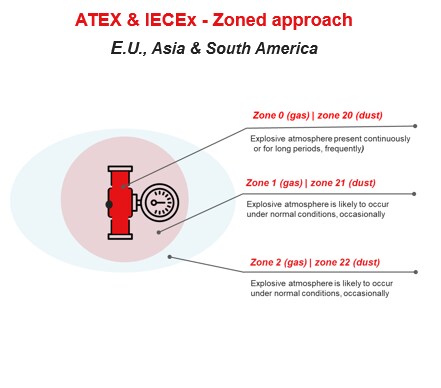
ATEX (Europe)
ATEX (from the French ATmosphères EXplosibles) is the European Union directive that governs equipment intended for use in explosive atmospheres. It uses a Zone system based on the likelihood and duration of exposure to explosive gases or dusts.
- Zone 0 (gas), Zone 20 (dust)– Explosive atmosphere is present continuously or for long periods
- Zone 1 (gas), Zone 21 (dust) – Likely to be present under normal conditions
- Zone 2 (gas), Zone 22 (dust) – Unlikely to occur, and if it does, only for a short duration
IECEx (International)
IECEx is the International Electrotechnical Commission System for Certification to Standards Relating to Equipment for Use in Explosive Atmospheres. It provides a globally harmonized certification system for manufacturers and end-users operating in hazardous environments.
IECEx
- Uses the same Zone classification system as ATEX (Zone 0, 1, 2 for gases; Zone 20, 21, 22 for dusts).
- Is built on IEC standards (such as IEC 60079) to ensure consistency worldwide.
- Offers a streamlined approach for deploying certified equipment across multiple countries, reducing the need for re-testing or re-certification regionally.
| System | Region / Origin | Classification Approach | Hazard Zones / Levels | Equipment Groups / Categories | Key Notes |
| NEC / CEC | North America (U.S. / Canada) | Class / Division system | – Class I: Gases/Vapors – Class 2: Dust – Class 3: Fibers/Flyings – Division 1: Normal operation – Division 2: Abnormal conditions | Not grouped like ATEX/IECEx | Widely used in the U.S. and Canada; based on presence likelihood and material type |
| ATEX | European Union | Zone system | – Zone 0 (gas), 20 (dust): Continuous presence – Zone 1 (gas), 21 (dust): Likely during normal operation – Zone 2 (gas), 22 (dust): Unlikely or short duration | – Group I: Mining – Group II: Industry | EU Directive (2014/34/EU); legal requirement in EU countries |
| IECEx | International (Global) | Zone system (same as ATEX) | – Zone 0, 1, 2 (Gases) – Zone 20, 21, 22 (Dusts) | Same as ATEX (follows IEC 60079 standards) | Globally harmonized; facilitates multi-country equipment certification |
Common challenges with analytical tools in hazardous process monitoring
Deploying instruments for process monitoring in hazardous locations presents a unique set of challenges:
- Ignition risk: Any spark or hot surface can trigger combustion.
- Limited accessibility: Equipment is often installed in hard-to-reach zones, making routine maintenance difficult.
- Environmental extremes: Vibration, dust, humidity, and high or low temperatures can impact sensitive instruments.
These challenges make it essential to select equipment that is both rugged and compliant.
Why Raman spectroscopy is ideal for process monitoring in hazardous locations
Raman spectroscopy provides real-time, non-destructive analysis of chemical composition without the need to transport or prepare samples, making it particularly well-suited for process monitoring in hazardous applications. It can:
- Analyze gases, liquids, and solids directly in-line
- Operate through sight glasses or flow cells
- Deliver immediate feedback for process control or safety decisions
The new generation of Raman analyzers are robust, compact, and require no calibration as well as minimal preventive maintenance. Moreover, sampling optics are specifically designed to withstand corrosive environments, elevated temperatures, and high-pressure conditions. With certified equipment and proper installation, Raman analyzers can help optimize process, improve safety, and reduce downtime in some of the most demanding industrial environments.
Key considerations for using Raman analyzers in hazardous environments
When choosing a Raman analyzer for use in a hazardous location, keep the following requirements and essential features in mind:
- Certification for ATEX/IECEX Zone 0 or 20, Class I,2, or 3 with Div 1. These certifications mean that the analyzer is designed for the safest operation
- Inherent safety and protection for optical radiation
- Thermal stability and low surface temperature to meet T-rating standards
- Remote control and diagnostics to reduce the need for physical access
- No calibration and minimal preventive maintenance for hard-to-reach hazardous areas
- Robust probes/optics to withstand high temperature, pressure, and corrosive conditions
Typical installation of Raman analyzers for process monitoring in hazardous locations
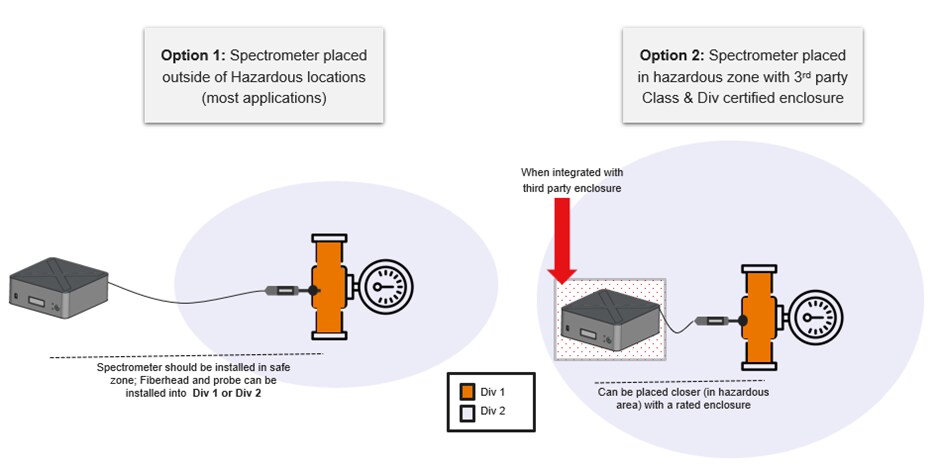
- The base spectrometer is commonly deployed in a non-hazardous (safe) area whenever possible. This base often includes the laser, detector, computer, and the majority of electronics.
- If the base spectrometer is required to be placed in hazardous locations, it is typically housed in an explosion-proof enclosure equipped with purge systems.
- Fiber optic cable with sampling probe, connected to the base spectrometer through an intrinsically safe circuit, is then used for hazardous process monitoring.
- The system is integrated into facility safety protocols, including emergency shutoff and pressure relief measures.
Key takeaways
- Hazardous locations require specialized, certified equipment to avoid ignition risks.
- Understanding the classification of your environment is critical for safe Raman analyzer deployment for process monitoring.
- Features like ATEX/IECEx/NEC or CEC certifications, remote sampling, and rugged design are essential.
- Raman offers a fast, safe, and reliable way to monitor chemical processes without requiring sample transport.
Additional Resources
- Application Note: Natural Gas Analysis in Hazardous Locations Using Raman Spectroscopy and Chemometric Modeling. Precise natural gas measurements are critical in any environment, and this note describes how Raman spectroscopy combined with chemometric modelling provides a potent solution.

The Critical Role of Process Mass Spectrometry in e-Fuels Production
Climate-friendly energy The thermometer is rising, all over ... Daniel Merriman
Read More
How to Use In-line Raman for Real-Time Natural Gas Compositional Analysis
Why Raman spectroscopy for natural gas analysis? Raman spe...
Read More
Where Do Flowmeter Measurements Factor Into Downstream Oil and Gas?
In the downstream sector of the oil and gas industry—where... Ethan Borchelt
Read More
Why Flow Computing is Key to Minimizing Disruptions in Station Control
Today’s station control systems—whether in oil and gas, ... Ethan Borchelt
Read More

Leave a Reply