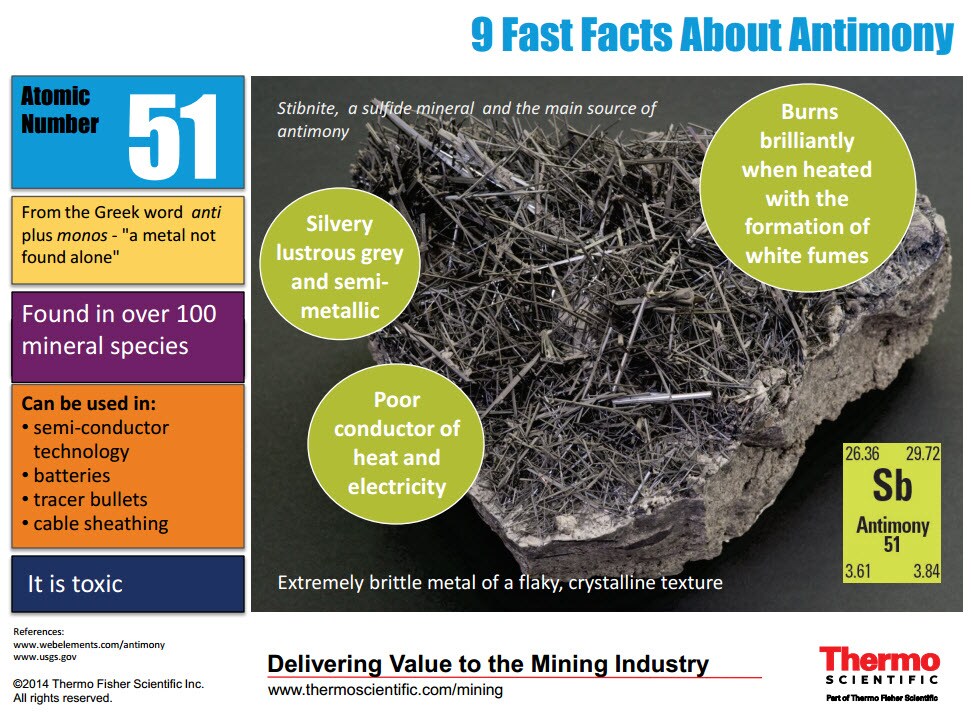
 It’s a silvery, lustrous grey and a semi-metallic toxic element. Yet it is commonly mined and used in semi-conductor technology. Take a look at this infographic and learn 9 Facts about Antimony.
More info about Antimony
Antimony is found in nature primarily as the sulfide mineral stibnite (Sb2S3). It has been known since ancient times and is used in various industrial applications due to its unique properties, including its ability to form alloys and compounds with other metals and its flame-retardant characteristics.
Uses in Industry:
-
Flame Retardants:
- Antimony trioxide (Sb2O3) is widely used as a flame retardant in plastics, textiles, rubber, and electronics. It works synergistically with halogenated flame retardants to enhance their effectiveness by forming a protective char layer on the material’s surface.
-
Lead-Acid Batteries:
- Antimony is alloyed with lead to improve the properties of lead-acid batteries. The addition of antimony increases the battery’s mechanical strength and resistance to corrosion, enhancing its performance and lifespan.
-
Alloys:
- Antimony is used to create various alloys, such as:
- Pewter: An alloy of tin with antimony and copper, used in tableware and decorative items.
- Babbitt Metal: An alloy used in bearings to reduce friction and wear.
- Type Metal: An alloy used in the printing industry for making typefaces and printing plates.
- Antimony is used to create various alloys, such as:
-
Semiconductors:
- Antimony is used in the semiconductor industry to produce diodes, infrared detectors, and Hall-effect devices. It is used in compounds like indium antimonide (InSb) and gallium antimonide (GaSb) for their semiconducting properties.
-
Ceramics and Glass:
- Antimony compounds are used in the production of ceramics and glass to remove bubbles and impurities, improving the clarity and quality of the final product.
-
Pigments:
- Antimony compounds, such as antimony yellow, are used as pigments in paints, enamels, and plastics due to their vibrant colors and stability.
-
Textiles:
- Antimony compounds are used in the textile industry as catalysts in the production of polyester fibers and as flame retardants in fabrics.
Analyzing Antimony
With all these important uses, it is crucial that manufacturers know they are producing quality antimony materials and meeting customer requirements, and it starts with the raw materials they are purchasing — especially from scrap recycling companies.
According to the USGS, “In 2024, no marketable antimony was mined in the United States. Primary antimony metal and oxide were produced by one company in Montana using imported feedstock; data were not available. Secondary antimony production came from antimonial lead recovered from spent lead-acid batteries and was intended for the lead-acid battery industry. … Recycling supplied about 15% of estimated domestic apparent consumption, and the remainder came from imports.”
Portable x-ray fluorescence (XRF) analyzers are used in elemental analysis in order to identify antimony, as well as metals and alloys. X-ray fluorescence (XRF) is a non-destructive analytical technique used to determine the chemical composition of materials. Handheld XRF technology is crucial to the mining industry, especially in the exploration stage. It offers a quick, non-destructive analysis which is often required for outcrop and soil analysis, advanced exploration and drilling, core sample analysis, mine mapping, grade control, and cuttings analysis for mud logging and reservoir characterization. It is also used extensively to identify the metal and alloys in a scrapyard or verify the content of raw materials in manufacturing plants.
Conclusion
Antimony’s versatility and unique properties make it valuable in various industrial applications. Its primary uses include flame retardants, lead-acid batteries, alloys, semiconductors, ceramics, glass, pigments, and textiles. These applications highlight antimony’s importance in enhancing the performance, safety, and durability of a wide range of products and materials.
- Additional Resources
- Visit our Handheld XRF Technology Learning Center
- ebook: XRF in the Field: XRF Technology for the Non-Scientist
- Infographic: 9 Facts about Antimony.
Editor’s Note: This antimony infographic article was originally published in August 2014 but the article has been substantially refreshed with new content.

Potash: A Look at the World’s Most Popular Fertilizer
Uses, Types, Production, and USGS Data Potash, pronounced po... Marlene Gasdia-Cochrane, Editor
Read More
What Is In Situ Geochemical Analysis — And Why It Is Critical for Modern Field Operations
In situ geochemical analysis has become a cornerstone of mod... Mathieu Bauer
Read More
Did You Read These Mining and Minerals Articles Yet?
According to Google, here are the Top 10 read articles this ... Marlene Gasdia-Cochrane, Editor
Read More
Nickel Ore Analysis: Boosting Mining Quality with WDXRF
Accurate analysis of nickel ores is essential for efficient ... Jill Staggert
Read More

Leave a Reply