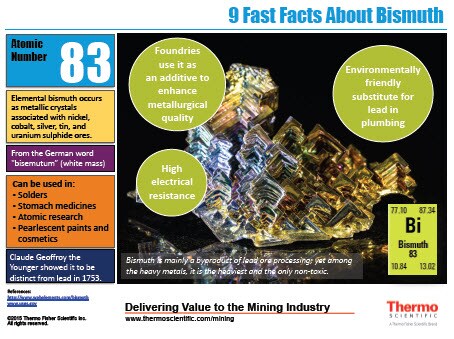
 Elemental bismuth occurs as metallic crystals associated with nickel, cobalt, silver, tin, and uranium sulphide ores. Number 83 on the periodic table, it is mainly a byproduct of lead ore processing; yet among the heavy metals, it is the heaviest and the only non-toxic.
According to the U.S. Geological Survey, “The Safe Drinking Water Act Amendment of 1996, which required that all new and repaired fixtures and pipes for potable water supply be lead free after August 1998, opened a wider market for bismuth as a metallurgical additive to lead-free pipe fittings, fixtures, and water meters.
Another application is the use of a bismuth-tellurium oxide alloy film paste for use in the manufacture of semiconductor devices. Bismuth also was used domestically in the manufacture of ceramic glazes, crystal ware, and pigments, and as an additive to freemachining steels and malleable iron castings. An emerging application is in display panels where lead will be replaced by bismuth metal.
Researchers in China developed a low-melting-point bismuth-indium-tin-zinc alloy that allows the liquid alloy to be squeezed through tubes that could be used in the 3D printing of electronic components. The new alloy’s low melting point requires little cooling, allowing for faster printing than is currently possible with higher melting point metals currently in use.”
Take a look at this Bismuth infographic and get nine fast facts about this increasingly important metal.
Leave a Reply