Search
The World's Best DNase
Improved TURBO DNA-free
- Removes trace quantities of DNA that plague RT-PCR
- DNase enhancer increases the potency of TURBO DNase by 2-3 orders of magnitude
- Remove DNase from RNA solutions in 5 minutes without phenol, alcohol, or heating
- TURBO DNase is RNase-free and recombinant in origin
The Best Way to Remove Contaminating DNA
Ambion recently introduced the highly potent
TURBO DNase (patent pending) in the
TURBO DNA-free Kit. TURBO DNase is a recombinant, engineered form of DNase I that is much more efficient than wild type DNase I in digesting trace amounts of unwanted DNA. TURBO DNase binds DNA substrates 6-fold more tightly than traditional DNase I, making this enzyme the tool of choice for clearing residual DNA that can generate a confounding signal in RT-PCR applications.
Enhanced DNase Activity
Ambion's continuing commitment to developing the best possible DNA removal technology has resulted in an enhancer that increases the effectiveness of TURBO DNase by two orders of magnitude. This enhancer is part of the TURBO DNase Buffer provided in both the improved version of the TURBO DNA-free Kit and the TURBO DNase enzyme, available separately. TURBO DNase is highly effective in eliminating DNA from most samples, including samples that are heavily contaminated with DNA. This is important for scientists who use RT-PCR to analyze the RNA. Since the TURBO DNase in the TURBO DNA-free Kit is already extremely potent, Ambion created an RNA preparation that was largely comprised of genomic DNA (gDNA) to quantify the level of improvement offered by the new DNase enhancer. Consequently, we prepared a mouse spleen total RNA sample that contained 70% DNA and only 30% RNA. This DNA-laden RNA was then treated with either the original TURBO DNA-free Kit or with the improved version. To better evaluate the differences in DNA removal between the two kits, we modified the standard protocol by using 4 times less TURBO DNase than is normally used. This was necessary to produce a detectable, residual DNA signal in real-time PCR by both kit formulations, so that their differences in fold DNA removal could be accurately calculated. Using these conditions, the original formulation of TURBO DNA-free reduced gDNA that could be PCR amplified by 451-fold. The improved kit reduced the gDNA contamination much further, by 277,000-fold, or 614 times more than the kit without the enhancer (Figure 1).
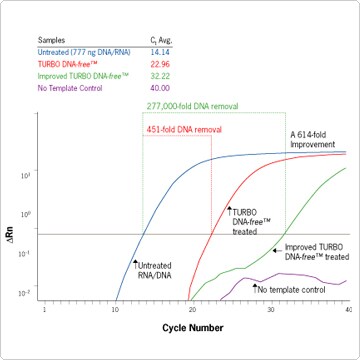
Figure 1. DNA Removal Improved >600 fold with New TURBO DNA-free. Mouse spleen total RNA samples, highly contaminated with DNA (30% RNA and 70% DNA; 23 µg), were treated with 4 U of TURBO DNase in a 60 µl reaction for 20 min at 37°C, or were left untreated. DNase digestion was halted by adding 6 µl (1/10 volume) of DNase Inactivation Reagent. Each treated sample (2 µl) was amplified in a 25 µl RT-PCR using a TaqMan primer:probe set for mouse GAPDH. RT-PCR analysis of the DNase treated samples unmasked the RNA-only signal, which appeared at 15.3 C t.
Additional studies have corroborated the superior efficiency of the improved kit in eliminating DNA from different sources of RNA using a variety of primer:probe sets in RT-PCR (data not shown). As a result, the TURBO DNA-free Kit, already the best choice for eradicating DNA from RNA preparations, is now even more effective in digesting DNA away from the most contaminated samples.
Destroy DNA and Preserve RNA Quality
Many current DNase inactivation protocols rely on either phenol/chloroform extraction to remove the DNase enzyme, or on a denaturing thermal inactivation step. Both procedures are undesirable. Organic extractions are tedious and prone to RNA loss during extraction and precipitation, while heating the DNase to destroy the enzyme also heats the RNA-- in the presence of divalent cations, this induces RNA strand scission. TURBO DNA-free, however, provides a fast and easy solution to the problem of DNase inactivation: a user-friendly resin that binds the TURBO DNase and physically separates it from the RNA in the digestion reaction. Simply add the resin to the DNase-treated sample, incubate for 2 minutes, pellet the resin, and recover the supernatant. Importantly, the DNase inactivation resin also binds and removes divalent cations, such as Mg
2+, that can induce RNA hydrolysis when the sample is heated. This is particularly important for researchers who need to heat denature RNA samples prior to RT-PCR.
Maximum RT-PCR Sensitivity
The extraordinary linear dynamic range of RT-PCR makes it effective for quantitation of both abundant and rare mRNA targets. Analysis of rare targets requires a sensitivity that often must stretch beyond 30 amplification cycles.
At high cycle numbers, RT-PCR is significantly less robust than it is in earlier cycles; suboptimal salt or pH conditions, or contaminants that have little impact on accurate detection at 15-25 cycles can profoundly distort detection and quantitation at >30 cycles. For this reason, the improved TURBO DNA-free Kit was carefully tested at the lower threshold for target detection to ensure maximum RT-PCR responsiveness. As shown in Figure 2, transcript levels from as little as 1 pg of total RNA could be quantitated in one-step qRT-PCR within a single Ct of the untreated control reaction. Thus, TURBO DNA-free offers researchers the confidence that rapid, simple, and highly effective DNA and DNase removal does not compromise sensitivity.
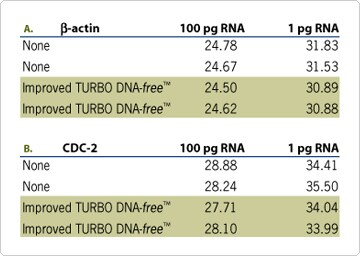
Figure 2. Treatment of RNA with TURBO DNA-free Maintains Target Sensitivity in Real-time PCR. (A) Purified HeLa total RNA (100 pg and 1 pg) was treated with the improved TURBO DNA-free according to the standard protocol. 5 µl of the treated sample was reverse transcribed with Ambion’s MessageSensor RT Kit and then amplified with a human b-actin TaqMan primer/probe set in one-step RT-PCR. (B) The same analysis described above was performed, except that PCR amplification was monitored with a human CDC-2 TaqMan primer/probe set.
Ordering Information