Search


Citations & References (18)
Invitrogen™
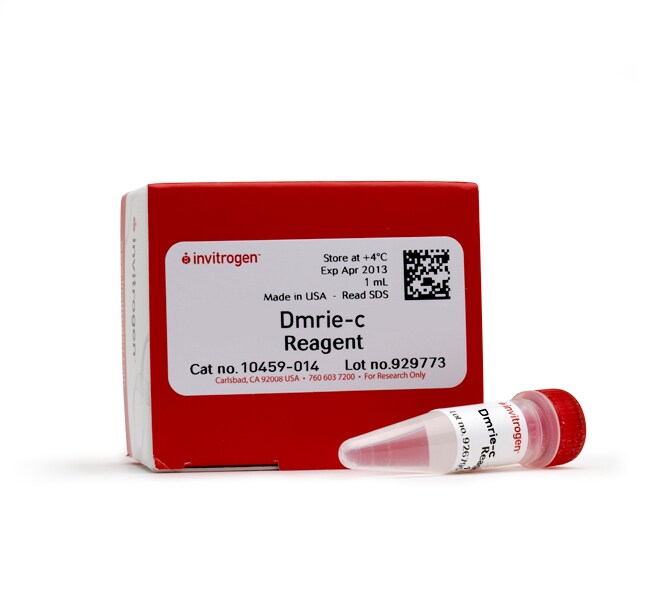
DMRIE-C Transfection Reagent
DMRIE-C Transfection Reagent is suitable for transfecting DNA and RNA into eukaryotic cells, and is particularly effective for transfecting suspensionRead more
| Catalog Number | Quantity |
|---|---|
| 10459014 | 1 mL |
Catalog number 10459014
Price (USD)
742.65
Online exclusive
774.00Save 31.35
Each
Quantity:
1 mL
Price (USD)
742.65
Online exclusive
774.00Save 31.35
Each
DMRIE-C Transfection Reagent is suitable for transfecting DNA and RNA into eukaryotic cells, and is particularly effective for transfecting suspension cells (e.g., Jurkat) and other lymphoid-derived cell lines. Refer to the Cell Lines database at www.invitrogen.com for a list of cell types successfully transfected. DMRIE-C can also be used for in vivo delivery of DNA. DMRIE-C is a 1:1 (M/M) liposome formulation of the cationic lipid DMRIE (1,2-dimyristyloxy-propyl-3-dimethyl-hydroxy ethyl ammonium bromide) and cholesterol in membrane-filtered water.
For Research Use Only. Not for use in diagnostic procedures.
Specifications
For Use With (Application)Transfection
High-throughput CompatibilityNot High-throughput Compatible (Manual)
Product TypeTransfection Reagent
Quantity1 mL
Serum CompatibleNo
Shipping ConditionWet Ice
Cell TypeEstablished Cell Lines
Format6-well Plate, 12-well Plate, 24-well Plate, 48-well Plate, 96-well Plate, Flasks
Sample TypePlasmid DNA
Transfection TechniqueLipid-based Transfection
Unit SizeEach
Contents & Storage
Contains one tube (1 ml) DMRIE-C Transfection Reagent. Store at 4°C. Do not freeze.
Frequently asked questions (FAQs)
I accidentally left my lipid reagent at room temperature. Can I still use it?
Do you offer a reagent for the transfection of suspension cells (e.g., Jurkat cells)?
What is the difference between reverse transfection and forward transfection? What should I use?
Is there a place where I can find references from other researchers who have used your transfection reagents?
Can I use antibiotics in the medium during transfection?
Citations & References (18)
Citations & References
Abstract
Induction of bacterial lipoprotein tolerance is associated with suppression of toll-like receptor 2 expression.
Journal:J Biol Chem
PubMed ID:12133836
'Tolerance to bacterial cell wall components including lipopolysaccharide (LPS) may represent an essential regulatory mechanism during bacterial infection. Two members of the Toll-like receptor (TLR) family, TLR2 and TLR4, recognize the specific pattern of bacterial cell wall components. TLR4 has been found to be responsible for LPS tolerance. However, the
Safety and short-term toxicity of a novel cationic lipid formulation for human gene therapy.
Journal:Hum Gene Ther
PubMed ID:8186291
'Among the potential nonviral vectors for human gene therapy are DNA-liposome complexes. In a recent clinical study, this delivery system has been utilized. In this report, a novel cationic lipid, dimyristyloxypropyl-3-dimethyl-hydroxyethyl ammonium (DMRIE), has been substituted into the DNA-liposome complex with dioleoyl phosphatidylethanolamine (DOPE), which both improves transfection efficiencies and
Nitrosative Stress-induced Apoptosis through Inhibition of NF-kappa B.
Journal:J Biol Chem
PubMed ID:12091382
'Nitrosative stress produced by cytokines predisposes to apoptotic cell death. However, the molecular mechanism by which this occurs is not well understood. We have shown previously that nitric oxide (NO) regulates the activity of the anti-apoptotic transcription factor NF-kappaB. Here we demonstrate that the inhibition of NF-kappaB by NO sensitizes
Evaluation of cationic liposome suitable for gene transfer into pregnant animals.
Journal:Biochem Biophys Res Commun
PubMed ID:10329392
'Cationic liposome-mediated in vivo gene transfer represents a promising approach for somatic gene therapy. To assess the most suitable liposome for gene delivery into a wide range of organs and fetuses in mice, we have explored several types of cationic liposomes conjugated with plasmid DNA carrying the beta-galactosidase gene through
BiZyme: a novel fusion protein-mediating selection of vaccinia virus recombinants by fluorescence and antibiotic resistance.
Journal:Biotechniques
PubMed ID:12019792
'Recombinant vaccinia virus is a useful and powerful tool for the expression and study of foreign genes. Methods that are currently available for the selection of vaccinia virus recombinants include the restoration of viral plaque-forming phenotype, the replication of viral DNA in the presence of BUdR or mycophenolic acid, and