Search


Citations & References (2)
Gibco™
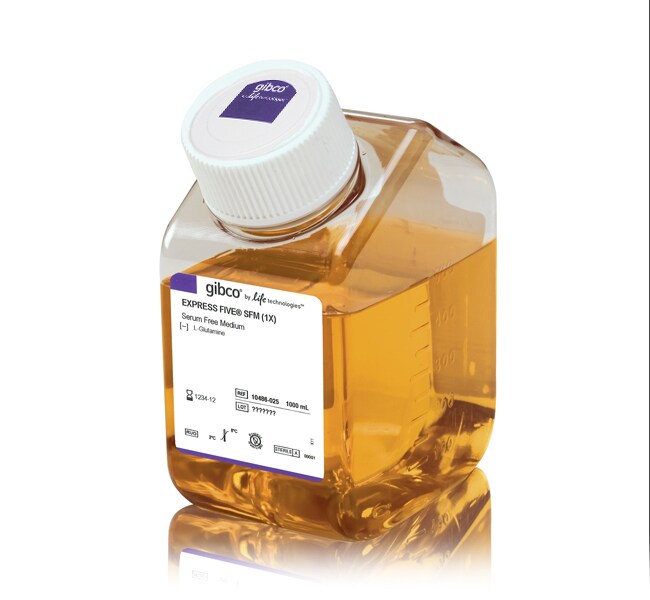
Express Five™ SFM
Express Five™ SFM is a protein-free, serum-free medium specifically developed to support the long-term suspension growth of High Five™ (BTI-TN-5B1-4)Read more
| Catalog Number | Quantity |
|---|---|
| 10486025 | 1000 mL |
Catalog number 10486025
Price (JPY)
12,800
Each
Quantity:
1000 mL
Express Five™ SFM is a protein-free, serum-free medium specifically developed to support the long-term suspension growth of High Five™ (BTI-TN-5B1-4) cells in suspension for use in the Baculovirus Expression Vector System (BEVS). This medium requires the addition of 18 mM L-glutamine before use. Gibco™ Express Five™ SFM features:
• Superior long-term suspension growth of High Five™ cells
• Protein-free, serum-free formulation
• Optimized for recombinant protein production
• Scalable in the CelliGen™ bioreactor and WAVE Bioreactor™ System
Superior growth of High Five™ cells
Gibco™ Express Five™ SFM provides peak cell densities of up to 6 × 10⁶ viable cells per mL in shaker cultures. Cells adapted to other commercially available serum-free media can be subcultured directly into Gibco™ Express Five™ SFM, usually without any further adaptation (see figure). Cells usually require adaptation from serum-containing formulations.
Protein-free, serum-free formulation
Gibco™ Express Five™ SFM is a protein-free and serum-free formulation, allowing for easier purification of your protein of interest.
Optimized for recombinant protein expression
Gibco™ Express Five™ SFM is optimized for high protein production using the Baculovirus Expression Vector System (BEVS). Using BEVS, we routinely achieve rβ-galactosidase protein expression of up to 1.7 U/cell, a significant improvement over other media (see figure)
Scalable in the CelliGen™ bioreactor and WAVE Bioreactor™ System
Protein production using Gibco™ Express Five™ SFM can be scaled up in bioreactors such as the 5 L CelliGen™ bioreactor and the WAVE Bioreactor™ System. The appropriate impeller or rocking speed and seeding density should be optimized for each system. Depending on the bioreactor design, it may be necessary to supplement Gibco™ Express Five™ SFM with additional Pluronic™ F-68 to avoid sheer stress in the culture.
cGMP manufacturing and quality system
Gibco™ Express Five™ SFM is manufactured at a cGMP-compliant facility located in Grand Island, New York. The facility is registered with the FDA as a medical device manufacturer and is certified to ISO 13485 standards.
• Superior long-term suspension growth of High Five™ cells
• Protein-free, serum-free formulation
• Optimized for recombinant protein production
• Scalable in the CelliGen™ bioreactor and WAVE Bioreactor™ System
Superior growth of High Five™ cells
Gibco™ Express Five™ SFM provides peak cell densities of up to 6 × 10⁶ viable cells per mL in shaker cultures. Cells adapted to other commercially available serum-free media can be subcultured directly into Gibco™ Express Five™ SFM, usually without any further adaptation (see figure). Cells usually require adaptation from serum-containing formulations.
Protein-free, serum-free formulation
Gibco™ Express Five™ SFM is a protein-free and serum-free formulation, allowing for easier purification of your protein of interest.
Optimized for recombinant protein expression
Gibco™ Express Five™ SFM is optimized for high protein production using the Baculovirus Expression Vector System (BEVS). Using BEVS, we routinely achieve rβ-galactosidase protein expression of up to 1.7 U/cell, a significant improvement over other media (see figure)
Scalable in the CelliGen™ bioreactor and WAVE Bioreactor™ System
Protein production using Gibco™ Express Five™ SFM can be scaled up in bioreactors such as the 5 L CelliGen™ bioreactor and the WAVE Bioreactor™ System. The appropriate impeller or rocking speed and seeding density should be optimized for each system. Depending on the bioreactor design, it may be necessary to supplement Gibco™ Express Five™ SFM with additional Pluronic™ F-68 to avoid sheer stress in the culture.
cGMP manufacturing and quality system
Gibco™ Express Five™ SFM is manufactured at a cGMP-compliant facility located in Grand Island, New York. The facility is registered with the FDA as a medical device manufacturer and is certified to ISO 13485 standards.
For Research Use Only. Not for use in diagnostic procedures.
Specifications
Cell LineHigh Five™
Cell TypeInsect Cell
Product LineExpress Five, Gibco
Product TypeInsect Cell Serum Free Medium (SFM)
Quantity1000 mL
Shipping ConditionRoom Temperature
ClassificationProtein-free, Serum-free
FormLiquid
Serum LevelSerum-free
Without AdditivesNo Glutamine
Unit SizeEach
Contents & Storage
Storage conditions: 2-8°C. Protect from light
Shipping conditions: Ambient
Shelf life: 18 months from date of manufacture
Shipping conditions: Ambient
Shelf life: 18 months from date of manufacture
Frequently asked questions (FAQs)
How do I adapt my cells to serum-free medium?
Why is the glutamine requirement so high for Express Five media?
Why is it necessary to gradually adapt the cells to serum-free medium?
Can I use antibiotics such as Pen-Strep in Express Five SFM?
Can I add GlutaMAX to Express Five SFM instead of L-Glutamine?
Citations & References (2)
Citations & References
Abstract
Asp-225 and glu-375 in autocatalytic attachment of the prosthetic heme group of lactoperoxidase.
Journal:J Biol Chem
PubMed ID:11756449
The heme in lactoperoxidase is attached to the protein by ester bonds between the heme 1- and 5-methyl groups and Glu-375 and Asp-275, respectively. To investigate the cross-linking process, we have examined the D225E, E375D, and D225E/E375D mutants of bovine lactoperoxidase. The heme in the E375D mutant is only partially
The type XIII collagen ectodomain is a 150-nm rod and capable of binding to fibronectin, nidogen-2, perlecan, and heparin.
Journal:J Biol Chem
PubMed ID:11956183
Type XIII collagen consists of a short N-terminal intracellular domain, a transmembrane domain, and a collagenous ectodomain, and it is found at many sites of cell adhesion. We report on the characterization of recombinant type XIII collagen. The shed ectodomain was purified from insect cell culture medium and shown to