Search


Citas y referencias (9)
Invitrogen™
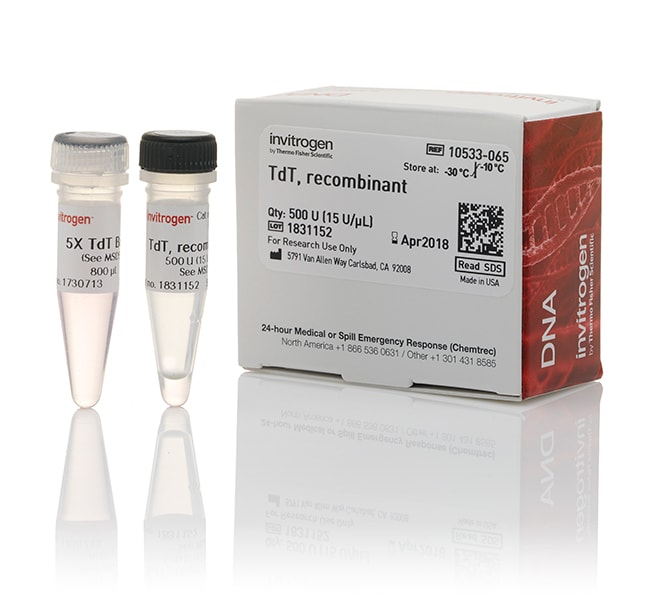
Terminal Deoxynucleotidyl Transferase, recombinant
La Terminal Deoxynucleotidyl Transferase recombinante (rTdT) es una ADN polimerasa que cataliza la el adición de desoxinucleótidos a los extremosMás información
Have Questions?
Cambiar vista

| Número de catálogo | Cantidad |
|---|---|
| 10533065 | 500 U |
| 10533073 | 3 × 500 U |
Número de catálogo 10533065
Precio (CLP)
352.440
Each
Cantidad:
500 U
Precio (CLP)
352.440
Each
La Terminal Deoxynucleotidyl Transferase recombinante (rTdT) es una ADN polimerasa que cataliza la el adición de desoxinucleótidos a los extremos el 3fi hidroxilo del ADN. Hay disponible un boletín técnico de TdT.
Aplicaciones: Adición de colas homopoliméricas de vector e inserto para clonación Marcado de oligonucleótidos con biotina (1,2), etiqueta 32 P o 35 S (3); o en apoptosis (TUNEL) (4,5).
Fuente: Purificado a partir del clon de E. coli de la Tdt de timo bovino.
Pruebas de rendimiento y calidad: Endonucleasa, exodesoxirribonucleasa 3´ y 5´ y niveles de incorporación probados.
Definición de unidad: Una unidad incorpora 1 nmol de dATP en el material precipitable ácido en 1 h a 37 °C, usando d(PA)50 como primer
Advertencia de peligro: Tóxico; cacodilato de potasio contenido en el tampón de reacción. También contiene cloruro de cobalto, un producto químico altamente tóxico.
Consulte MSDS.
Condiciones de reacción de la unidad: 0,2 M de cacodilato de potasio (pH 7,2), 10 mM de MgO4 C4 H6 , 1 mM de 2-mercaptoetanol, 0,5 mg/ml de BSA,
100 flm de d(pA)50, 1 mM [3H]dATP, y enzima en 0,15 ml durante 1 h a 37 °C.
Aplicaciones: Adición de colas homopoliméricas de vector e inserto para clonación Marcado de oligonucleótidos con biotina (1,2), etiqueta 32 P o 35 S (3); o en apoptosis (TUNEL) (4,5).
Fuente: Purificado a partir del clon de E. coli de la Tdt de timo bovino.
Pruebas de rendimiento y calidad: Endonucleasa, exodesoxirribonucleasa 3´ y 5´ y niveles de incorporación probados.
Definición de unidad: Una unidad incorpora 1 nmol de dATP en el material precipitable ácido en 1 h a 37 °C, usando d(PA)50 como primer
Advertencia de peligro: Tóxico; cacodilato de potasio contenido en el tampón de reacción. También contiene cloruro de cobalto, un producto químico altamente tóxico.
Consulte MSDS.
Condiciones de reacción de la unidad: 0,2 M de cacodilato de potasio (pH 7,2), 10 mM de MgO4 C4 H6 , 1 mM de 2-mercaptoetanol, 0,5 mg/ml de BSA,
100 flm de d(pA)50, 1 mM [3H]dATP, y enzima en 0,15 ml durante 1 h a 37 °C.
Para uso exclusivo en investigación. No apto para uso en procedimientos diagnósticos.
Especificaciones
Tampón compatibleTampón 5X, tampón de reacción
Tipo de productoTdT
Cantidad500 U
Condiciones de envíoAprobado para su envío en hielo húmedo o seco
EnzimaTerminal Deoxynucleotidyl Transferase
Unit SizeEach
Contenido y almacenamiento
La desoxinucleotidiltransferasa terminal recombinante (rTdT) se suministra con vial de 5X de tampón [500 mM de cacodilato de potasio (pH 7,2), 10 mM de CoCl2, 1 mM de DTT]. Almacenar a -20 °C.
Preguntas frecuentes
Is the Terminal Deoxynucleotidyl Transferase (TdT) within the Pierce Biotin 3' End DNA Labeling Kit (Cat. No. 89818) available separately?
Citations & References (9)
Citations & References
Abstract
Interaction of human nuclear topoisomerase I with guanosine quartet-forming and guanosine-rich single-stranded DNA and RNA oligonucleotides.
Journal:J Biol Chem
PubMed ID:11756434
'Human nuclear DNA topoisomerase I (top1) plays a crucial role in DNA replication, transcription, and chromosome condensation. In this study, we show that intra- and intermolecular guanosine quartets (G-quartets) can inhibit top1-mediated DNA cleavage at a high affinity site. Top1-mediated DNA cleavage was also inhibited by a 16-mer single-stranded oligodeoxynucleotide
The novel WD-repeat protein MORG1 acts as a molecular scaffold for HIF prolyl-hydroxylase 3 (PHD3).
Journal:J Biol Chem
PubMed ID:16407229
'Hypoxia-inducible factor-1 (HIF-1), a transcriptional complex composed of an oxygen-sensitive alpha- and a beta-subunit, plays a pivotal role in cellular adaptation to low oxygen availability. Under normoxia, the alpha-subunit of HIF-1 is hydroxylated by a family of prolyl hydroxylases (PHDs) and consequently targeted for proteasomal degradation. Three different prolyl hydroxylases
Coordinated transcription of key pathways in the mouse by the circadian clock.
Journal:Cell
PubMed ID:12015981
'In mammals, circadian control of physiology and behavior is driven by a master pacemaker located in the suprachiasmatic nuclei (SCN) of the hypothalamus. We have used gene expression profiling to identify cycling transcripts in the SCN and in the liver. Our analysis revealed approximately 650 cycling transcripts and showed that
DEMETER, a DNA glycosylase domain protein, is required for endosperm gene imprinting and seed viability in arabidopsis.
Journal:Cell
PubMed ID:12150995
'We isolated mutations in Arabidopsis to understand how the female gametophyte controls embryo and endosperm development. For the DEMETER (DME) gene, seed viability depends only on the maternal allele. DME encodes a large protein with DNA glycosylase and nuclear localization domains. DME is expressed primarily in the central cell of
The orphan nuclear receptor REV-ERBalpha controls circadian transcription within the positive limb of the mammalian circadian oscillator.
Journal:Cell
PubMed ID:12150932
Mammalian circadian rhythms are generated by a feedback loop in which BMAL1 and CLOCK, players of the positive limb, activate transcription of the cryptochrome and period genes, components of the negative limb. Bmal1 and Per transcription cycles display nearly opposite phases and are thus governed by different mechanisms. Here, we