Search

Gibco™
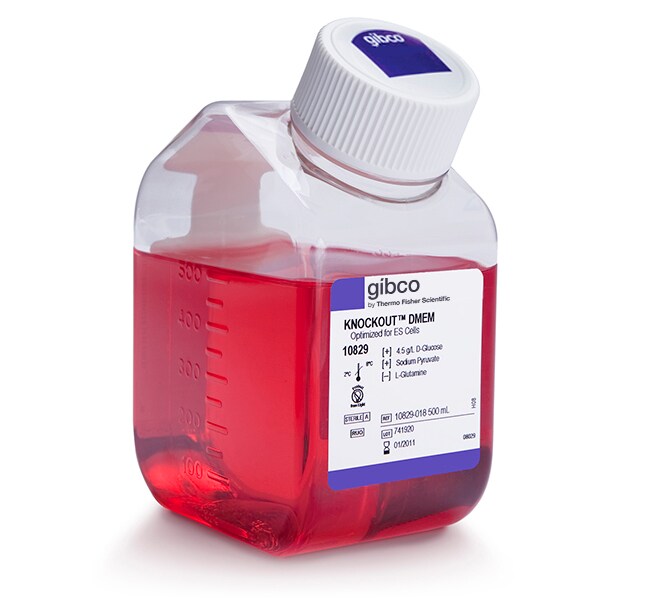
KnockOut™ DMEM
KnockOut D-MEM is a basal medium optimized for growth of undifferentiated embryonic and induced pluripotent stem cells. The osmolarity is optimized to approximate that of mouse embryonic tissue.
| Catalog Number | Quantity |
|---|---|
| 10829018 | 500 mL |
Catalog number 10829018
Price (USD)
55.25
Each
Quantity:
500 mL
Price (USD)
55.25
Each
KnockOut D-MEM is a basal medium optimized for growth of undifferentiated embryonic and induced pluripotent stem cells. The osmolarity is optimized to approximate that of mouse embryonic tissue. It is designed specifically to improve the morphology of ES cells. The osmolality of KnockOut D-MEM has been reduced to better mimic the natural environment of embryonic tissue. When used together, KnockOutD-MEM and KnockOut SR significantly reduce ES cell differentiation as compared to ES Cell Qualified FBS and traditional D-MEM.
KnockOut D-MEM contains no L-glutamine.
KnockOut™ D-MEM is a basal medium optimized for growth of undifferentiated embryonic and induced pluripotent stem cells (1). The osmolarity is optimized to approximate that of mouse embryonic tissue.
Contains no L-glutamine.
For Research Use Only. Not for use in diagnostic procedures.
Specifications
Cell TypeStem Cells (Embryonic), Stem Cells (iPS - Induced Pluripotent Stem)
Manufacturing QualitycGMP for medical devices, 21 CFR Part 820 and ISO 13485
Product LineKnockOut
Product TypeKnockOut DMEM
Quantity500 mL
Shipping ConditionRoom Temperature
FormLiquid
With AdditivesHigh Glucose, Phenol Red
Without AdditivesNo Glutamine
Unit SizeEach
Contents & Storage
Store in refrigerator (2–8°C) and protect from light.