Search

Invitrogen™
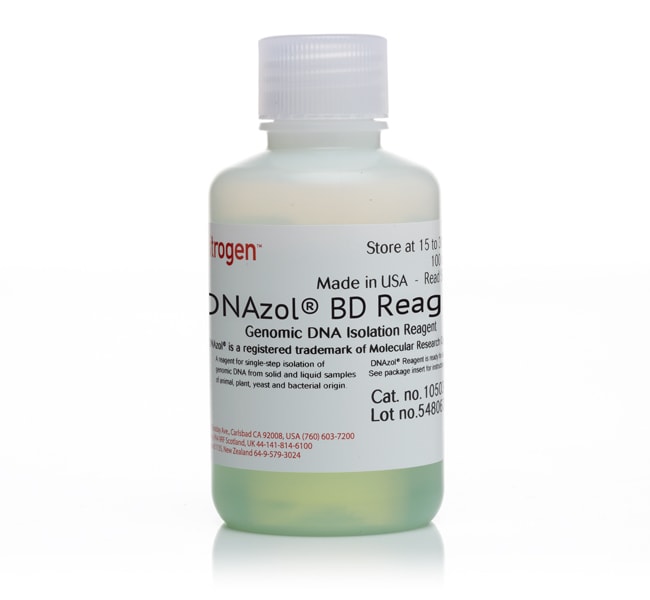
DNAzol™ BD Reagent, for isolation of genomic DNA from whole blood
DNAzol™ BD Reagent is a ready-to-use organic reagent specifically formulated for the isolation of genomic DNA from whole blood inRead more
| Catalog Number | Quantity |
|---|---|
| 10974020 | 100 mL |
Catalog number 10974020
Price (USD)
536.00
Each
Quantity:
100 mL
Price (USD)
536.00
Each
DNAzol™ BD Reagent is a ready-to-use organic reagent specifically formulated for the isolation of genomic DNA from whole blood in about 30 minutes.
• Specifically formulated for extraction of genomic DNA from whole blood
• Optimized for the rapid Isolation of genomic DNA
Efficient Isolation of Genomic DNA from Whole Blood
DNAzol™ BD Reagent is specifically formulated for the isolation of genomic DNA from whole blood. DNAzol™ BD Reagent procedure is based on the use of a novel guanidine-detergent lysing solution that hydrolyzes RNA and allows the selective precipitation of DNA from the lysate. 1 ml of DNAzol™ Reagent can be used to isolate genomic DNA from 0.5 ml of whole blood to yield 10-20 μg DNA. In addition to the isolation of genomic DNA, DNAzol™ BD Reagent can also be used for the isolation of apoptotic fragments from whole blood and viral DNA from serum.
Rapid Isolation of Genomic DNA
The DNAzol™ Reagent combines reliability, efficiency and simplicity in its isolation protocol. In the procedure, blood samples are mixed with DNAzol™ Reagent and DNA is precipitated from the resulting lysate with isopropanol. The DNA pellet is then washed successively with DNAzol™ Reagent followed by ethanol, and then solubilized. The entire procedure can be completed in about 30 min.
Isolated DNA can be Used for a Number of Downstream Applications:
Genomic DNA extracted using the DNAzol™ procedure is suitable for a variety of applications, including Southern blotting, cloning, PCR, restriction endonuclease digestion, and dot blot hybridization.
For Research Use Only. Not intended for animal or human diagnostic or therapeutic use.
• Specifically formulated for extraction of genomic DNA from whole blood
• Optimized for the rapid Isolation of genomic DNA
Efficient Isolation of Genomic DNA from Whole Blood
DNAzol™ BD Reagent is specifically formulated for the isolation of genomic DNA from whole blood. DNAzol™ BD Reagent procedure is based on the use of a novel guanidine-detergent lysing solution that hydrolyzes RNA and allows the selective precipitation of DNA from the lysate. 1 ml of DNAzol™ Reagent can be used to isolate genomic DNA from 0.5 ml of whole blood to yield 10-20 μg DNA. In addition to the isolation of genomic DNA, DNAzol™ BD Reagent can also be used for the isolation of apoptotic fragments from whole blood and viral DNA from serum.
Rapid Isolation of Genomic DNA
The DNAzol™ Reagent combines reliability, efficiency and simplicity in its isolation protocol. In the procedure, blood samples are mixed with DNAzol™ Reagent and DNA is precipitated from the resulting lysate with isopropanol. The DNA pellet is then washed successively with DNAzol™ Reagent followed by ethanol, and then solubilized. The entire procedure can be completed in about 30 min.
Isolated DNA can be Used for a Number of Downstream Applications:
Genomic DNA extracted using the DNAzol™ procedure is suitable for a variety of applications, including Southern blotting, cloning, PCR, restriction endonuclease digestion, and dot blot hybridization.
For Research Use Only. Not intended for animal or human diagnostic or therapeutic use.
For Research Use Only. Not for use in diagnostic procedures.
Specifications
Final Product TypeGenomic DNA
For Use With (Application)PCR, Southern Blotting, Sequencing, Cloning
High-throughput CompatibilityNot High-throughput Compatible (Manual)
Product LineDNAzol
Product TypeBD Reagent
Quantity100 mL
Sample TypeBlood
Shipping ConditionRoom Temperature
TargetGenomic DNA
Test Time30 min.
Isolation TechnologyOrganic Extraction
Unit SizeEach
Contents & Storage
Store at room temperature.