Search


Citations & References (6)
Invitrogen™
100 bp DNA Ladder
Invitrogen 100 bp DNA Ladder is designed for sizing and approximate quantification of double-stranded DNA in the range of 100Read more
Have Questions?
Change view

| Catalog Number | Quantity |
|---|---|
| 15628050 | 500 Applications |
| 15628019 | 100 Applications |
Catalog number 15628050
Price (USD)
407.65
Online exclusive
438.00Save 30.35
Each
Quantity:
500 Applications
Price (USD)
407.65
Online exclusive
438.00Save 30.35
Each
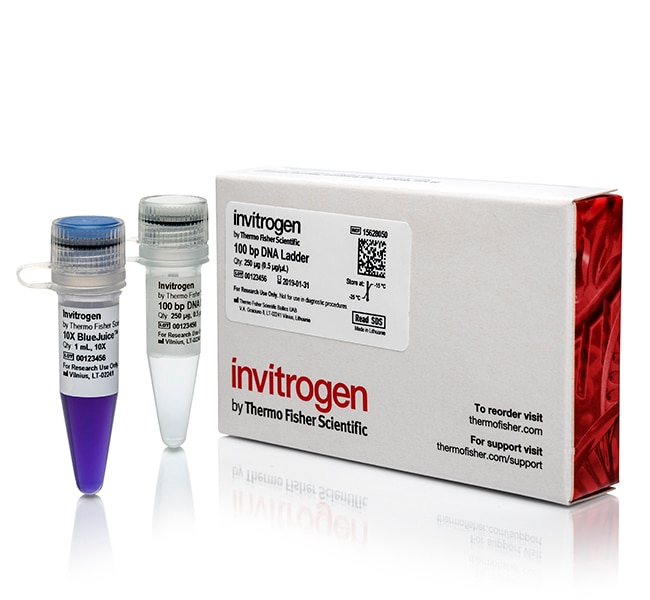
Invitrogen 100 bp DNA Ladder is designed for sizing and approximate quantification of double-stranded DNA in the range of 100 bp to 2,000 bp. 100 bp DNA Ladder consists of 13 individual chromatography-purified DNA fragments and has reference bands at 2000, 1500, and 600 bp for easy orientation.
100 bp DNA Ladder is ideal for separation on 1–2% agarose gels.
Highlights of 100 bp DNA Ladder:
• Sharp, clear bands—chromatography purified fragments for consistent and reliable results
• Convenient—provided with 10X BlueJuice Gel Loading Buffer for tracking of sample DNA migration
• Precise—an exact amount of DNA in each band
Product use
The double-stranded DNA ladder can be visualized on 1–2% agarose gels after ethidium bromide or SYBR Safe staining. The ladder is designed with a uniform intensity of DNA bands for a clear view of each band. An exact amount of DNA in each band allows approximate quantification of DNA samples.
This ladder can be radiolabeled with T4 polynucleotide kinase or T4 DNA polymerase.
100 bp DNA Ladder is ideal for separation on 1–2% agarose gels.
Highlights of 100 bp DNA Ladder:
• Sharp, clear bands—chromatography purified fragments for consistent and reliable results
• Convenient—provided with 10X BlueJuice Gel Loading Buffer for tracking of sample DNA migration
• Precise—an exact amount of DNA in each band
Product use
The double-stranded DNA ladder can be visualized on 1–2% agarose gels after ethidium bromide or SYBR Safe staining. The ladder is designed with a uniform intensity of DNA bands for a clear view of each band. An exact amount of DNA in each band allows approximate quantification of DNA samples.
This ladder can be radiolabeled with T4 polynucleotide kinase or T4 DNA polymerase.
For Research Use Only. Not for use in diagnostic procedures.
Specifications
Concentration0.5 μg/μL
Gel CompatibilityAgarose gel
Kit Contents500 μL DNA Ladder, 1 mL 10X Loading Buffer
No. of Reactions500 Applications
Quantity500 Applications
Ready to LoadNo
Sample Loading Volume1 mL
Shipping ConditionApproved for shipment at Room Temperature or on Dry Ice
TechnologyIndividual chromatography-purified DNA fragments
Volume (Metric)500 μL
Gel TypeAgarose
Product TypeDNA Ladder
Size Range100 to 2000 bp
Unit SizeEach
Contents & Storage
• 500 µL 100 bp DNA Ladder
• 1 mL 10X BlueJuice Gel Loading Buffer
Store at -20°C.
• 1 mL 10X BlueJuice Gel Loading Buffer
Store at -20°C.
Frequently asked questions (FAQs)
Can I know the sequences of Invitrogen DNA ladders?
Are Invitrogen DNA ladders composed of linear or circular/supercoiled DNA?
Are Invitrogen DNA ladders composed of single-stranded or double-stranded DNA fragments?
Why are the DNA bands from my molecular weight ladder smearing?
I'm seeing anomalous migration of my DNA ladder. What happened?
Citations & References (6)
Citations & References
Abstract
A duplex PCR-based assay for measuring the amount of bacterial contamination in a nucleic acid extract from a culture of free-living protists.
Journal:PLoS One
PubMed ID:23593495
'Cultures of heterotrophic protists often require co-culturing with bacteria to act as a source of nutrition. Such cultures will contain varying levels of intrinsic bacterial contamination that can interfere with molecular research and cause problems with the collection of sufficient material for sequencing. Measuring the levels of bacterial contamination for
Identification and characterization of non-saccharomyces spoilage yeasts isolated from Brazilian wines.
Journal:World J Microbiol Biotechnol
PubMed ID:23355138
'The industry of fine wines and also locally consumed table wines is emerging in Brazil with an increasing volume and economic impact. Enologists in this region currently lack information about the prevalence and characteristics of spoilage yeasts, which may contaminate and potentially undervalue Brazilian wines. Herein, we analyzed 50 local
Systemically administered gp100 encoding DNA vaccine for melanoma using water-in-oil-in-water multiple emulsion delivery systems.
Journal:
PubMed ID:23702000
'The purpose of this study was to develop a water-in-oil-in-water (W/O/W) multiple emulsions-based vaccine delivery system for plasmid DNA encoding the gp100 peptide antigen for melanoma immunotherapy. The gp100 encoding plasmid DNA was encapsulated in the inner-most aqueous phase of squalane oil containing W/O/W multiple emulsions using a two-step emulsification
Multiplex PCR assay targeting a diguanylate cyclase-encoding gene, cgcA, to differentiate species within the genus Cronobacter.
Journal:Appl Environ Microbiol
PubMed ID:23144142
In a comparison to the widely used Cronobacter rpoB PCR assay, a highly specific multiplexed PCR assay based on cgcA, a diguanylate cyclase gene, that identified all of the targeted six species among 305 Cronobacter isolates was designed. This assay will be a valuable tool for identifying suspected Cronobacter isolates
Mycobacterial interspersed repetitive-unit-variable-number tandem-repeat (MIRU-VNTR) genotyping of mycobacterium intracellulare for strain comparison with establishment of a PCR-based database.
Journal:J Clin Microbiol
PubMed ID:23175249
Strain comparison is important to population genetics and to evaluate relapses in patients with Mycobacterium avium complex (MAC) lung disease, but the "gold standard" of pulsed-field gel electrophoresis (PFGE) is time-consuming and complex. We used variable-number tandem repeats (VNTR) for fingerprinting of respiratory isolates of M. intracellulare from patients with