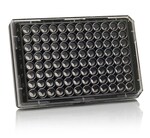
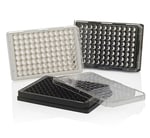
96-Well-Platte, schwarz/transparenter Boden, TC-Oberfläche
Thermo Scientific™

96-Well-Platte, schwarz/transparenter Boden, TC-Oberfläche

Farbe:Schwarz, transparenter Boden; Sterilität:Steril; Deckel:Mit Deckel; Typ: Transparente Polymerbasis
Have Questions?
KatalognummerMenge
16530530/Cs.
Katalognummer 165305
Preis (EUR)
475,00
Case of 30
Zum Warenkorb hinzufügen
Menge:
30/Cs.
Preis (EUR)
475,00
Case of 30
Zum Warenkorb hinzufügen

Thermo Scientific™ Nunc MicroWell 96-Well-Platten mit transparentem Boden und Polymerbasis haben Kammerstrukturen aus weißem oder schwarzem Polystyrol und Polystyrolfolie am Plattenboden. Die Platten wurden für Fluoreszenz- und Lumineszenzanwendungen in Zellkulturen sowie mikroskopische Anwendungen optimiert.

Kammerstrukturen aus weißem oder schwarzem Polystyrol mit Plattenböden aus Polymer oder Deckglas verbinden die optische Klarheit von reinem, kristallinem Polystyrol mit der optimalen Oberfläche für ein breites HTS-Anwendungsspektrum.

  • Bei Einsatz von schwarzen oder weißen Nunc Mikrotiterplatten sind Hintergrund, Eigenfluoreszenz und Cross-Talk verbessert.
  • Schwarze Mikrotiterplatten werden für Fluoreszenz-Messungen empfohlen; Rückstreuung des Lichts und Hintergrund-Fluoreszenz werden auf ein Minimum reduziert.
  • Weiße Mikrotiterplatten mit maximaler Reflexion und minimaler Autolumineszenz werden für Lumineszenzmessungen empfohlen
  • Erhältlich in schwarz für Fluoreszenztests oder in weiß für Lumineszenz- und Fluoreszenztests; beide mit transparentem Boden
  • Polymer-Trägerplatte
  • Arbeitsvolumen 50 bis 200 μl/Well
  • Kundenspezifische Barcodierung möglich

Bestellinformationen:

Bestellnr. 152040, 152036, 152028 und 152037 werden in Reinraumumgebung hergestellt.

Aufhebung der Nutzungsbeschränkung auf interne Forschungszwecke: Jegliche dem Käufer auferlegte Beschränkung, das/die Produkt(e) nur zu internen Forschungszwecken zu nutzen, gilt nicht für das/die Produkt(e) auf Webseiten, die mit dieser Erklärung verbunden sind.
Specifications
Zertifizierung/KonformitätAlle von Nunc hergestellten Mikrotiterplatten erfüllen die Anforderungen gemäß ANSI (American National Standards) (ANSI/SBS 1-2004).
DeckelMit Deckel
Anzahl pro Karton30
Anzahl pro Packung10
Verpackung10 Packungen, 30 Kartons
ProdukttypTransparente Polymerbasis
Menge30/Cs.
Arbeitsvolumen (metrisch)50 bis 200 mL
Array8 x 12
FarbeSchwarz, Mit durchsichtigem Boden
MaterialPolystyrol
Anzahl Wells96
ProduktlinieNunc
SterilitätSteril
OberflächenbehandlungZellkultur
Volumen (metrisch) Well400 μl
WellformFlacher Boden (F-Well)
Unit SizeCase of 30

Häufig gestellte Fragen (FAQ)

What is the difference between the Nunclon Delta surface and a tissue culture (TC) surface from a competitor?

Our Nunclon Delta surface for adherent cells is a standard tissue culture (TC) surface modification that makes the polystyrene surface more hydrophilic. This facilitates maximum adhesion for a broad range of cell types.

The Nunclon Delta surface is Thermo Scientific Nunclon Delta-certified, which is a Thermo Fisher proprietary certification that has a quality standard to help ensure consistency. Every lot of Thermo Scientific Nunclon Delta-certified cell cultureware is tested with Gibco media for:
- Less than 10% growth variation in L929, Hel299 and primary chick embryo cells
- Less than 15% variation colony formation of V79-4 cells

More information and all applicable products can be found in the "Product selection guide for every step of your cell culture workflow" brochure .

How does cell culturing on Nunc 384-Well Microplates that have a cell culture-treated surface compare with 96-Well Microplates that have a cell culture-treated surface?

The cell culture-treated surfaces are very similar but the wells of the Nunc 384-Well Microplates are smaller than the wells of the Nunc 96-Well Microplate.
Culture recommendations for the Nunc 384-Well Microplates are:
- 15 - 50 µL media per well
- 0.5 - 2.0 x 10^4 cells per well

Should I use an opaque black/white immuno plate, or an "optical-bottom" design?

Opaque plates can only be used on “top reader” instruments, which detect (or, in fluorescence mode, excite and detect) from above the plate. Readers that detect from underneath the plate (or imaging systems) use optical-bottom plates, which have a black or white upper well structure and a transparent (polystyrene film or optical coverglass) bottom.

Find additional tips, troubleshooting help, and resources within our Antibodies and Immunoassays Support Center.