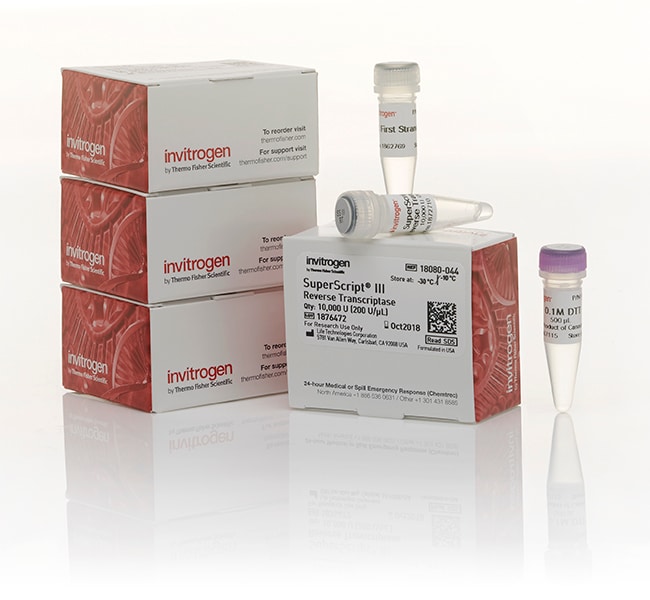
SuperScript™ III Reverse Transcriptase
Invitrogen™

SuperScript™ III Reverse Transcriptase

Invitrogen SuperScript III Reverse Transkriptase ist eine gentechnisch veränderte reverse MMLV-Transkriptase (RT), die durch die Einführung mehrerer Mutationen eine verringerteWeitere Informationen
Have Questions?
Ansicht ändernbuttonViewtableView
KatalognummerAnzahl Reaktionen
18080085200 Reaktionen
1808009310 Reaktionen
1808004450 Reaktionen
Katalognummer 18080085
Preis (EUR)
1.417,65
Exklusiv online
1.688,00
Ersparnis 270,35 (16%)
Each
Anzahl Reaktionen:
200 Reaktionen
Großbestellung oder individuelle Größe anfordern
Preis (EUR)
1.417,65
Exklusiv online
1.688,00
Ersparnis 270,35 (16%)
Each
Invitrogen SuperScript III Reverse Transkriptase ist eine gentechnisch veränderte reverse MMLV-Transkriptase (RT), die durch die Einführung mehrerer Mutationen eine verringerte RNase H-Aktivität, eine höhere Halbwertszeit und eine verbesserte thermische Stabilität bietet. SuperScript III RT bietet eine höhere cDNA-Ausbeute, längere cDNAs, eine höhere Effizienz bei GC-reichen Ziel-RNAs und eine verbesserte Gesamtleistung im Vergleich zu Wildtyp-MMLV-Enzymen und MMLV-RNase H-Minus-Enzymen.

Die SuperScript RTs sind die zuverlässigsten und am weitesten verbreiteten RTs mit bis heute über 50.000 Zitaten, Rezensionen und Publikationen.

Hinweis: Das neueste Mitglied der SuperScript RT-Familie, SuperScript IV reverse Transkriptase, bietet verbesserte Thermostabilität, Prozessivität, Ausbeute und Leistung bei beliebigen RNA-Proben, einschließlich solcher mit suboptimalem Reinheitsgrad oder suboptimaler Integrität.

Nur für Forschungszwecke. Nicht zur Verwendung bei diagnostischen Verfahren.

Specifications
EndprodukttypcDNA (Erststrang)
FormatRörchen
Anzahl Reaktionen200 Reaktionen
Optimale Reaktionstemperatur50 °C
Menge200 Reaktionen
ReaktionsformatSeparate Komponenten
ReagenztypReverse Transkription
Reverse TranskriptaseSuperScript III
Ribonuklease-H-AktivitätKeine
VersandbedingungTrockeneis
Größe (Endprodukt)Bis 12,3 kb
AusgangsmaterialRNA
VerfahrenReverse Transkription
Konzentration200 U/μl
GC-Rich PCR PerformanceHoch
Reaktionsgeschwindigkeit30 bis 50 min
Unit SizeEach
Inhalt und Lagerung

• SuperScript™ III Reverse Transkriptase, 4x 10.000 Einheiten (200 E/μl)
• 5X-Erststrangpuffer, 4x 1 ml
• DTT, 4x 500 μl (100 mM)

Lagerung bei –20 °C

Häufig gestellte Fragen (FAQ)

Which components of the SuperScript III First Strand Synthesis System for RT-PCR are available for purchase separately?

The following components are available as stand-alone items:

- Superscript III Reverse Transcriptase (Cat. Nos. 18080093, 18080044, 18080085)
- Oligo (dT)20 Primer (Cat. No. 18418020)
- Random hexamers (Cat. No. 48190011)
- 10 mM dNTP Mix (Cat. Nos. 18427013, 18427088)
- RNAseOUT Recombinant Ribonuclease Inhibitor (Cat. No. 10777019)
- E. coli RNAse H (Cat. Nos. 18021014, 18021071)

I am interested in generating cDNA from total RNA. What is the difference between SuperScript III Reverse Transcriptase and SuperScript III First Strand Synthesis System for RT-PCR?

SuperScript III Reverse Transcriptase (Cat. Nos. 18080093, 18080044, 18080085) contains the stand-alone enzyme and a vial each of 5X first-strand buffer and 100 mM DTT.

SuperScript III First Strand Synthesis System for RT-PCR is a complete kit that provides the SuperScript III Reverse Transcriptase and all the other components required for synthesis of first-strand cDNA from total or poly(A)- RNA. It includes:
- Superscript III Reverse Transcriptase
- Oligo (dT)20 Primer
- Random hexamers
- 10X RT buffer
- 25 mM MgCl2
- 0.1 M DTT
- 10 mM dNTP Mix
- RNAseOUT Recombinant Ribonuclease Inhibitor
- E. coli RNAse H
- DEPC-treated water
- Total HeLa RNA control
- Sense control primer
- Anti-sense control primer
Note: The kit does not include the PCR amplification enzyme.

How can I remove genomic DNA contamination from my sample prior to performing RT-PCR?

We recommend using ezDNase (Cat. No. 11766051). ezDNase Enzyme's high specificity for double-stranded DNA enables efficient and fast genomic DNA removal without reduction in the quality or quantity of RNA. ezDNase Enzyme is heat-labile and so can be easily deactivated by heat treatment at moderate temperature (55 degrees C). These features make ezDNase Enzyme an excellent choice for genomic DNA removal prior to reverse transcription reactions.

How much RNA should be employed for first-strand cDNA synthesis?

The amount of RNA template for a cDNA synthesis is highly flexible and depends upon the amount of sample available and an individual's need. In general, 1 µg total RNA is used in a typical 20-µL RT reaction.

Find additional tips, troubleshooting help, and resources within ourReverse Transcription and RACE Support Center.

Should I treat the cDNA with RNase H prior to downstream processing?

RNase H treatment is not always necessary. Many PCR reactions work without it. However, for cDNA synthesized with RNase H-deficient reverse transcriptases (like SuperScript II, III, and IV), RNA/cDNA hybrids—especially GC-rich ones—may not denature well, reducing PCR sensitivity. RNase H treatment can help in such cases. Additionally, RNase H treatment is beneficial for cloning larger fragments.