Search


Citations & References (5)
Thermo Scientific™
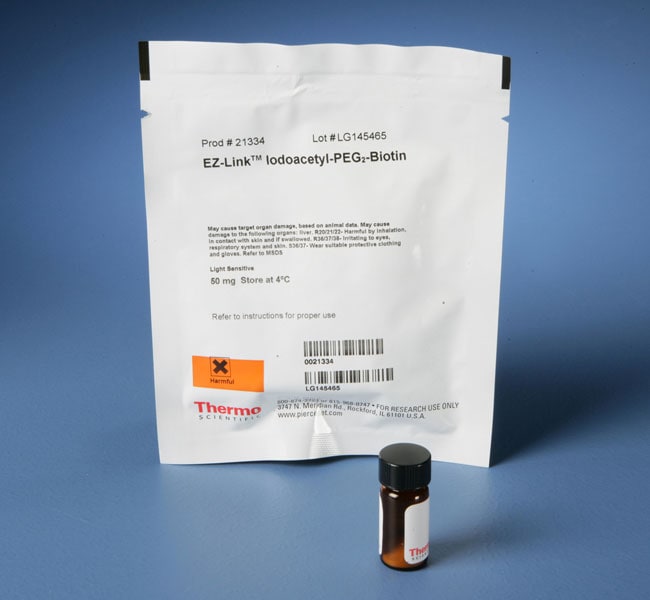
EZ-Link™ Iodoacetyl-PEG2-Biotin
Thermo Scientific EZ-Link Iodoacetyl-PEG2-Biotin is a mid-length, haloacetyl-activated, sulfhydryl-reactive biotinylation reagent that contains a 2-unit ethylene glycol in its spacerRead more
| Catalog Number | Quantity |
|---|---|
| 21334 | 50 mg |
Catalog number 21334
Price (USD)
320.00
Each
Quantity:
50 mg
Price (USD)
320.00
Each
Thermo Scientific EZ-Link Iodoacetyl-PEG2-Biotin is a mid-length, haloacetyl-activated, sulfhydryl-reactive biotinylation reagent that contains a 2-unit ethylene glycol in its spacer arm for increased water-solubility characteristics.
Features of EZ-Link Iodoacetyl-PEG2-Biotin:
• Protein labeling—biotinylate antibodies or other proteins for use in protein methods
• Thiol-reactive—reacts with sulfhydryls (-SH), such as the side-chain of cysteine (C)
• Iodoacetyl-activated—perform reactions in the dark at pH 7.5 to 8.5 in Tris or borate buffer
• Pegylated—spacer arm contains a hydrophilic, 2-unit, polyethylene glycol (PEG) group
• Enhances solubility—pegylation imparts water solubility to the biotinylated molecule, helping to prevent aggregation of biotinylated antibodies stored in solution
• Irreversible—forms permanent thioether bonds; spacer arm cannot be cleaved
• Solubility—can be dissolved directly in aqueous buffers for labeling reactions
• Medium length—spacer arm (total length added to target) is 24.7 angstroms
Iodoacetyl-PEG2-Biotin enables simple and efficient biotin labeling of antibodies, cysteine-containing peptides and other thiol-containing molecules. The iodoacetyl group reacts with reduced thiols (sulfhydryl groups,—SH) at alkaline pH to form stable thioether bond. The hydrophilic, 2-unit polyethylene glycol (PEG) spacer arm imparts water solubility that is transferred to the biotinylated molecule, thus reducing aggregation of labeled proteins stored in solution. The PEG segment adds length and flexibility to the spacer arm, minimizing steric hindrance involved with binding to avidin molecules.
We manufacture biotin reagents to ensure the highest possible overall product integrity, consistency and performance for the intended research applications.
Biotinylation reagents differ in reactivity, length, solubility, cell permeability and cleavability. Three types of sulfhydryl-reactive compounds are available: maleimido, iodoacetyl and pyridyldithiol. Iodoacetyl reagents specifically react with sulfhydryl groups (-SH) at pH 8.3 to form permanent thioether bonds.
In proteins, sulfhydryls exist where there are cysteine (C) residues. Cystine disulfide bonds must be reduced to make sulfhydryl groups available for labeling. Hinge-region disulfide bridges of antibodies can be selectively reduced to make functional half-antibodies that can be labeled.
Features of EZ-Link Iodoacetyl-PEG2-Biotin:
• Protein labeling—biotinylate antibodies or other proteins for use in protein methods
• Thiol-reactive—reacts with sulfhydryls (-SH), such as the side-chain of cysteine (C)
• Iodoacetyl-activated—perform reactions in the dark at pH 7.5 to 8.5 in Tris or borate buffer
• Pegylated—spacer arm contains a hydrophilic, 2-unit, polyethylene glycol (PEG) group
• Enhances solubility—pegylation imparts water solubility to the biotinylated molecule, helping to prevent aggregation of biotinylated antibodies stored in solution
• Irreversible—forms permanent thioether bonds; spacer arm cannot be cleaved
• Solubility—can be dissolved directly in aqueous buffers for labeling reactions
• Medium length—spacer arm (total length added to target) is 24.7 angstroms
Iodoacetyl-PEG2-Biotin enables simple and efficient biotin labeling of antibodies, cysteine-containing peptides and other thiol-containing molecules. The iodoacetyl group reacts with reduced thiols (sulfhydryl groups,—SH) at alkaline pH to form stable thioether bond. The hydrophilic, 2-unit polyethylene glycol (PEG) spacer arm imparts water solubility that is transferred to the biotinylated molecule, thus reducing aggregation of labeled proteins stored in solution. The PEG segment adds length and flexibility to the spacer arm, minimizing steric hindrance involved with binding to avidin molecules.
We manufacture biotin reagents to ensure the highest possible overall product integrity, consistency and performance for the intended research applications.
Biotinylation reagents differ in reactivity, length, solubility, cell permeability and cleavability. Three types of sulfhydryl-reactive compounds are available: maleimido, iodoacetyl and pyridyldithiol. Iodoacetyl reagents specifically react with sulfhydryl groups (-SH) at pH 8.3 to form permanent thioether bonds.
In proteins, sulfhydryls exist where there are cysteine (C) residues. Cystine disulfide bonds must be reduced to make sulfhydryl groups available for labeling. Hinge-region disulfide bridges of antibodies can be selectively reduced to make functional half-antibodies that can be labeled.
For Research Use Only. Not for use in diagnostic procedures.
Specifications
Cell PermeabilityCell-Impermeant
Label TypeBiotin & Analogs
Product LineEZ-Link
Product TypeIodoacetyl-PEG2-Biotin
Quantity50 mg
Reactive MoietyHaloacetyl
Chemical ReactivityThiol
Label or DyeBiotin
SolubilityDMF (Dimethylformamide), DMSO (Dimethylsulfoxide), Water
SpacerMid-length, Pegylated
Unit SizeEach
Contents & Storage
Store desiccated at 4°C. Shipped at ambient temperature.
Frequently asked questions (FAQs)
What is the advantage of using EZ-Link HPDP-Biotin over maleimide- or iodoacetyl-containing biotinylation reagents?
Citations & References (5)
Citations & References
Abstract
High-fat diet-induced changes in liver thioredoxin and thioredoxin reductase as a novel feature of insulin resistance.
Journal:
PubMed ID:25426412
High-fat diet (HFD) can induce oxidative stress. Thioredoxin (Trx) and thioredoxin reductase (TrxR) are critical antioxidant proteins but how they are affected by HFD remains unclear. Using HFD-induced insulin-resistant mouse model, we show here that liver Trx and TrxR are significantly decreased, but, remarkably, the degree of their S-acylation is
Characterization of transcription factor response kinetics in parallel.
Journal:BMC Biotechnol
PubMed ID:27557669
'Transcription factors (TFs) are effectors of cell signaling pathways that regulate gene expression. TF networks are highly interconnected; one signal can lead to changes in many TF levels, and one TF level can be changed by many different signals. TF regulation is central to normal cell function, with altered TF
Hydrogen Sulfide Inhibits High-Salt Diet-Induced Renal Oxidative Stress and Kidney Injury in Dahl Rats.
Journal:Oxid Med Cell Longev
PubMed ID:26823949
'BACKGROUND. The study was designed to investigate if H2S could inhibit high-salt diet-induced renal excessive oxidative stress and kidney injury in Dahl rats. METHODS. Male salt-sensitive Dahl and SD rats were used. Blood pressure (BP), serum creatinine, urea, creatinine clearance rate, and 24-hour urine protein were measured. Renal ultra- and
Redox-proteomes of human NOS1-transduced versus MOCK SH-SY5Y neuroblastoma cells under full nutrition, serum-free starvation, and rapamycin treatment.
Journal:Data Brief
PubMed ID:30456248
'Upregulations of neuronal nitric oxide synthase (nNOS/NOS1) in the mouse brain upon aging and stress suggest a role of NO-dependent redox protein modifications for age-associated protein imbalances or dysfunctions. We generated a cell model, in which constitutive expression of nNOS in SH-SY5Y cells at a level comparable with mouse brain
The Increased Endogenous Sulfur Dioxide Acts as a Compensatory Mechanism for the Downregulated Endogenous Hydrogen Sulfide Pathway in the Endothelial Cell Inflammation.
Journal:Front Immunol
PubMed ID:29760703
Endogenous hydrogen sulfide (H