Search


Citations & References (1)
Gibco™
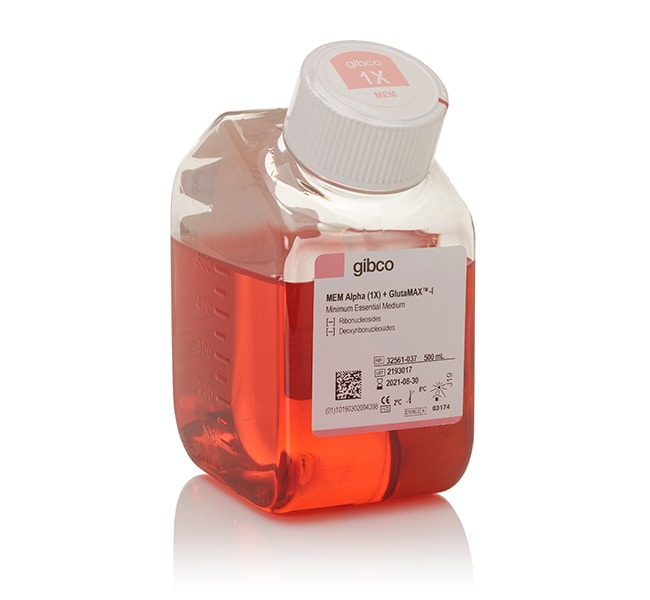
MEM α, GlutaMAX™ Supplement, no nucleosides
Minimum Essential Medium (MEM) α is widely used for mammalian cell culture as well as selection for transfected DHFR negativeRead more
Have Questions?
Change view

| Catalog Number | Quantity |
|---|---|
| 32561037 | 500 mL |
| 32561102 | 10 x 500 mL |
Catalog number 32561037
Price (USD)
65.65
Online exclusive
76.75Save 11.10
Each
Quantity:
500 mL
Price (USD)
65.65
Online exclusive
76.75Save 11.10
Each
Minimum Essential Medium (MEM) α is widely used for mammalian cell culture as well as selection for transfected DHFR negative cells. MEM α can be used with a variety of suspension and adherent mammalian cells, including keratinocytes, primary rat astrocytes, and human melanoma cells. We offer a variety of Gibco™ MEM α modifications for a range of cell culture applications. Find the right formulation using the media selector tool.
This MEM α is modified as follows:
| With | Without |
| • Phenol Red | • Ribonucleosides |
| • GlutaMAX™ | • Deoxyribonucleosides |
The complete formulation is available.
Gibco™ MEM α is a modification of Minimum Essential Medium (MEM) that contains non-essential amino acids, sodium pyruvate, lipoic acid, vitamin B12, biotin, and ascorbic acid. MEM α is available without nucleosides for use as a selection medium for DG44 and other DHFR negative cells. Gibco™ MEM α with GlutaMAX™ supplement minimizes toxic ammonia build-up and improves cell viability and growth in an easy-to-use format. This product is made with Earle’s salts.
MEM α contains no proteins, lipids, or growth factors. Therefore, MEM α requires supplementation, commonly with 10% Fetal Bovine Serum (FBS). MEM α uses a sodium bicarbonate buffer system (2.2 g/L) and therefore requires a 5-10% CO2 environment to maintain physiological pH.
For Research Use or Further Manufacturing. Not for diagnostic use or direct administration into humans or animals.
Specifications
Cell LineHeLa, BHK-21, 293, HEP-2, HT-1080, MCF-7, and fibroblasts
Cell TypePrimary Rat Astrocytes
Concentration1 X
Manufacturing QualitycGMP-compliant under the ISO 13485 standard
Product LineGibco, GlutaMAX
Product TypeMEM α (Minimum Essential Medium α)
Quantity500 mL
Shelf Life12 Months From Date of Manufacture
Shipping ConditionRoom Temperature
ClassificationAnimal Origin-free
FormLiquid
Serum LevelStandard Serum Supplementation
SterilitySterile-filtered
Sterilization MethodSterile-filtered
With AdditivesLow Glucose, GlutaMAX, Phenol Red, Sodium Pyruvate
Without AdditivesNo HEPES, No Ribonucleosides, No Deoxyribonucleosides
Unit SizeEach
Contents & Storage
Storage conditions: 2-8° C. Protect from light
Shipping conditions: Ambient
Shelf life: 12 months from date of manufacture
Shipping conditions: Ambient
Shelf life: 12 months from date of manufacture
Frequently asked questions (FAQs)
Where can I find the osmolality for MEM Medium?
How long can I keep my media after supplementing with serum?
My medium was shipped at room temperature but it is supposed to be stored refrigerated. Is it okay?
Will depletion, absence, or breakdown of essential growth-promoting components such as glutamine or growth factors reduce the growth rate of my culture?
Will the media formulations containing GlutaMAX supplement change with respect to L-glutamine content?
Citations & References (1)
Citations & References
Abstract
Point mutations identified in Lec8 Chinese hamster ovary glycosylation mutants that inactivate both the UDP-galactose and CMP-sialic acid transporters.
Journal:J Biol Chem
PubMed ID:11319223
'Nucleotide-sugar transporters (NSTs) are critical components of glycosylation pathways in eukaryotes. The identification of structural elements that are involved in NST functions provides an important task. Chinese hamster ovary glycosylation mutants defective in nucleotide-sugar transport provide access to inactive transporters that can define such structure/function relationships. In this study, we