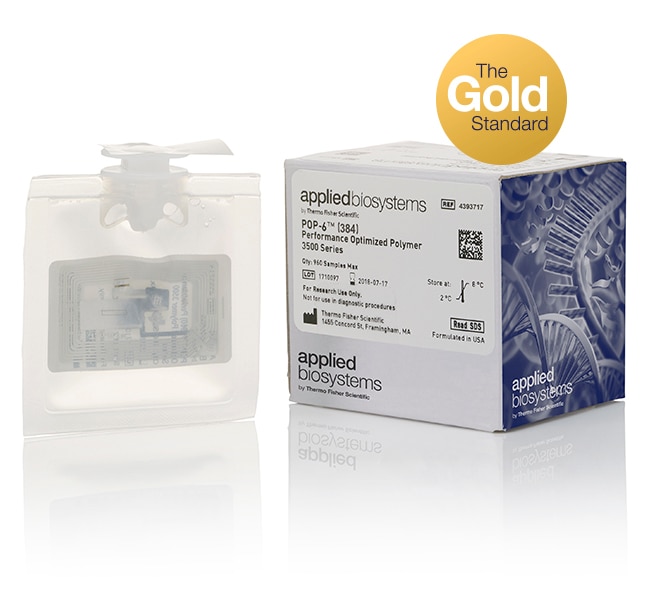
POP-6™ Polymer, for 3500/SeqStudio™ Flex
Applied Biosystems™

POP-6™ Polymer, for 3500/SeqStudio™ Flex

POP-4, POP-6 und POP-7 werden in praktischen Beuteln angeboten, die leicht zu handhaben sind. Die POP-6 Trennmatrix ist für die standardmäßige Sequenzierung und Fragmentanalyse optimiert.
Have Questions?
Ansicht ändernbuttonViewtableView
Menge:
384 Proben
96 Proben
960 Samples
Katalognummer 4393717
Preis (EUR)
341,00
Each
Zum Warenkorb hinzufügen
Menge:
384 Proben
Preis (EUR)
341,00
Each
Zum Warenkorb hinzufügen
Pop-4, POP-6 und POP-7 werden bequem in einfach zu bedienenden Beuteln angeboten, die POP-6-Trennmatrix ist für die Standardsequenzierung und Fragmentanalyse optimiert.POP Polymere umkleiden dynamisch die Kapillarwand und steuern so den elektroosmotischen Fluss.Die gesicherte Qualität und die einheitliche Konsistenz machen die Schätzarbeit überflüssig und helfen Ihnen, die Reproduzierbarkeit sicherzustellen.POP Polymere wurden speziell zur Trennung von DNA-Fragmenten mit bekanntem Größenbereich bei gewünschter Auflösung und Laufzeit formuliert.

POP-4, POP-6 und POP-7 werden in einfach zu handhabenden Beuteln mit verschiedenen Probenformaten angeboten. Die POP-6 Trennmatrix ist für die standardmäßige Sequenzierung und Fragmentanalyse optimiert.

Anwenderfreundlich: Vorformuliert und in einerm einzigen Beutel, was nicht nur Zeit spart, sondern auch Zuverlässigkeit und Konsistenz gewährleistet
Einschließlich RFID-Etikett (Radio Frequency Identification): Einfache Nachverfolgung wichtiger Informationen wie Teile-Chargen-Nummer, verbleibende Proben und Verfallsdaten (auf dem Software-Dashboard angezeigt)
Robuste Rezeptur: Formuliert für Sequenzierungs- und Fragmentanalyse-Anwendungen
Nachfüllbar: Ermöglicht die mehrfache Verwendung von Kapillaren

Reproduzierbare Ergebnisse
POP-Polymere beschichten die Kapillarwand dynamisch, um den elektroosmotischen Fluss zu steuern. Die gesicherte Qualität und die einheitliche Konsistenz machen die Schätzarbeit überflüssig und helfen Ihnen, die Reproduzierbarkeit sicherzustellen. POP-Polymere werden speziell formuliert, um DNA-Fragmente eines bekannten Größenbereichs mit einer gewünschten Auflösung und Laufzeit zu trennen.

Viel Auswahl
POP-7-Polymere sind sehr vielseitig und für eine breite Palette von Anwendungen von der kurzen bis langen Lesesequenzierung bis hin zur Fragmentanalyse konzipiert. POP-4 Polymere sind speziell für HIDForensische Anwendungen konzipiert, während POP-6 Polymere die Wahl für bestimmte Sequenzierungsanwendungen (und Fragmentanalyse) sind.

Für teilweise benutzte Beutel, die aufbewahrt werden müssen, wird eine Kappe (4412619) empfohlen, die in die Öffnung des Beutels eingesetzt wird.

Nur für Forschungszwecke
Specifications
Zur Verwendung mit (Anwendung)Standardsequenzierung, Fragmentanalyse (Vergällung)
ProduktliniePOP-6
Empfohlene LagerungDer Beutel enthält 384 Proben des Polymers. Beutel bei 2 – 8 °C aufbewahren, bis er gebrauchsfertig ist. Beachten Sie das Verfallsdatum auf dem Etikett. Beachten Sie, dass abgelaufene Beutel nicht auf dem Gerät verwendet werden können.
Menge384 Proben
Unit SizeEach

Häufig gestellte Fragen (FAQ)

What is the white residue around the Applied Biosystems 3500/3500xL Genetic Analyzer array knob?

When placing the array on the instrument, the last step in the process is to loosen the array knob and the instrument forces any air bubbles around the array tip through the threading and the middle of the array knob. Some polymer gets pushed through as well and when it dries up, it appears as a white, flaky residue. Use a damp, lint-free cloth to remove it.

Find additional tips, troubleshooting help, and resources within our Capillary Electrophoresis Instruments Support Center.

I seem to be getting bubbles from the polymer pouch on my Applied Biosystems 3500/3500xL Genetic Analyzer but the polymer level is normal. What is causing it?

On the Applied Biosystems 3500 Series Genetic Analyzer, the polymer pouch may not be sitting properly or the check valve may be stuck in the open position. Carefully detach the polymer pouch by pulling down the handle next to it, and then pull the handle up while guiding the pouch into place and secure it by pushing up on the plastic head of the pouch. If this fails, perform a wash on the system using the conditioning pouch. If reseating the tube/pouch and cleanup do not fix the problem, a service call may be required.

Find additional tips, troubleshooting help, and resources within our Capillary Electrophoresis Instruments Support Center.

I have an Applied Biosystems 3500/3500xL Genetic Analyzer. When do my consumables expire?

If we do not specify the expiry date or number of uses, the warranty will last for 12 months from the date of shipment.

Find additional tips, troubleshooting help, and resources within our Capillary Electrophoresis Instruments Support Center.

My Applied Biosystems 3500/3500xL Genetic Analyzer consumables have expired, but how long past expiration can I really use them?

Thermo Fisher Scientific can only provide warranty on performance on non-expired reagents. Using reagents past their expiration date is a risk and may compromise your data integrity.

Find additional tips, troubleshooting help, and resources within our Capillary Electrophoresis Instruments Support Center.

How long can I keep the buffer on the Applied Biosystems 3500/3500xL Genetic Analyzer?

For the Applied Biosystems 3500 Series Genetic Analyzer, the buffer will keep for 14 days if room temperature is <25 degrees C and for 7 days if >25 degrees C.

Find additional tips, troubleshooting help, and resources within our Capillary Electrophoresis Instruments Support Center.