Search

Invitrogen™
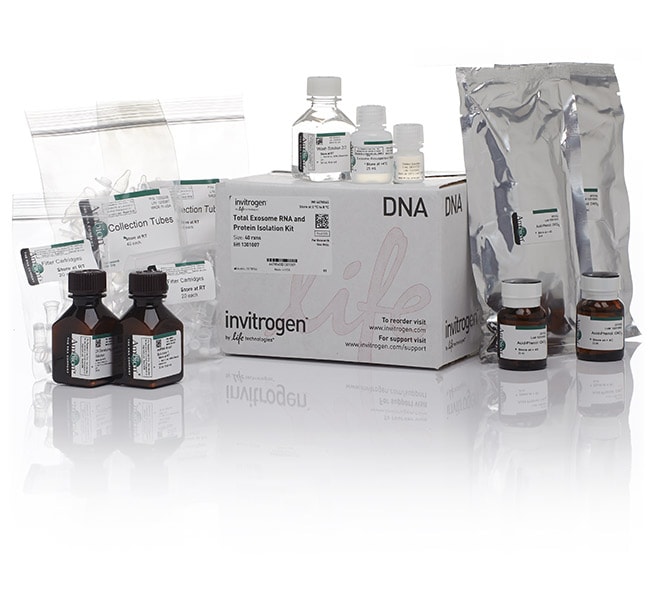
Total Exosome RNA & Protein Isolation Kit
The Total Exosome RNA and Protein Isolation Kit enables isolation of total RNA and proteins from exosome samples extracted fromRead more
| Catalog Number | Quantity |
|---|---|
| 4478545 | 40 preps |
Catalog number 4478545
Price (KRW)
472,000
Online offer
Ends: 31-Dec-2026
524,000Save 52,000
Each
Quantity:
40 preps
Price (KRW)
472,000
Online offer
Ends: 31-Dec-2026
524,000Save 52,000
Each
The Total Exosome RNA and Protein Isolation Kit enables isolation of total RNA and proteins from exosome samples extracted from biological fluids (e.g., by using Total Exosome Isolation (from cell culture media) or Total Exosome Isolation (from serum)).
• Extracts highly pure total RNA (including small RNA fraction) from exosomes
• Recovers protein and RNA from the same sample
• Compatible with all protocols for exosome isolation
The Total Exosome RNA and Protein Isolation Kit is designed for the isolation of both RNA and protein from pre-isolated or enriched exosomes (not supplied). It is suitable for studies of RNA expression (specifically miRNA), processing, or function. The kit allows recovery of both RNA and proteins from the same purified exosome preparation. One portion of the sample is subjected to organic extraction, followed by immobilization of RNA on glass-fiber filters to purify total RNA or enrich for small RNA species. The other portion is then used directly for common protein applications such as Western blotting.
High yields of ultra-pure RNA can be prepared in about 30–60 minutes. The RNA can then be used in a variety of downstream applications, including qRT-PCR, high-throughput sequencing (e.g., using the Ion Torent™ PGM™, Ion Torrent™ Proton™, or SOLiD™ sequencing instruments), microarray analysis, solution hybridization assays, and blot hybridization.
For Research Use Only. Not for human or animal therapeutic or diagnostic use.
• Extracts highly pure total RNA (including small RNA fraction) from exosomes
• Recovers protein and RNA from the same sample
• Compatible with all protocols for exosome isolation
The Total Exosome RNA and Protein Isolation Kit is designed for the isolation of both RNA and protein from pre-isolated or enriched exosomes (not supplied). It is suitable for studies of RNA expression (specifically miRNA), processing, or function. The kit allows recovery of both RNA and proteins from the same purified exosome preparation. One portion of the sample is subjected to organic extraction, followed by immobilization of RNA on glass-fiber filters to purify total RNA or enrich for small RNA species. The other portion is then used directly for common protein applications such as Western blotting.
High yields of ultra-pure RNA can be prepared in about 30–60 minutes. The RNA can then be used in a variety of downstream applications, including qRT-PCR, high-throughput sequencing (e.g., using the Ion Torent™ PGM™, Ion Torrent™ Proton™, or SOLiD™ sequencing instruments), microarray analysis, solution hybridization assays, and blot hybridization.
For Research Use Only. Not for human or animal therapeutic or diagnostic use.
For Research Use Only. Not for use in diagnostic procedures.
Specifications
Final Product TypeTotal RNA, Protein, micro RNA
High-throughput CompatibilityNot High-throughput Compatible (Manual)
Isolation TechnologySpin Column (Glass Fiber Filter), Organic Extraction
Purification TargetTotal RNA, Protein, RNA & Protein, miRNA
Quantity40 preps
Sample TypeOrganelle & Vesicle-Related Samples, Exosomes
Shipping ConditionRoom Temperature
For Use With (Application)Next-Generation Sequencing, Real-Time Quantitative PCR (qPCR), Western Blot, microRNA Analysis
Product TypeTotal Exosome Isolation
Unit SizeEach
Contents & Storage
Store at 2°C to 8°C.