Search
 Element Search
 Structure Search

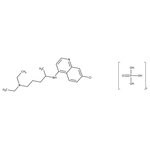

Thermo Scientific Chemicals
Chloroquine diphosphate salt, 98%
Chloroquine diphosphate salt, CAS # 50-63-5, is a member of the quinolone family that is considered to be a DNA intercalator. It shows anti-malarial, anti-inflammatory, and anti-filaricides activities. | CAS: 50-63-5 | C18H32ClN3O8P2 | 515.86 g/mol
Have Questions?
Change view



Price (EUR)
168,00
Each
Chemical Identifiers
CAS50-63-5
IUPAC Name7-chloro-N-[5-(diethylamino)pentan-2-yl]quinolin-4-amine; bis(phosphoric acid)
Molecular FormulaC18H32ClN3O8P2
InChI KeyQKICWELGRMTQCR-UHFFFAOYNA-N
SMILESOP(O)(O)=O.OP(O)(O)=O.CCN(CC)CCCC(C)NC1=C2C=CC(Cl)=CC2=NC=C1
View more
Specifications Specification Sheet
Specification SheetAppearance (Color)White to beige
Infrared spectrumConforms
Loss on drying=<2 % (105°C, 16 h)
HPLC>=97.5 %
Appearance (Form)Powder
This Thermo Scientific Chemicals brand product was originally part of the Acros Organics product portfolio. Some documentation and label information may refer to the legacy brand. The original Acros Organics product / item code or SKU reference has not changed as a part of the brand transition to Thermo Scientific Chemicals.
General Information
• Chloroquine diphosphate salt is a DNA intercalator that shows anti-malarial and anti-inflammatory activities.
• It has been described that this compound interferes with the biosynthesis of nucleic acids, suggesting a cellular mechanism of action
Applications
• Chloroquine diphosphate salt is used as a DNA intercalator to dissociate antigen-antibody complexes without denaturing red blood cell antigens
• This compound shows anti-malarial activity against Plasmodium falciparum, except against chloroquine-resistant strains. It has been used in in vitro antiplasmodial assays. In parasites the mechanism of action remains unclear, but this compound can inhibit the parasitic enzyme heme polymerase that converts the toxic heme into non-toxic hemozoin, resulting in the accumulation of toxic heme within the parasite.
• It shows very high anti-viral activity against NiV but lower activity against other viruses at concentrations lower than 20 μM
• Chloroquine diphosphate salt is used to study the role of endosomal acidification in cellular processes, such as the signaling of intracellular TLRs
• Chloroquine diphosphate salt has been used in autophagy inhibition studies
RUO – Research Use Only
General References:
- Mauthe, M.; Orhon, I.; Rocchi, C. Chloroquine inhibits autophagic flux by decreasing autophagosome-lysosome fusion. Autophagy. 2018, 14, (8), 1435–1455.
- Gaudiano, M. C.; Antoniella, E.; Bertocchi, P.; Valvo, L.. Development and validation of a reversed-phase LC method for analyzing potentially counterfeit antimalarial medicines. Journal of Pharmaceutical and Biomedical Analysis. 2006, 42, (1), 132-135.
- Minchinton, R.M.; Waters, A.H. Chloroquine stripping of HLA antigens from neutrophils without removal of neutrophil specific antigens. British Journal of Haematology. 1984, 57, (4), 703-706.