Search


Citations & References (2)
Gibco™
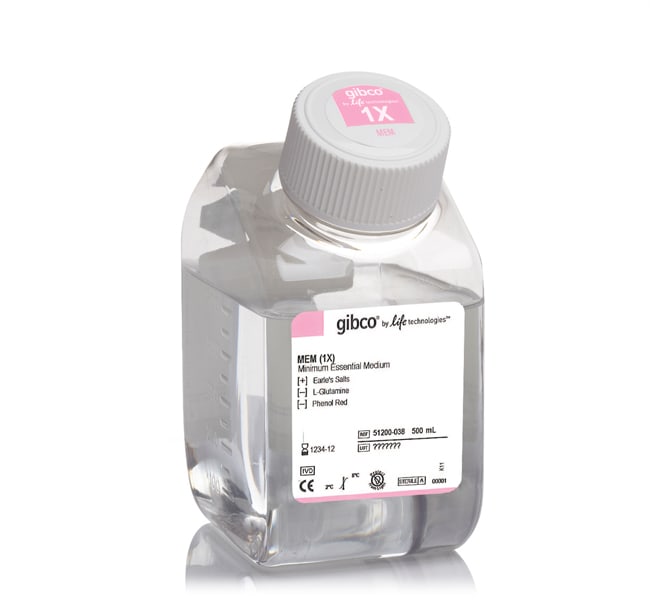
MEM, no glutamine, no phenol red
MEM (Minimum Essential Medium) is one of the most commonly used of all cell culture media. MEM can be usedRead more
| Catalog Number | Quantity |
|---|---|
| 51200038 | 500 mL |
Catalog number 51200038
Price (USD)
67.25
Each
Quantity:
500 mL
Price (USD)
67.25
Each
MEM (Minimum Essential Medium) is one of the most commonly used of all cell culture media. MEM can be used with a variety of suspension and adherent mammalian cells, including HeLa, BHK-21, 293, HEP-2, HT-1080, MCF-7, fibroblasts, and primary rat astrocytes. We offer a variety of MEM modifications for a range of cell culture applications. Find the right formulation using the media selector tool.
This MEM is modified as follows:
| Without |
| • L-glutamine |
| • HEPES |
| • Phenol Red |
The complete formulation is available.
Using MEM
MEM was developed by Harry Eagle, and was based on his earlier formulation of Basal Medium Eagle (BME). Many other modifications of MEM followed, including Glasgow’s MEM, MEM α, DMEM, and Temin’s Modification. MEM is available with Earle’s salts for use in a CO2 incubator, or with Hanks' salts for use without CO2. This product is made with Earle’s salts. MEM contains no proteins, lipids, or growth factors. Therefore, MEM requires supplementation, commonly with 10% Fetal Bovine Serum (FBS). MEM uses a sodium bicarbonate buffer system (2.2 g/L), and therefore requires a 5–10% CO2 environment to maintain physiological pH.
For Research Use or Further Manufacturing. Not for diagnostic use or direct administration into humans or animals.
Specifications
Cell LineHeLa, BHK-21, 293, HEP-2, HT-1080, MCF-7, and fibroblasts
Cell TypePrimary Rat Astrocytes
Concentration1 X
Manufacturing QualitycGMP-compliant under the ISO 13485 standard
Product LineGibco
Product TypeMEM (Minimum Essential Medium)
Quantity500 mL
Shelf Life12 Months From Date of Manufacture
Shipping ConditionRoom Temperature
ClassificationAnimal Origin-free
FormLiquid
Serum LevelStandard Serum Supplementation
SterilitySterile-filtered
With AdditivesLow Glucose
Without AdditivesNo Glutamine, No HEPES, No Phenol Red, No Sodium Pyruvate
Unit SizeEach
Contents & Storage
Storage conditions: 2-8° C. Protect from light
Shipping conditions: Ambient
Shelf life: 12 months from date of manufacture
Shipping conditions: Ambient
Shelf life: 12 months from date of manufacture
Frequently asked questions (FAQs)
Where can I find the osmolality for MEM Medium?
I understand that some media are worse than others for fluorescence imaging. How do I choose?
Should I be concerned about phenol red in my media when labeling my live cells with fluorescent dyes?
How long can I keep my media after supplementing with serum?
My medium was shipped at room temperature but it is supposed to be stored refrigerated. Is it okay?
Citations & References (2)
Citations & References
Abstract
Astrocytes in culture produce anandamide and other acylethanolamides.
Journal:J Biol Chem
PubMed ID:11916961
'Anandamide (arachidonylethanolamide) is an endocannabinoid that belongs to the acylethanolamide lipid family. It is produced by neurons in a calcium-dependent manner and acts through cannabinoid CB1 receptors. Other members of the acylethanolamide lipid family are also produced by neurons and act through G-protein-coupled receptors: homo-gamma-linolenylethanolamide (HEA) and docosatetraenylethanolamide (DEA) act
Contact and encirclement of glioma cells in vitro is an intrinsic behavior of a clonal human neural stem cell line.
Journal:PLoS One
PubMed ID:23240066
Pathotropic neural stem and/or progenitor cells (NSCs) can potentially deliver therapeutic agents to otherwise inaccessible cancers. In glioma, NSCs are found in close contact with tumor cells, raising the possibility that specificity of NSC contact with glioma targets originates in the tumor cells themselves. Alternatively, target preferences may originate, at