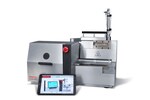
HAAKE™ MiniLab 3 Micro Compounder
El producto real puede variar
HAAKE™ MiniLab 3 Micro Compounder

HAAKE™ MiniLab 3 Micro Compounder

Getting new compounds faster and documenting structural changes online has never been easier with the Thermo Scientific™ HAAKE™ MiniLab 3 Micro Compounder.
Have Questions?
Cambiar vistabuttonViewtableView
Número de catálogoTemperatura máxima
567-2270350 °C
567-2275420 °C
Número de catálogo 567-2270
Precio (MXN)
-
Temperatura máxima:
350 °C

Find unmatched flexibility in designing today's products for tomorrow's world. The Thermo Scientific™ HAAKE™ MiniLab 3 Micro Compounder provides extrusion specifications and online rheology measurements for pilot and scale-up projects across a range of compounded materials.

Using material amounts as small as 5 grams, or 7 cm3, the HAAKE MiniLab 3 delivers meaningful results that enable you to streamline your new material development. Its screw speed and pressure range make it ideal for compounding expensive materials and for performing reactive extrusions.

Getting new compounds faster and documenting structural changes online has never been easier. The HAAKE MiniLab 3 Micro Compounder is a conical, twin-screw compounder with an integrated backflow channel. The compounder works as either a stand-alone unit or can be fully computer-controlled system, and can be used with either co- or counter-rotating screws. It is equipped with an inert gas flush system. Due to its channel and a bypass valve design, the residence time is well defined. Two pressure transducers are integrated in the backflow channel, which allow the measurement of relative melt viscosity when counter-rotating screws are used. Using the optional force feeder with the HAAKE MiniLab 3 Micro Compounder, continuous extrusion with very small volume flows is possible.

The HAAKE MiniLab 3 Micro Compounder Features:

  • Co- and counter-rotating twin screws
  • Integrated viscosity measurement (with HAAKE PolySoft OS)
  • Automatic bypass operation for circulation/extrusion
  • Pneumatic feeding
  • Local control via tablet (Android™) for  intuitive operation
  • Split barrel exit for easy cleaning
  • Compact enough to fit into laboratory fume hood


Recommended for material science research, such as testing expensive additives and developing new formulations.

Especificaciones
DerivaciónPneumatic
Modo de controlLocal via tablet (Android™)
HAAKE PolySoft OS Windows™ Software
DescripciónHAAKE Standard MiniLab 3 Micro Compounder
Requisitos eléctricos115/230 V ±10%, 50/60 Hz
Diseño de la extrusoraConical
Altura (métrico)59 cm
Longitud (métrico)65 cm
Temperatura máxima350 °C
Par de apriete máx.5 Nm
Potencia del motor400 W
PresiónUp to 300 bar
Tipo de tornilloCo-/counter rotating
Anchura (métrico)47 cm
ExtrusorasYes
Vel. máx400 rpm
MicroextrusiónYes
Intervalo de velocidad1 to 400 rpm
Unit SizeEach

Preguntas frecuentes

Should I choose the Thermo Scientific HAAKE MiniLab 3 micro compounder or the Process 11 Parallel Twin-Screw Extruder?

The choice depends on your stage of development, the application and the amount of material available. The Thermo Scientific HAAKE MiniLab 3 micro compounder is designed for early-stage formulation development and micro-compounding using sample quantities as small as 5 g. The Thermo Scientific Process 11 Parallel Twin-Screw Extruder is designed for continuous compounding, process optimization, and scale-up using larger sample quantities. Researchers often use the HAAKE MiniLab 3 compounder for formulation development before moving to the Process 11 extruder for larger-scale process development.

Should I choose the Thermo Scientific HAAKE MiniLab 3 micro compounder or the HAAKE MiniCTW micro conical twin-screw extruder?

The choice depends on whether your application requires rheological characterization during micro-compounding or compounding alone. The Thermo Scientific HAAKE MiniLab 3 micro compounder features an integrated backflow channel that continuously recirculates the material, enabling rheological characterization during processing in addition to micro-compounding. The Thermo Scientific HAAKE MiniCTW micro conical twin-screw extruder is designed for micro-compounding only and is well suited for applications that do not require integrated rheological characterization.

What applications is the Thermo Scientific HAAKE MiniLab 3 micro compounder used for?

The Thermo Scientific HAAKE MiniLab 3 micro compounder is used for micro-compounding, polymer formulation development, additive screening, reactive extrusion, nanocomposite research, and rheological characterization. Its ability to process sample quantities as small as 5 g makes it suitable for evaluating high-value polymers, biopolymers, pharmaceutical formulations, recycled materials, and specialty compounds when material availability is limited. The instrument's co- and counter-rotating twin-screw design, integrated online viscosity measurement, and controlled residence time help researchers study material behavior, evaluate formulations, and generate processing data before scaling up to larger extrusion systems. The HAAKE MiniLab 3 micro compounder is used in academic and industrial polymer research for formulation development and process evaluation.

What is the minimum sample size required for micro-compounding with the Thermo Scientific HAAKE MiniLab 3 micro compounder?

The Thermo Scientific HAAKE MiniLab 3 micro compounder is designed for compounding and rheological characterization of samples in quantities as small as 5 g (7 cm³). Its low sample requirement is designed to support polymer formulation development, additive evaluation, material screening, and research involving specialty polymers, nanocomposites, biopolymers, and pharmaceutical compounds when material availability is limited. Processing small sample quantities can help researchers evaluate formulations while reducing material consumption during early-stage development.

What is micro-compounding and when is it used?

Micro-compounding is a small-scale polymer processing technique used to evaluate formulation and compounding behavior when only limited amounts of material are available. It is commonly used in polymer research and early-stage material development, where materials may be expensive or available only in small quantities. Micro-compounding systems are used to prepare and evaluate polymer formulations using small sample volumes under controlled processing conditions. Depending on the instrument design, they may be used for compounding only or may also support characterization of material behavior during processing. Micro-compounding is commonly used to develop new polymer formulations, evaluate additives and fillers, screen recycled materials, and optimize processing conditions before scaling up to larger extrusion or manufacturing processes.