Search
 Búsqueda por elementos
 Búsqueda por estructura


Thermo Scientific Chemicals
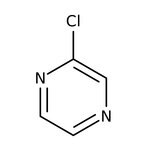
2-Cloropirazina, 98 %, Thermo Scientific Chemicals
CAS: 14508-49-7 | C4H3ClN2 | 114.53 g/mol
Have Questions?
Cambiar vista

Número de catálogo A10108.14
también denominado A10108-14
Precio (USD)
-
Cantidad:
25 g
Identificadores químicos
CAS14508-49-7
Especificaciones Hoja de especificaciones
Hoja de especificacionesFormLiquid
Appearance (Color)Clear colorless to yellow
Assay (GC)≥97.5%
Water Content (Karl Fischer Titration)≤3%
Refractive Index1.5320-1.5390 @ 20°C
2-Chloropyrazine is used in cardiotonic, in biological, drug, flavoring and perfumery industry.
This Thermo Scientific Chemicals brand product was originally part of the Alfa Aesar product portfolio. Some documentation and label information may refer to the legacy brand. The original Alfa Aesar product / item code or SKU reference has not changed as a part of the brand transition to Thermo Scientific Chemicals.
Aplicaciones
La 2-cloropirazina se utiliza en productos cardiotónicos, biología, farmacología, aromatizantes y perfumería.
Solubilidad
Soluble en metanol.
Notas
Almacenar en un lugar fresco y seco en recipientes bien sellados. Mantener el recipiente herméticamente cerrado.
La 2-cloropirazina se utiliza en productos cardiotónicos, biología, farmacología, aromatizantes y perfumería.
Solubilidad
Soluble en metanol.
Notas
Almacenar en un lugar fresco y seco en recipientes bien sellados. Mantener el recipiente herméticamente cerrado.
RUO – Research Use Only
General References:
- C Gosmini; JY Nédélec; J Périchon. Electrochemical cross-coupling between functionalized aryl halides and 2-chloropyrimidine or 2-chloropyrazine catalyzed by nickel 2, 2'-bipyridine complex. Tetrahedron Letters. 2000, 41, (2), 201-203.
- JM Bégouin, C Gosmini. Cobalt-catalyzed cross-coupling between in situ prepared arylzinc halides and 2-chloropyrimidine or 2-chloropyrazine. The Journal of organic chemistry. 2009, 74, (8), 3221-3224.
- The activated chlorine is readily displaced by nucleophiles. In an interesting synthesis of a fused pyridine, intramolecular cycloaddition is followed by elimination of HCN via a retro-Diels-Alder reaction: Tetrahedron, 44, 2977 (1988):
- Selectively metallated at the 3-position by LDA or Li tetramethylpiperidide. The lithio-derivative reacts with electrophiles in good yield: Synthesis, 881 (1988).