Search
 Elementsuche
 Struktursuche

Thermo Scientific Chemicals
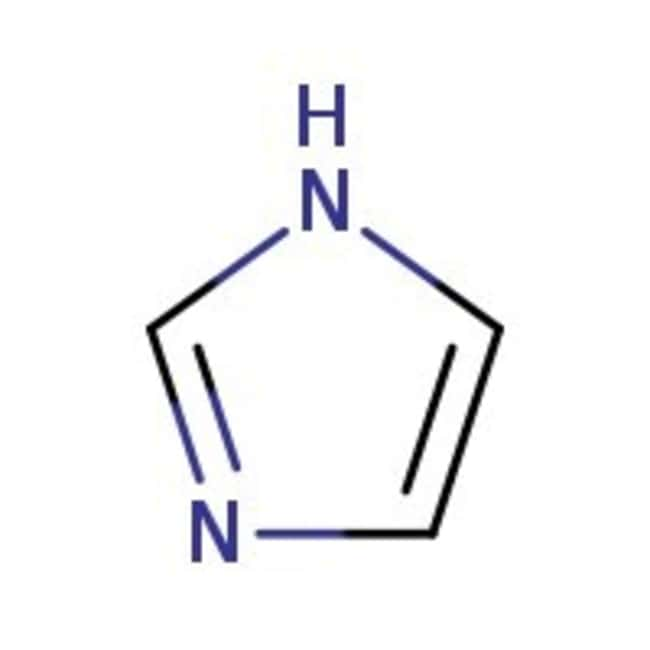
Imidazol, 99%, Thermo Scientific Chemicals
CAS: 288-32-4 | C3H4N2 | 68.08 g/mol
Have Questions?
Ansicht ändern





Katalognummer A10221.0E
Preis (EUR)
276,65
Exklusiv online
307,00Ersparnis 30,35 (10%)
Each
Menge:
2500 g
Preis (EUR)
276,65
Exklusiv online
307,00Ersparnis 30,35 (10%)
Each
Chemikalien-Kennzeichnungen
CAS288-32-4
IUPAC Name1H-imidazole
Molecular FormulaC3H4N2
InChI KeyRAXXELZNTBOGNW-UHFFFAOYSA-N
SMILESN1C=CN=C1
Mehr anzeigen
Specifications Datenblatt
DatenblattCommentPurchased in the U.K. and in other countries
Water Content (Karl Fischer Titration)≤0.5%
Assay from Suppliers CofA≥98.5 to ≤101.5% (Acidimetric) (non-U.K. specification)
Appearance (Color)White to pale cream to pale yellow
FormCrystals or flakes or powder or crystalline flakes or crystalline powder
Mehr anzeigen
Imidazole is used as a buffer in the range of pH 6.2-7.8. It is also an histamine antagonist. It acts as a chelator and forms complexes with various divalent cations. It is used as a corrosion inhibitor on certain transition metals such as copper. Its derivatives, like polybenzimidazole (PBI), act as fire retardants. It finds application in photography and electronics. Imidazole salts are used as ionic liquids and precursors to stable carbenes. Imidazole derivatives like ketoconazole, miconazole and clotrimazole are involved in the treatment of various systemic fungal infections. It is a part of the theophylline molecule, present in tea leaves and coffee beans, which stimulates the central nervous system.
This Thermo Scientific Chemicals brand product was originally part of the Alfa Aesar product portfolio. Some documentation and label information may refer to the legacy brand. The original Alfa Aesar product / item code or SKU reference has not changed as a part of the brand transition to Thermo Scientific Chemicals.
Anwendungen
Imidazol wird als Puffer im pH-Bereich von 6.2 bis 7.8 verwendet. Es ist auch ein Histamin-Antagonist. Es fungiert als Chelator und bildet Komplexe mit verschiedenen zweiwertigen Kationen. Es wird als Korrosionsschutzmittel auf bestimmten Übergangsmetallen wie Kupfer verwendet. Seine Derivate wie Polybenzimidazol (PBI) wirken als Flammschutzmittel. Es findet Anwendung in der Fotografie und Elektronik. Imidazol-Salze werden als ionische Flüssigkeiten und Vorstufen für stabile Carbone verwendet. Imidazol-Derivate wie Ketoconazol, Miconazol und Clotrimazol sind an der Behandlung verschiedener systemischer Pilzinfektionen beteiligt. Sie sind ein Teil des Theophyllin-Moleküls, das in Teeblättern und Kaffeebohnen vorkommt und das zentrale Nervensystem stimuliert.
Löslichkeit
Mischbar mit Wasser, Ethanol, Äther, Aceton, Chloroform, Pyridin und Methanol. Leicht mischbar mit Benzol und Petrolether.
Hinweise
Nicht kompatibel mit Säuren, Säureanhydriden und starken Oxidationsmitteln.
Imidazol wird als Puffer im pH-Bereich von 6.2 bis 7.8 verwendet. Es ist auch ein Histamin-Antagonist. Es fungiert als Chelator und bildet Komplexe mit verschiedenen zweiwertigen Kationen. Es wird als Korrosionsschutzmittel auf bestimmten Übergangsmetallen wie Kupfer verwendet. Seine Derivate wie Polybenzimidazol (PBI) wirken als Flammschutzmittel. Es findet Anwendung in der Fotografie und Elektronik. Imidazol-Salze werden als ionische Flüssigkeiten und Vorstufen für stabile Carbone verwendet. Imidazol-Derivate wie Ketoconazol, Miconazol und Clotrimazol sind an der Behandlung verschiedener systemischer Pilzinfektionen beteiligt. Sie sind ein Teil des Theophyllin-Moleküls, das in Teeblättern und Kaffeebohnen vorkommt und das zentrale Nervensystem stimuliert.
Löslichkeit
Mischbar mit Wasser, Ethanol, Äther, Aceton, Chloroform, Pyridin und Methanol. Leicht mischbar mit Benzol und Petrolether.
Hinweise
Nicht kompatibel mit Säuren, Säureanhydriden und starken Oxidationsmitteln.
RUO – Research Use Only
Allgemeine Referenzen:
- Nukleophilkatalysator für viele Acylierungs- und Silylierungsreaktionen, siehe hierzu 4-(Dimethyl amino) Pyridin, A13016.
- Zur Verwendung in: Silylierung von 1,3-Diketonen siehe Hexamethyl -Disilazan, A15139; Einführung der TBDMS- und TBDPS-Gruppen; siehe: Tert-Butyl -Dimethyl Chlorosilan, A13064 und tert-Butyl Diphenyl Chlorosilan, A12721.
- In Kombination mit Triphenylphosphin und Jod werden Bidiole in Alkene umgewandelt: Synthese, 469 (1979) und Alkohole zu Alkyliodiden: Synth. Commun., 20, 1473 (1990).
- Mit 2 Molen eines Aroylhalogenids ergibt sich nach der Hydrolyse eine gute Ausbeute an 2-Aroylimidazolen: Synthesis, 675 (1978).
- Sankar, M.; Ajithkumar, T. G.; Sankar, G.; Manikandan, P. Supported imidazole as heterogeneous catalyst for the synthesis of cyclic carbonates from epoxides and CO 2. Catal. Commun. 2015, 59, 201-205.
- Hart, K. R.; Sottos, N. R.; White, S. R. Repeatable self-healing of an epoxy matrix using imidazole initiated polymerization. Polymer 2015, 67, 174-184.