Search
 Búsqueda por elementos
 Búsqueda por estructura
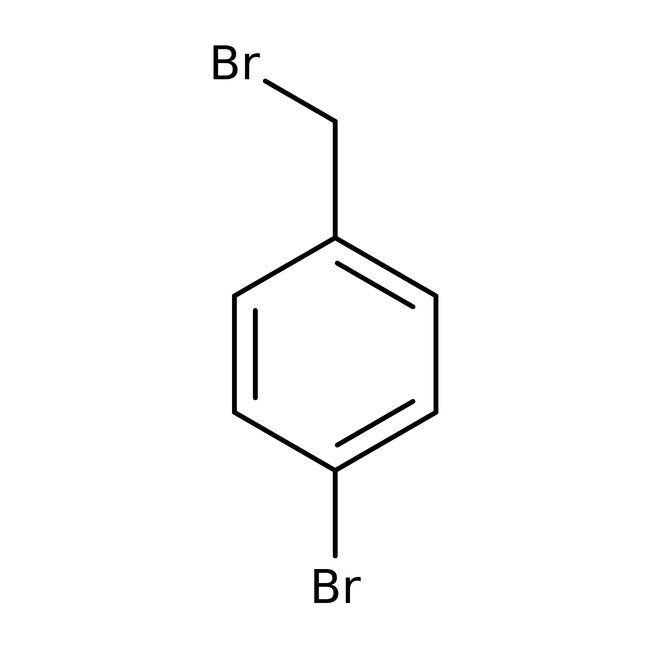

Thermo Scientific Chemicals
4-Bromuro bromobencílico, + 98 %, Thermo Scientific Chemicals
CAS: 589-15-1 | C7H6Br2 | 249.933 g/mol
Have Questions?
Cambiar vista

Número de catálogo A10892.14
también denominado A10892-14
Precio (USD)
-
Cantidad:
25 g
Identificadores químicos
CAS589-15-1
IUPAC Name1-bromo-4-(bromomethyl)benzene
Molecular FormulaC7H6Br2
InChI KeyYLRBJYMANQKEAW-UHFFFAOYSA-N
SMILESBrCC1=CC=C(Br)C=C1
Ver más
Especificaciones Hoja de especificaciones
Hoja de especificacionesAppearance (Color)White to pale cream
Assay from Supplier's CofA≥98.0% (GC)
FormPowder
Melting Point62.0-64.0°C
4-Bromobenzyl bromide is used to prepare a 20-member aminomethyl-substituted biaryl library via sequential N-alkylation of various amines.
This Thermo Scientific Chemicals brand product was originally part of the Alfa Aesar product portfolio. Some documentation and label information may refer to the legacy brand. The original Alfa Aesar product / item code or SKU reference has not changed as a part of the brand transition to Thermo Scientific Chemicals.
Aplicaciones
El bromuro de 4-bromobencilo se utiliza para preparar una biblioteca de biarilo de aminometilsustituido de 20 miembros mediante la N-alquilación secuencial de varias aminas.
Solubilidad
Fácilmente soluble en alcohol caliente, éter, disulfuro de carbono, benceno y ácido acético glacial. Soluble en agua y alcohol.
Notas
Mantener los recipientes bien cerrados en un lugar seco y bien ventilado. Almacenar en 4 °C. Incompatible con agentes oxidantes fuertes. Es sensible a la luz.
El bromuro de 4-bromobencilo se utiliza para preparar una biblioteca de biarilo de aminometilsustituido de 20 miembros mediante la N-alquilación secuencial de varias aminas.
Solubilidad
Fácilmente soluble en alcohol caliente, éter, disulfuro de carbono, benceno y ácido acético glacial. Soluble en agua y alcohol.
Notas
Mantener los recipientes bien cerrados en un lugar seco y bien ventilado. Almacenar en 4 °C. Incompatible con agentes oxidantes fuertes. Es sensible a la luz.
RUO – Research Use Only
- Gilles Brackmana.; Ulrik Hillaertb.; Serge Van Calenberghb.; Hans J. Nelisa.;Tom Coenyea. Use of quorum sensing inhibitors to interfere with biofilm formation and development in Burkholderia multivorans and Burkholderia cenocepacia. Research in Microbiology. 2009, 160, (2), 144-151.