Search
 Element Search
 Structure Search


Thermo Scientific Chemicals
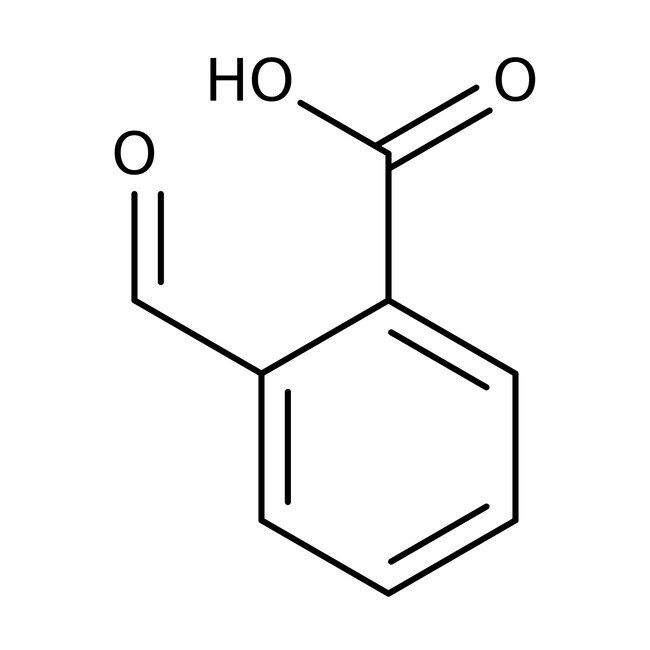
2-Carboxybenzaldehyde, 98+%
CAS: 119-67-5 | C8H6O3 | 150.133 g/mol
Have Questions?
Change view


Catalog number A11201.0B
also known as A11201-0B
Price (USD)
737.65
Online Exclusive
819.00Save 81.35 (10%)
Each
Quantity:
1000 g
Price (USD)
737.65
Online Exclusive
819.00Save 81.35 (10%)
Each
Chemical Identifiers
CAS119-67-5
IUPAC Name2-formylbenzoic acid
Molecular FormulaC8H6O3
InChI KeyDYNFCHNNOHNJFG-UHFFFAOYSA-N
SMILESOC(=O)C1=CC=CC=C1C=O
View more
Specifications Specification Sheet
Specification SheetAppearance (Color)White to cream
FormCrystals or powder or crystalline powder
Assay (HPLC)≥98.0%
CommentSpecification differs for U.S. and non-U.S. material where indicated
Identification (FTIR)Conforms (non-U.S. specification)
2-Carboxybenzaldehyde is a carboxylated derivative of benzaldehyde which is readily converted to 2-hydroxymethyl benzoic acid by CBA dehydrogenase. 2-Carboxybenzaldehyde is a metabolite of ampicillin phthalidyl ester. It has been used to synthesize a series of N-substituted isoindolinones by reductive C-N coupling and intramolecular amidation with amines.
This Thermo Scientific Chemicals brand product was originally part of the Alfa Aesar product portfolio. Some documentation and label information may refer to the legacy brand. The original Alfa Aesar product / item code or SKU reference has not changed as a part of the brand transition to Thermo Scientific Chemicals.
Applications
2-Carboxybenzaldehyde is a carboxylated derivative of benzaldehyde which is readily converted to 2-hydroxymethyl benzoic acid by CBA dehydrogenase. 2-Carboxybenzaldehyde is a metabolite of ampicillin phthalidyl ester. It has been used to synthesize a series of N-substituted isoindolinones by reductive C-N coupling and intramolecular amidation with amines.
Solubility
Soluble in water.
Notes
Air Sensitive. Store away from air and oxidizing agents. Incompatible with strong bases.
2-Carboxybenzaldehyde is a carboxylated derivative of benzaldehyde which is readily converted to 2-hydroxymethyl benzoic acid by CBA dehydrogenase. 2-Carboxybenzaldehyde is a metabolite of ampicillin phthalidyl ester. It has been used to synthesize a series of N-substituted isoindolinones by reductive C-N coupling and intramolecular amidation with amines.
Solubility
Soluble in water.
Notes
Air Sensitive. Store away from air and oxidizing agents. Incompatible with strong bases.
RUO – Research Use Only
General References:
- Ka young lee; Jeong mi kim; Jae nyoung kim. Facile synthesis of 3-alkylidene-3H-isobenzofuranones from the Baylis-Hillman reaction of 2-carboxybenzaldehyde. Synlett. 2003, 357-360.
- KA Krasnov; VG Kartsev; EE Santarovich. Reaction of Barbituric, 2-Thiobarbituric Acids and Their Derivatives with 2-Carboxybenzaldehyde and Opianic Acid: Synthesis and Tautomerism of 5-(3'-Oxo-1',3'-dihydroisobenzofuran-1'-yl)barbituric Acids and Their 2-Thio Analogs. Chemistry of Heterocyclic Compounds. 2002, 38, 702-709.
- The aldehyde is in equilibrium with the cyclic lactol, which reacts with both alkyl and aryl Grignard reagents to give substituted phthalides: Tetrahedron, 44, 2903 (1988):