Search
 Búsqueda por elementos
 Búsqueda por estructura


Thermo Scientific Chemicals
Óxido de boro, 99 %, Thermo Scientific Chemicals
CAS: 1303-86-2 | B2O3 | 69.62 g/mol
Have Questions?
Cambiar vista



Número de catálogo A11707.0E
también denominado A11707-0E
Precio (EUR)
225,00
Each
Cantidad:
2500 g
Precio (EUR)
225,00
Each
Identificadores químicos
CAS1303-86-2
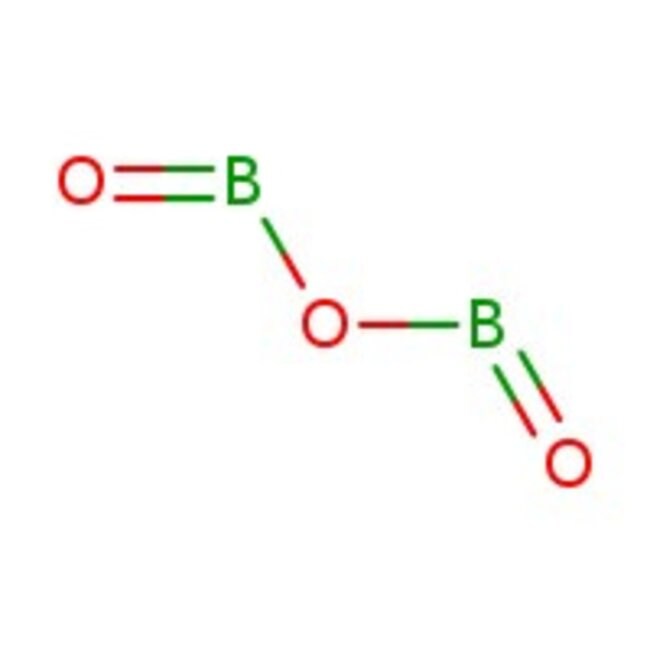
IUPAC Nameoxo[(oxoboranyl)oxy]borane
Molecular FormulaB2O3
InChI KeyJKWMSGQKBLHBQQ-UHFFFAOYSA-N
SMILESO=BOB=O
Ver más
Especificaciones Hoja de especificaciones
Hoja de especificacionesAppearance (Color)White
FormCrystals or powder or crystalline powder
Assay from Supplier's CofA≥97.5%
Boron oxide is used as a flux, an acid catalyst and a chemical intermediate in production of boron halides, esters, carbide, nitride and metallic borides. Boron oxide has shown a promising effect on glycerol hydrogenolysis to 1,2-propanediol. It is also an essential material for the preparation of cordierite ceramics from talc. It is actively involved in the production of borosilicate glass. It is an additive used in high-temperature lubricants.
This Thermo Scientific Chemicals brand product was originally part of the Alfa Aesar product portfolio. Some documentation and label information may refer to the legacy brand. The original Alfa Aesar product / item code or SKU reference has not changed as a part of the brand transition to Thermo Scientific Chemicals.
Aplicaciones
El óxido de boro se utiliza como flujo, catalizador ácido e intermediario químico en la producción de haluros de boro, ésteres, carburo, nitruro y boruros metálicos. El óxido de boro ha mostrado un efecto prometedor en la hidrogenólisis del glicerol al 1,2-propanediol. También es un material esencial para la preparación de material de cerámica de cordierita a partir del talco. Participa activamente en la producción de vidrio de borosilicato. Es un aditivo que se utiliza en lubricantes de alta temperatura.
Solubilidad
Soluble en agua. Ligeramente soluble en metanol.
Notas
Higroscópico y sensible a la humedad. Incompatible con ácidos y agentes oxidantes fuertes.
El óxido de boro se utiliza como flujo, catalizador ácido e intermediario químico en la producción de haluros de boro, ésteres, carburo, nitruro y boruros metálicos. El óxido de boro ha mostrado un efecto prometedor en la hidrogenólisis del glicerol al 1,2-propanediol. También es un material esencial para la preparación de material de cerámica de cordierita a partir del talco. Participa activamente en la producción de vidrio de borosilicato. Es un aditivo que se utiliza en lubricantes de alta temperatura.
Solubilidad
Soluble en agua. Ligeramente soluble en metanol.
Notas
Higroscópico y sensible a la humedad. Incompatible con ácidos y agentes oxidantes fuertes.
RUO – Research Use Only
General References:
- Kline, J.; Tangstad, M.; Tranell, G. A Raman Spectroscopic Study of the Structural Modifications Associated with the Addition of Calcium Oxide and Boron Oxide to Silica. Metall. Mater. Trans. B 2015, 46 (1), 62-73.
- Solozhenko, V. L.; Kurakevych, O. O.; Godec, Y. L.; Brazhkin, V. V. Thermodynamically Consistent p-T Phase Diagram of Boron Oxide B2O3 by in Situ Probing and Thermodynamic Analysis. J. Phys. Chem. C 2015, 119 (35), 20600-20605.