Search
 Búsqueda por elementos
 Búsqueda por estructura


Thermo Scientific Chemicals
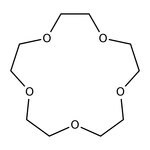
15-Corona-5, 98 %, Thermo Scientific Chemicals
CAS: 33100-27-5 | C10H20O5 | 220.265 g/mol
Have Questions?
Cambiar vista


Número de catálogo A12265.03
también denominado A12265-03
Precio (EUR)
24,00
Each
Cantidad:
1 g
Precio (EUR)
24,00
Each
Identificadores químicos
CAS33100-27-5
IUPAC Name1,4,7,10,13-pentaoxacyclopentadecane
Molecular FormulaC10H20O5
InChI KeyVFTFKUDGYRBSAL-UHFFFAOYSA-N
SMILESC1COCCOCCOCCOCCO1
Ver más
Especificaciones Hoja de especificaciones
Hoja de especificacionesAssay (GC)≥97.5%
Appearance (Color)Clear colorless to pale yellow
Water Content (Karl Fischer Titration)≤1%
Identification (FTIR)Conforms
Refractive Index1.4640-1.4680 @ 20?C
Ver más
15-Crown-5 is used as an efficient phase transfer catalyst and as a complexing agent. It is used to isolate oxonium ion (H7O3)+ salts especially from a solution of tetrchloroauric acid. It catalyzes the O-alkylation of the sodium salts of carboxylic acids in the penicillin and cephalosporin series, thereby facilitating esterification reaction without usage of acid. It is also used to facilitate the Williamson synthesis of ethers with hindered alcohols and sodium hydride. It is used with lithium aluminum hydride, for performing reduction reactions in hydrocarbon solvents. Further, it is involved in the Horner-Wadsworth-Emmons reaction to prepare stilbenes from aldehydes.
This Thermo Scientific Chemicals brand product was originally part of the Alfa Aesar product portfolio. Some documentation and label information may refer to the legacy brand. The original Alfa Aesar product / item code or SKU reference has not changed as a part of the brand transition to Thermo Scientific Chemicals.
Aplicaciones
El 15-crown-5 se utiliza como catalizador de transferencia de fase eficiente y como agente complejante. Se utiliza para aislar el ion oxonio (H7o3)+ sales especialmente de una solución de ácido tetracloroáurico. Cataliza la O-alquilación de las sales de sodio de los ácidos carboxílicos en la serie de penicilina y cefalosporina, facilitando así la reacción de esterificación sin el uso de ácido. También se utiliza para facilitar la síntesis de Williamson de éteres con alcoholes obstaculizados e hidruro de sodio. Se utiliza con hidruro de aluminio de litio, para realizar reacciones de reducción en disolventes de hidrocarburos. Además, está involucrado en la reacción Horner-Wadsworth-Emmons para preparar los estilbenos de aldehídos.
Solubilidad
Miscible con disolventes orgánicos.
Notas
Higroscópicas. Sensible a la humedad. Incompatible con agentes oxidantes fuertes y ácidos fuertes.
El 15-crown-5 se utiliza como catalizador de transferencia de fase eficiente y como agente complejante. Se utiliza para aislar el ion oxonio (H7o3)+ sales especialmente de una solución de ácido tetracloroáurico. Cataliza la O-alquilación de las sales de sodio de los ácidos carboxílicos en la serie de penicilina y cefalosporina, facilitando así la reacción de esterificación sin el uso de ácido. También se utiliza para facilitar la síntesis de Williamson de éteres con alcoholes obstaculizados e hidruro de sodio. Se utiliza con hidruro de aluminio de litio, para realizar reacciones de reducción en disolventes de hidrocarburos. Además, está involucrado en la reacción Horner-Wadsworth-Emmons para preparar los estilbenos de aldehídos.
Solubilidad
Miscible con disolventes orgánicos.
Notas
Higroscópicas. Sensible a la humedad. Incompatible con agentes oxidantes fuertes y ácidos fuertes.
RUO – Research Use Only
General References:
- Crown ether (see Appendix 2) especially suited to complexing sodium ions. Thus, catalyzes the O-alkylation of the Na salts of carboxylic acids in the penicillin and cephalosporin series, providing a method for esterification without exposure to acid: Synthesis, 52, (1986).
- Greatly facilitates the Williamson synthesis of ethers with hindered alcohols and NaH: Tetrahedron Lett., 38, 4679 (1997). Promotes the cleavage of unsymmetrical ethers by Sodium iodide, A15480, in the opposite sense to BBr3, i.e. by nucleophilic displacement from the less substituted carbon atom: Tetrahedron Lett., 22, 4239 (1981).
- Greatly increases the reactivity of phosphonate anions generated by reaction with NaH in the Horner-Wadsworth-Emmons reaction. Thus, has been used in a high-yield synthesis of stilbenes from aldehydes and Diethyl benzyl phosphonate, A10645: Synthesis, 117 (1981).
- Use in combination with Lithium aluminum hydride, A18116, enables reductions to be carried out in hydrocarbon solvents: J. Chem. Soc., Chem. Commun., 1234 (1985).
- Kuo, T. Y.; Tseng, W. H.; Chen, C. H. Force Spectroscopy of Metal-Crown Ether Multivalency: Effect of Local Environments on Energy Landscape and Sensing Kinetics. Angew. Chem. Int. Ed. 2015, 54 (32), 9213-9217.
- Inokuchi, Y.; Ebata, T.; Rizzo, T. R. Solvent Effects on the Encapsulation of Divalent Ions by Benzo-18-Crown-6 and Benzo-15-Crown-5. J. Phys. Chem. A 2015, 119 (29), 8097-8105.