Search
 Búsqueda por elementos
 Búsqueda por estructura


Thermo Scientific Chemicals
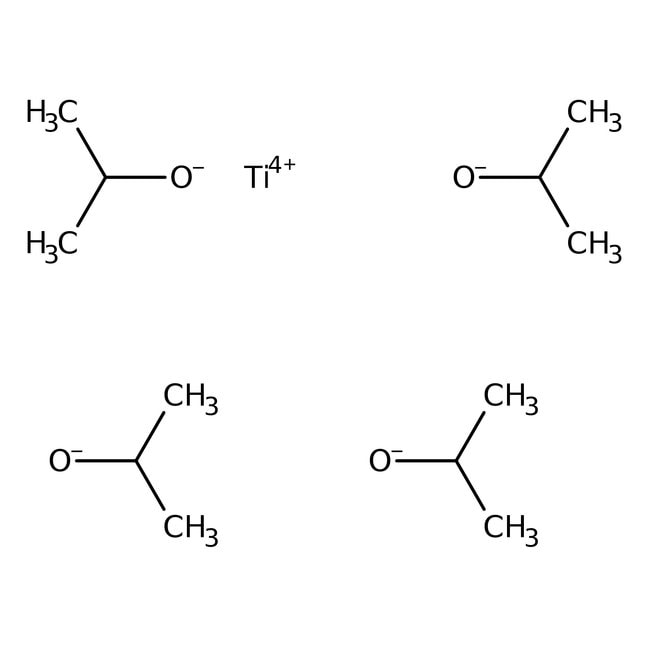
Isopropóxido de titanio (IV), 95 %, Thermo Scientific Chemicals
CAS: 546-68-9 | C12H28O4Ti | 284.219 g/mol
Have Questions?
Cambiar vista



Número de catálogo A13703.0E
también denominado A13703-0E
Precio (EUR)
320,00
Each
Cantidad:
2500 g
Precio (EUR)
320,00
Each
Identificadores químicos
CAS546-68-9
IUPAC Nametitanium(4+) tetrakis(propan-2-olate)
Molecular FormulaC12H28O4Ti
InChI KeyVXUYXOFXAQZZMF-UHFFFAOYSA-N
SMILES[Ti+4].CC(C)[O-].CC(C)[O-].CC(C)[O-].CC(C)[O-]
Ver más
Especificaciones Hoja de especificaciones
Hoja de especificacionesAssay (unspecified)≥94.0% (based on titanium EA)
Appearance (Color)Clear colorless to pale yellow
Elemental AnalysisTitanium Ti: 15.85-17.84% (Theory 16.85%)
FormLiquid
Titanium(IV) isopropoxide is used as a precursor for the preparation of titanium and barium-strontium-titanate thin films. It is useful to make porous titanosilicates and potential ion-exchange materials for cleanup of radioactive wastes. It is an active component of sharpless epoxidation as well as involved in the synthesis of chiral epoxides. In Kulinkovich reaction, it is involved as a catalyst in the preparation of cyclopropanes.
This Thermo Scientific Chemicals brand product was originally part of the Alfa Aesar product portfolio. Some documentation and label information may refer to the legacy brand. The original Alfa Aesar product / item code or SKU reference has not changed as a part of the brand transition to Thermo Scientific Chemicals.
Aplicaciones
El isopropóxido de titanio (IV) se utiliza como precursor en la preparación de películas delgadas de titanio y bario-estroncio-titanato. Sirve para crear titanosilicatos porosos y potenciales materiales de intercambio iónico para la limpieza de desechos radiactivos. Es un componente activo de la epoxidación sin ácido y participa en la síntesis de epóxidos quirales. En la reacción de Kulinkovich, participa como catalizador en la preparación de ciclopropanos.
Solubilidad
Soluble en etanol anhidro, éter, benceno y cloroformo.
Nota
Sensible a la humedad. Almacénese en lugar fresco. Mantenga el recipiente bien cerrado en un lugar seco y bien ventilado. Incompatible con agentes oxidantes fuertes y ácidos fuertes. Reacciona con el agua y produce dióxido de titanio.
El isopropóxido de titanio (IV) se utiliza como precursor en la preparación de películas delgadas de titanio y bario-estroncio-titanato. Sirve para crear titanosilicatos porosos y potenciales materiales de intercambio iónico para la limpieza de desechos radiactivos. Es un componente activo de la epoxidación sin ácido y participa en la síntesis de epóxidos quirales. En la reacción de Kulinkovich, participa como catalizador en la preparación de ciclopropanos.
Solubilidad
Soluble en etanol anhidro, éter, benceno y cloroformo.
Nota
Sensible a la humedad. Almacénese en lugar fresco. Mantenga el recipiente bien cerrado en un lugar seco y bien ventilado. Incompatible con agentes oxidantes fuertes y ácidos fuertes. Reacciona con el agua y produce dióxido de titanio.
RUO – Research Use Only
General References:
- Catalyst for transesterification, avoiding acidic or basic conditions. The reaction is carried out such that one alcohol is removed to displace the equilibrium: Synthesis, 138 (1982); Org. Synth. Coll., 8, 201 (1993). For application to carbamates, including Boc to Cbz conversion, see: J. Org. Chem., 62, 7096 (1997).
- For use in the Sharpless enantioselective epoxidation of allylic alcohols, see tert-Butyl hydroperoxide, A13926. For analogous enantioselective oxidation of sulfides to sulfoxides, see Cumene hydroperoxide, L06866. Epoxy alcohols can also be obtained in high yield in one pot by hydroperoxidation of alkenes with singlet oxygen in the presence of Ti(O-i-Pr)4: J. Am. Chem. Soc., 111, 203 (1989).
- Also catalyzes the ring-opening of 2,3-epoxy alcohols (e.g. from the above reactions) with various nucleophiles, including amines, thiols, thiolate anions, halides, carboxylates etc. The mild conditions result in increased regioselectivity: J. Org. Chem., 50, 1557 (1985).
- See also Dimethyl amine hydrochloride, A12133.
- For conversion of epoxides to episulfides, see Thiourea, A12828. For use in reductive alkylation of amines, see Sodium cyanoborohydride, 87839. For use in enantioselective synthesis of homoallylic alcohols, see (R)-(+)-1,1'-Bi(2-naphthol) , L08305. For reduction of amides to aldehydes, see Diphenyl silane, A10884.
- For a brief feature on uses of the reagent, see: Synlett, 2261 (2003).