Search

Thermo Scientific™
Jump-In™ GripTite™ HEK 293 Kit
The Jump-In™ GripTite™ HEK293 Kit allows the targeted integration of genetic material into a specific pre-engineered R4 site in theRead more
| Catalog Number | Quantity |
|---|---|
| A14150 | 1 Kit |
Catalog number A14150
Price (USD)
12,870.00
Each
Quantity:
1 Kit
Price (USD)
12,870.00
Each
The Jump-In™ GripTite™ HEK293 Kit allows the targeted integration of genetic material into a specific pre-engineered R4 site in the Jump-In™ GripTite™ HEK293 cell line, to create an isogenic stable cell line with less effort and in less time than traditional cell engineering methods.
The high retargeting efficiency, made possible by the R4 sites in the GripTite™ HEK293 cell line, allows the use of the isogenic pool for additional experiments without the need for clonal selection. Alternatively, the high retargeting efficiency allows for the easy selection of a positive stable clone expressing your gene of interest.
The Jump-In™ GripTite™ HEK293 Kit Lets You:
• Quickly and efficiently develop stably engineered isogenic cell pools in about half the time compared to traditional cell engineering methods
• Utilize isogenic expression from a defined genomic locus as the ideal solution for comparative analysis of gene families, isoforms, or orthologs
• Generate multiple cell lines in parallel using the simplified work flow
• Easily access the technology without complicated licenses or restrictions to interpret
Save Time with Rapid and Efficient Generation of Engineered Cell Lines
With the Jump-In™ GripTite™ HEK293 Kit you can generate functional cell pools in as little as 2 weeks without laborious clone isolation and analysis, and the streamlined protocol makes it easier to generate several cell lines at the same time. Even generation of clonal cell lines can be done with reduced time and effort due to the high percentage of positive clones. In addition, the Jump-In™ technology gives you the freedom to generate an unlimited number of cell lines without restrictive licensing requirements.
Expand Your Experimental Capabilities
The Jump-In™GripTite™ HEK293 Kit is the ideal solution for cells and assays where transient engineering technologies are problematic, as well as for difficult to 'engineer' cell lines. The kit also provides a convenient way to create target panels of gene families, isoforms, or orthologs. Genes coding for large proteins or multi-unit proteins are not a problem since the Gateway™ destination vectors accept large inserts.
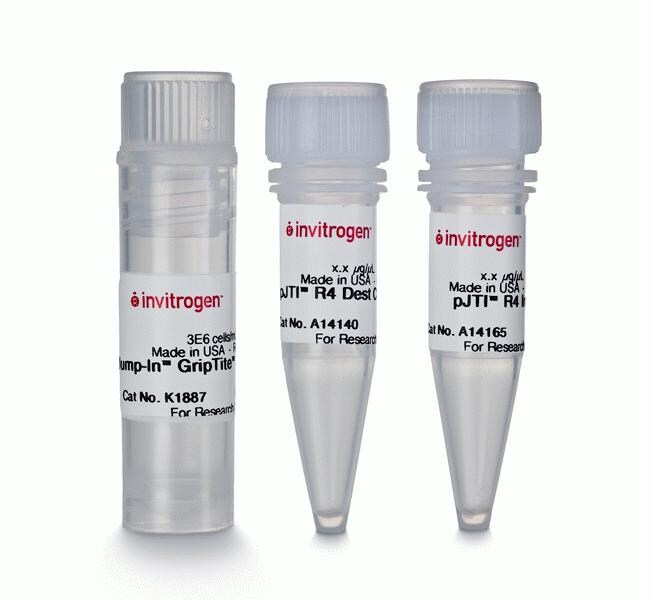
The kit includes:
• pJTI™ R4 Dest CMV pA vector (100 μg)
• pJTI™ R4 Int vector (100 μg)
• Jump-In™GripTite™ HEK293 Cells (2 vials @ 1 ml each)
For Research Use Only. Not intended for any animal or human therapeutic or diagnostic use.
The high retargeting efficiency, made possible by the R4 sites in the GripTite™ HEK293 cell line, allows the use of the isogenic pool for additional experiments without the need for clonal selection. Alternatively, the high retargeting efficiency allows for the easy selection of a positive stable clone expressing your gene of interest.
The Jump-In™ GripTite™ HEK293 Kit Lets You:
• Quickly and efficiently develop stably engineered isogenic cell pools in about half the time compared to traditional cell engineering methods
• Utilize isogenic expression from a defined genomic locus as the ideal solution for comparative analysis of gene families, isoforms, or orthologs
• Generate multiple cell lines in parallel using the simplified work flow
• Easily access the technology without complicated licenses or restrictions to interpret
Save Time with Rapid and Efficient Generation of Engineered Cell Lines
With the Jump-In™ GripTite™ HEK293 Kit you can generate functional cell pools in as little as 2 weeks without laborious clone isolation and analysis, and the streamlined protocol makes it easier to generate several cell lines at the same time. Even generation of clonal cell lines can be done with reduced time and effort due to the high percentage of positive clones. In addition, the Jump-In™ technology gives you the freedom to generate an unlimited number of cell lines without restrictive licensing requirements.
Expand Your Experimental Capabilities
The Jump-In™GripTite™ HEK293 Kit is the ideal solution for cells and assays where transient engineering technologies are problematic, as well as for difficult to 'engineer' cell lines. The kit also provides a convenient way to create target panels of gene families, isoforms, or orthologs. Genes coding for large proteins or multi-unit proteins are not a problem since the Gateway™ destination vectors accept large inserts.
The kit includes:
• pJTI™ R4 Dest CMV pA vector (100 μg)
• pJTI™ R4 Int vector (100 μg)
• Jump-In™GripTite™ HEK293 Cells (2 vials @ 1 ml each)
For Research Use Only. Not intended for any animal or human therapeutic or diagnostic use.
For Research Use Only. Not for use in diagnostic procedures.
Specifications
Cell LineJump-In™ GripTite™ Hek293
Delivery TypeTransfection
Expression SystemMammalian
For Use With (Application)Protein expression, Assay development
Key FunctionsStable Cell Line Development, Targeted Integration
Product LineJump-In
Product TypeHEK293 Kit
Quantity1 Kit
Selection Agent (Eukaryotic)Geneticin™ (G-418), Hygromycin
System TypeJump-In™
FormatKit
PromoterCMV
Unit SizeEach
Contents & Storage
The kit includes:
Jump-In™ GripTite™ HEK293 cells
pJTI™ R4 Int (integrase vector)
pJTI™ R4 DEST CMV pA (destination vector)
Upon receipt, immediately store the cells in liquid nitrogen and the vectors at -20°C. Cells stored at -80°C can quickly lose viability.
Jump-In™ GripTite™ HEK293 cells
pJTI™ R4 Int (integrase vector)
pJTI™ R4 DEST CMV pA (destination vector)
Upon receipt, immediately store the cells in liquid nitrogen and the vectors at -20°C. Cells stored at -80°C can quickly lose viability.