Search
 Búsqueda por elementos
 Búsqueda por estructura



Thermo Scientific Chemicals
Yoduro de sodio, +99 % (peso seco, agua < 1,0 %), Thermo Scientific Chemicals
CAS: 7681-82-5 ∣ INa ∣ 149.894 g/mol
Have Questions?
Cambiar vista





Número de catálogo A15480.36
también denominado A15480-36
Precio (EUR)
179,00
Each
Cantidad:
500 g
Precio (EUR)
179,00
Each
Identificadores químicos
CAS7681-82-5
IUPAC Namesodium iodide
Molecular FormulaINa
InChI KeyFVAUCKIRQBBSSJ-UHFFFAOYSA-M
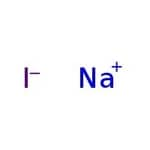
SMILES[Na+].[I-]
Ver más
Especificaciones Hoja de especificaciones
FormCrystals or powder or crystalline powder or fused solid
Assay (Titration ex Iodide)≥99.0 to ≤101.0% (dry wt. basis)
Appearance (Color)White
Loss on Drying≤1.5% (200°C/constant weight)
Sodium iodide is widely used for halide exchange (Finkelstein reaction), for example in the conversion of an alkyl chloride, allyl chloride and arylmethyl chloride into their respective iodides, which are precursors for pharmaceutical and fine chemical products. They are used to ehnance the efficiency of the formation of Wittig adducts from less reactive chlorides and bromides. Appropriate prepartions find use as a nutrient supplement. Sodium iodide is used as the precursor to the control agent in ab initio emulsion polymerization. Sodium iodide finds use in the determination of dissolved oxygen in the modified Winkler method, synthesis of the fluorescent dye coppersensor-1 (CS1) for imaging labile copper pools in biological samples, and the cleavage of esters, lactones, carbamates and ethers in combination with chlorotrimethylsilane.
This Thermo Scientific Chemicals brand product was originally part of the Alfa Aesar product portfolio. Some documentation and label information may refer to the legacy brand. The original Alfa Aesar product / item code or SKU reference has not changed as a part of the brand transition to Thermo Scientific Chemicals.
Aplicaciones
El yoduro de sodio se utiliza muy a menudo para el intercambio de haluro (reacción de Finkelstein), por ejemplo en la conversión de un cloruro de alquilo, cloruro de alilo y cloruro de arilo en sus respectivos yoduros, que son precursores de productos químicos finos y farmacéuticos. Se utilizan para mejorar la eficiencia de la formación de aductos de Wittig a partir de cloruros y bromuros menos reactivos. Sus preparaciones apropiadas se usan como suplemento nutritivo. El yoduro de sodio se utiliza como precursor del agente de control en la polimerización por emulsión ab initio. El yoduro de sodio se utiliza en la determinación del oxígeno disuelto en el método de Winkler modificado, la síntesis del coppersensor-1 (CS1) de tinte fluorescente para la adquisición de imágenes de agrupaciones de cobre lábil en muestras biológicas y la división de ésteres, lactonas, carbamatos y éteres en combinación con el clorotrimetilsilano.
Solubilidad
Muy soluble en agua y amoníaco líquido. Libremente soluble en acetona, ácido fórmico, formamida, metanol y acetonitrilo. Soluble en N,N-dimetilformamida.
Notas
Delicuescente. Almacenar en un recipiente herméticamente cerrado. Incompatible con ácidos y agentes oxidantes fuertes.
RUO – Research Use Only
General References:
- Converts alkyl chlorides or bromides to iodides (Finkelstein reaction). Preferred solvents are acetone or MEK, in which NaI, but not the chloride or bromide, is soluble. See, e.g.: Org. Synth. Coll., 2, 476 (1955); 4, 84 (1963). Activated aryl halides, such as 1-chloro-2,4-dinitrobenzene can be converted to iodides by reaction with NaI in DMF: Org. Synth. Coll., 5, 478 (1973).
- Frequently used in catalytic amounts to increase the rate of nucleophilic displacement reactions of alkyl halides and sulfonates; see, for example: Org. Synth. Coll., 9, 46 (1998).
- Ethers can be cleaved to ω-iodo esters with a combination of NaI and an acyl chloride: Tetrahedron Lett., 23, 681 (1982). Cleavage of ethers also occurs in the presence of TMS chloride: Angew. Chem. Int. Ed., 20, 690 (1981); J. Org. Chem., 44, 1247 (1979); 48, 3667 (1983). The same combination also reduces benzylic alcohols to arylmethanes: Tetrahedron Lett., 28, 3817 (1987); Bull. Chem. Soc. Jpn., 62, 3537 (1989) and deprotects MEM ethers: Tetrahedron Lett., 25, 1429 (1984); see 2-Methoxyethoxymethyl chloride, L01050.
- In combination with Titanium(IV) chloride, 14713, reduction of amine oxides and nitrones occurs: Chem. Ber., 123, 647 (1990). Similarly, sulfoxides are reduced to sulfides: Synthesis, 155 (1991), and mild reductive deoximation can be effected: Synth. Commun., 21,1777 (1991).
- Penheiter, A. R.; Russell, S. J.; Carlson, S. K. The Sodium Iodide Symporter (NIS) as an Imaging Reporter for Gene, Viral, and Cell-based Therapies. Curr. Gene Ther. 2012, 12, (1), 33-47.
- Tonnar, J.; Lacroix-Desmazes, P. Use of Sodium Iodide as the Precursor to the Control Agent in Ab Initio Emulsion Polymerization. Angew. Chem. Int. Ed. 2008, 47, 1294-1297.