Search
 Búsqueda por elementos
 Búsqueda por estructura


Thermo Scientific Chemicals
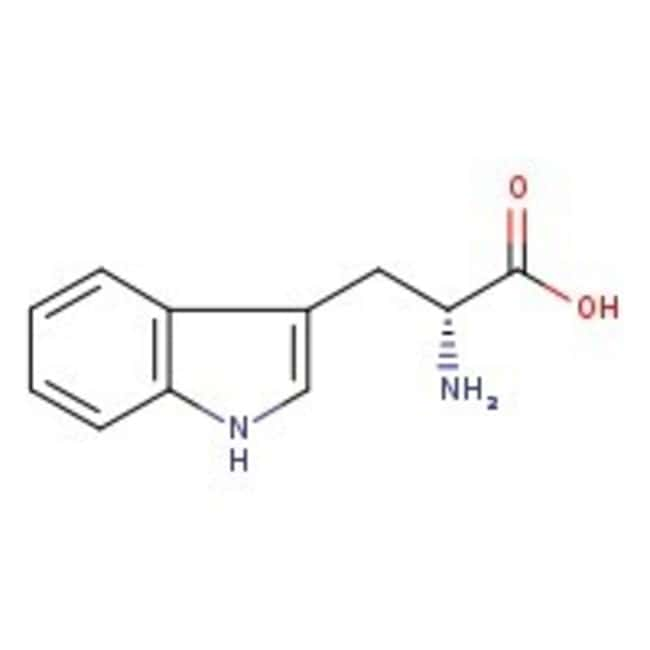
D-triptófano, 99 %
CAS: 153-94-6 | C11H12N2O2 | 204.23 g/mol
Have Questions?
Cambiar vista

Número de catálogo A18426.22
también denominado A18426-22
Precio (USD)
-
Cantidad:
100 g
Identificadores químicos
CAS153-94-6
IUPAC Name(2R)-2-amino-3-(1H-indol-3-yl)propanoic acid
Molecular FormulaC11H12N2O2
InChI KeyQIVBCDIJIAJPQS-SECBINFHSA-N
SMILESN[C@H](CC1=CNC2=CC=CC=C12)C(O)=O
Ver más
Especificaciones Hoja de especificaciones
Hoja de especificacionesAssay (Non-aqueous acid-base Titration)≥98.5 to ≤101.5%
Optical Rotation31.0 ± 1.5? (C=1 in water)
Appearance (Color)White to cream
FormPowder
Identification (FTIR)Conforms
D-Tryptophan is used for human embryonic kidney cell (HEK-293, ATCC: CRL-1573) culture. The product is a sweetener used to study the release of incretins from enteroendocrine cells triggered by sugar but not by sweeteners.
This Thermo Scientific Chemicals brand product was originally part of the Alfa Aesar product portfolio. Some documentation and label information may refer to the legacy brand. The original Alfa Aesar product / item code or SKU reference has not changed as a part of the brand transition to Thermo Scientific Chemicals.
Aplicaciones
El D-triptófano se utiliza para el cultivo de células embrionarias de riñón humano (HEK-293, ATCC: CRL-1573). El producto es un edulcorante que se utiliza para estudiar la liberación de los increíbles de las células enteroendocrinas provocada por el azúcar pero no por los edulcorantes.
Solubilidad
Soluble en ácido clorhídrico 0,5 M (50 mg/ml), agua (11 mg/ml a 20 °C), alcohol caliente y dimetilsulfóxido. Insoluble en cloroformo.
Notas
Mantener el recipiente herméticamente cerrado. Almacenar en un lugar fresco y seco, en recipientes bien sellados. Incompatible con agentes oxidantes.
El D-triptófano se utiliza para el cultivo de células embrionarias de riñón humano (HEK-293, ATCC: CRL-1573). El producto es un edulcorante que se utiliza para estudiar la liberación de los increíbles de las células enteroendocrinas provocada por el azúcar pero no por los edulcorantes.
Solubilidad
Soluble en ácido clorhídrico 0,5 M (50 mg/ml), agua (11 mg/ml a 20 °C), alcohol caliente y dimetilsulfóxido. Insoluble en cloroformo.
Notas
Mantener el recipiente herméticamente cerrado. Almacenar en un lugar fresco y seco, en recipientes bien sellados. Incompatible con agentes oxidantes.
RUO – Research Use Only
General References:
- Yukihiro Fujita.; Rhonda D Wideman.; Madeleine Speck.; Ali Asadi.; David S King.; Travis D Webber.; Masakazu Haneda.; Timothy J Kieffer. Incretin release from gut is acutely enhanced by sugar but not by sweeteners in vivo. American Journal of Physiology - Endocrinology and Metabolism. 2009, 296 (3), 473-479.
- Daniela Vullo.; Alessio Innocenti.; Isao Nishimori.; Andrea Scozzafava.; Kai Kaila.; Claudiu T Supuran. Carbonic anhydrase activators: activation of the human isoforms VII (cytosolic) and XIV (transmembrane) with amino acids and amines. Bioorganic & Medicinal Chemistry Letters. 2007, 17 (15), 4107-4112.