Search


Citations & References (6)
Invitrogen™
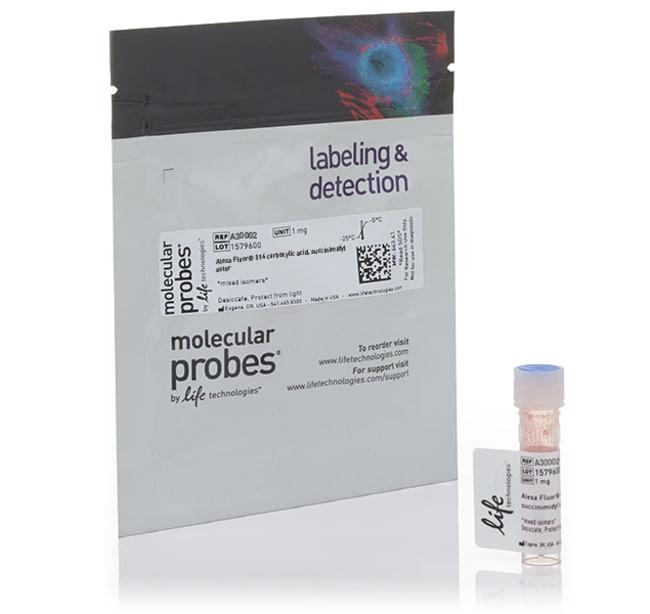
Alexa Fluor™ 514 NHS Ester (Succinimidyl Ester)
Alexa Fluor™ 514 is a bright, green-fluorescent dye. Used for stable signal generation in imaging and flow cytometry, Alexa Fluor™Read more
| Catalog Number | Quantity |
|---|---|
| A30002 also known as A-30002 | 1 mg |
Catalog number A30002
also known as A-30002
Price (USD)
506.00
Each
Quantity:
1 mg
Price (USD)
506.00
Each
Alexa Fluor™ 514 is a bright, green-fluorescent dye. Used for stable signal generation in imaging and flow cytometry, Alexa Fluor™ 514 dye is water soluble and pH-insensitive from pH 4 to pH 10. In addition to reactive dye formulations, we offer Alexa Fluor™ 514 dye conjugated to a variety of antibodies, peptides, proteins, tracers, and amplification substrates optimized for cellular labeling and detection.
The NHS ester (or succinimidyl ester) of Alexa Fluor™ 514 is the most popular tool for conjugating this dye to a protein or antibody. NHS esters can be used to label to the primary amines (R-NH2) of proteins, amine-modified oligonucleotides, and other amine-containing molecules. The resulting Alexa Fluor™ conjugate will exhibit brighter fluorescence and greater photostability than the conjugates of other spectrally similar fluorophores.
Detailed information about this AlexaFluor™ NHS ester:
Fluorophore label: Alexa Fluor™ 514 dye
Reactive group: NHS ester
Reactivity: Primary amines on proteins and ligands, amine-modified oligonucleotides
Ex/Em of the conjugate: 517/542 nm
Extinction coefficient: 80,000 cm-1M-2
Typical Conjugation Reaction
You can conjugate amine-reactive reagents with virtually any protein or peptide (the provided protocol is optimized for IgG antibodies). You can scale the reaction for any amount of protein, but the concentration of the protein should be at least 2 mg/mL for optimal results. We recommend trying three different degrees of labeling, using three different molar ratios of the reactive reagent to protein.
The Alexa Fluor™ NHS ester is typically dissolved in high-quality anhydrous dimethylformamide (DMF) or dimethylsulfoxide (DMSO) (D12345), and the reaction is carried out in 0.1–0.2 M sodium bicarbonate buffer, pH 8.3, at room temperature for 1 hour. Because the pKa of the terminal amine is lower than that of the lysine epsilon-amino group, you may achieve more selective labeling of the amine terminus using a buffer closer to neutral pH.
Conjugate Purification
Labeled antibodies are typically separated from free Alexa Fluor™ dye using a gel filtration column, such as Sephadex™ G-25, BioGel™ P-30, or equivalent. For much larger or smaller proteins, select a gel filtration media with an appropriate molecular weight cut-off or purify by dialysis. We offer several purification kits optimized for different quantities of antibody conjugate:
Antibody Conjugate Purification Kit for 0.5-1 mg (A33086)
Antibody Conjugate Purification Kit for 20-50 μg (A33087)
Antibody Conjugate Purification kit for 50-100 μg (A33088)
Learn More About Protein and Antibody Labeling
We offer a wide selection of Molecular Probes™ antibody and protein labeling kits to fit your starting material and your experimental setup. See our Antibody Labeling kits or use our Labeling Chemistry Selection Tool for other choices. To learn more about our labeling kits, read Kits for Labeling Proteins and Nucleic Acids—Section 1.2 in The Molecular Probes™ Handbook.
We’ll Make a Custom Conjugate for You
If you can’t find what you’re looking for in our online catalog, we’ll prepare a custom antibody or protein conjugate for you. Our custom conjugation service is efficient and confidential, and we stand by the quality of our work. We are ISO 13485:2000 certified.
The NHS ester (or succinimidyl ester) of Alexa Fluor™ 514 is the most popular tool for conjugating this dye to a protein or antibody. NHS esters can be used to label to the primary amines (R-NH2) of proteins, amine-modified oligonucleotides, and other amine-containing molecules. The resulting Alexa Fluor™ conjugate will exhibit brighter fluorescence and greater photostability than the conjugates of other spectrally similar fluorophores.
Detailed information about this AlexaFluor™ NHS ester:
Fluorophore label: Alexa Fluor™ 514 dye
Reactive group: NHS ester
Reactivity: Primary amines on proteins and ligands, amine-modified oligonucleotides
Ex/Em of the conjugate: 517/542 nm
Extinction coefficient: 80,000 cm-1M-2
Typical Conjugation Reaction
You can conjugate amine-reactive reagents with virtually any protein or peptide (the provided protocol is optimized for IgG antibodies). You can scale the reaction for any amount of protein, but the concentration of the protein should be at least 2 mg/mL for optimal results. We recommend trying three different degrees of labeling, using three different molar ratios of the reactive reagent to protein.
The Alexa Fluor™ NHS ester is typically dissolved in high-quality anhydrous dimethylformamide (DMF) or dimethylsulfoxide (DMSO) (D12345), and the reaction is carried out in 0.1–0.2 M sodium bicarbonate buffer, pH 8.3, at room temperature for 1 hour. Because the pKa of the terminal amine is lower than that of the lysine epsilon-amino group, you may achieve more selective labeling of the amine terminus using a buffer closer to neutral pH.
Conjugate Purification
Labeled antibodies are typically separated from free Alexa Fluor™ dye using a gel filtration column, such as Sephadex™ G-25, BioGel™ P-30, or equivalent. For much larger or smaller proteins, select a gel filtration media with an appropriate molecular weight cut-off or purify by dialysis. We offer several purification kits optimized for different quantities of antibody conjugate:
Antibody Conjugate Purification Kit for 0.5-1 mg (A33086)
Antibody Conjugate Purification Kit for 20-50 μg (A33087)
Antibody Conjugate Purification kit for 50-100 μg (A33088)
Learn More About Protein and Antibody Labeling
We offer a wide selection of Molecular Probes™ antibody and protein labeling kits to fit your starting material and your experimental setup. See our Antibody Labeling kits or use our Labeling Chemistry Selection Tool for other choices. To learn more about our labeling kits, read Kits for Labeling Proteins and Nucleic Acids—Section 1.2 in The Molecular Probes™ Handbook.
We’ll Make a Custom Conjugate for You
If you can’t find what you’re looking for in our online catalog, we’ll prepare a custom antibody or protein conjugate for you. Our custom conjugation service is efficient and confidential, and we stand by the quality of our work. We are ISO 13485:2000 certified.
For Research Use Only. Not for use in diagnostic procedures.
Specifications
Chemical ReactivityAmine
Emission542 nm
Excitation517 nm
Label or DyeAlexa Fluor™ 514
Product TypeDye
Quantity1 mg
Reactive MoietyActive Ester, Succinimidyl Ester
Shipping ConditionRoom Temperature
Label TypeAlexa Fluor
Product LineAlexa Fluor
Unit SizeEach
Contents & Storage
Store in freezer (-5 to -30°C) and protect from light.
Frequently asked questions (FAQs)
I am labeling a protein with Alexa Fluor 488 SDP ester. The manual recommends using a sodium bicarbonate buffer at pH 8.3. Can I use a different buffer instead?
I am not going to use all of my Alexa Fluor succinimidyl ester reactive dye. Can I just make it up in DMSO and store aliquots at -20 degrees C?
Citations & References (6)
Citations & References
Abstract
Toxicity of organic fluorophores used in molecular imaging: literature review.
Journal:Mol Imaging
PubMed ID:20003892
'Fluorophores are potentially useful for in vivo cancer diagnosis. Using relatively inexpensive and portable equipment, optical imaging with fluorophores permits real-time detection of cancer. However, fluorophores can be toxic and must be investigated before they can be administered safely to patients. A review of published literature on the toxicity of
Robust approaches to quantitative ratiometric FRET imaging of CFP/YFP fluorophores under confocal microscopy.
Journal:J Microsc
PubMed ID:19196425
'Ratiometric quantification of CFP/YFP FRET enables live-cell time-series detection of molecular interactions, without the need for acceptor photobleaching or specialized equipment for determining fluorescence lifetime. Although popular in widefield applications, its implementation on a confocal microscope, which would enable sub-cellular resolution, has met with limited success. Here, we characterize sources
Glioblastoma cellular architectures are predicted through the characterization of two-cell interactions.
Journal:
PubMed ID:24733941
To understand how pairwise cellular interactions influence cellular architectures, we measured the levels of functional proteins associated with EGF receptor (EGFR) signaling in pairs of U87EGFR variant III oncogene receptor cells (U87EGFRvIII) at varying cell separations. Using a thermodynamics-derived approach we analyzed the cell-separation dependence of the signaling stability, and
O-glycosylation as a novel control mechanism of peptidoglycan hydrolase activity.
Journal:
PubMed ID:23760506
Acm2, the major autolysin of Lactobacillus plantarum, is a tripartite protein. Its catalytic domain is surrounded by an O-glycosylated N-terminal region rich in Ala, Ser, and Thr (AST domain), which is of low complexity and unknown function, and a C-terminal region composed of five SH3b peptidoglycan (PG) binding domains. Here,
Programmable in situ amplification for multiplexed imaging of mRNA expression.
Journal:Nat Biotechnol
PubMed ID:21037591
In situ hybridization methods enable the mapping of mRNA expression within intact biological samples. With current approaches, it is challenging to simultaneously map multiple target mRNAs within whole-mount vertebrate embryos, representing a significant limitation in attempting to study interacting regulatory elements in systems most relevant to human development and disease.