Search


Citations & References (5)
Invitrogen™
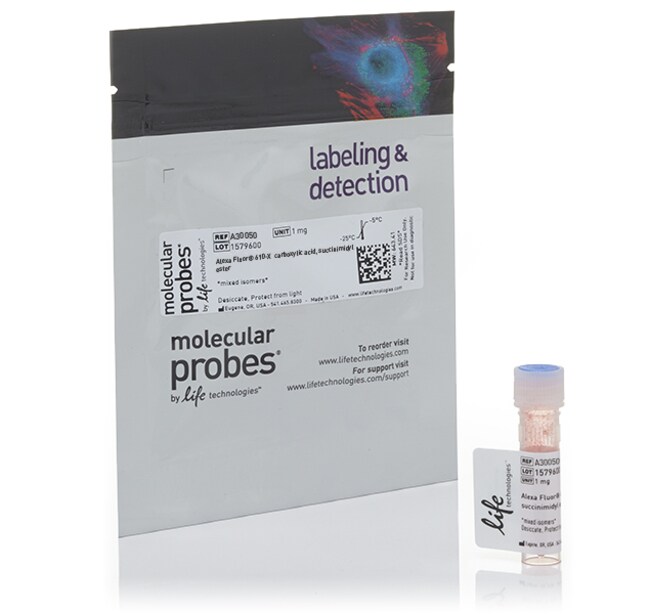
Alexa Fluor™ 610-X NHS Ester (Succinimidyl Ester)
Alexa Fluor™ 610-X is a bright and photostable Texas Red™ dye substitute. Used for stable signal generation in imaging andRead more
| Catalog Number | Quantity |
|---|---|
| A30050 | 1 mg |
Catalog number A30050
Price (USD)
504.00
Each
Quantity:
1 mg
Price (USD)
504.00
Each
Alexa Fluor™ 610-X is a bright and photostable Texas Red™ dye substitute. Used for stable signal generation in imaging and flow cytometry, Alexa Fluor™ 610-X dye is water soluble and pH-insensitive from pH 4 to pH 10. In addition to reactive dye formulations, we offer Alexa Fluor™ 610–R-Phycoerythrin tandem antibody conjugates for flow cytometry.The NHS ester (or succinimidyl ester) of Alexa Fluor™ 610-X is the most popular tool for conjugating this dye to a protein or antibody. NHS esters can be used to label to the primary amines (R-NH2) of proteins, amine-modified oligonucleotides, and other amine-containing molecules. The resulting Alexa Fluor™ conjugate will exhibit brighter fluorescence and greater photostability than the conjugates of other spectrally similar fluorophores.
Detailed information about this AlexaFluor™ NHS ester:
Fluorophore label: Alexa Fluor™ 610-X dye
Reactive group: NHS ester
Reactivity: Primary amines on proteins and ligands, amine-modified oligonucleotides
Ex/Em of the conjugate: 603/623 nm
Extinction coefficient: 144,000 cm-1M-1
Spectrally similar dyes: Texas Red™
Molecular weight: 1284.8
Typical Conjugation Reaction
You can conjugate amine-reactive reagents with virtually any protein or peptide (the provided protocol is optimized for IgG antibodies). You can scale the reaction for any amount of protein, but the concentration of the protein should be at least 2 mg/mL for optimal results. We recommend trying three different degrees of labeling, using three different molar ratios of the reactive reagent to protein.
The Alexa Fluor™ NHS ester is typically dissolved in high-quality anhydrous dimethylformamide (DMF) or dimethylsulfoxide (DMSO) (D12345), and the reaction is carried out in 0.1–0.2 M sodium bicarbonate buffer, pH 8.3, at room temperature for 1 hour. Because the pKa of the terminal amine is lower than that of the lysine epsilon-amino group, you may achieve more selective labeling of the amine terminus using a buffer closer to neutral pH.
Conjugate Purification
Labeled antibodies are typically separated from free Alexa Fluor™ dye using a gel filtration column, such as Sephadex™ G-25, BioGel™ P-30, or equivalent. For much larger or smaller proteins, select a gel filtration media with an appropriate molecular weight cut-off or purify by dialysis. We offer several purification kits optimized for different quantities of antibody conjugate:
Antibody Conjugate Purification Kit for 0.5-1 mg (A33086)
Antibody Conjugate Purification Kit for 20-50 μg (A33087)
Antibody Conjugate Purification kit for 50-100 μg (A33088)
Learn More About Protein and Antibody Labeling
We offer a wide selection of Molecular Probes™ antibody and protein labeling kits to fit your starting material and your experimental setup. See our Antibody Labeling kits or use our Labeling Chemistry Selection Tool for other choices. To learn more about our labeling kits, read Kits for Labeling Proteins and Nucleic Acids—Section 1.2 in The Molecular Probes™ Handbook.
We’ll Make a Custom Conjugate for You
If you can’t find what you’re looking for in our online catalog, we’ll prepare a custom antibody or protein conjugate for you. Our custom conjugation service is efficient and confidential, and we stand by the quality of our work. We are ISO 13485:2000 certified.
Detailed information about this AlexaFluor™ NHS ester:
Fluorophore label: Alexa Fluor™ 610-X dye
Reactive group: NHS ester
Reactivity: Primary amines on proteins and ligands, amine-modified oligonucleotides
Ex/Em of the conjugate: 603/623 nm
Extinction coefficient: 144,000 cm-1M-1
Spectrally similar dyes: Texas Red™
Molecular weight: 1284.8
Typical Conjugation Reaction
You can conjugate amine-reactive reagents with virtually any protein or peptide (the provided protocol is optimized for IgG antibodies). You can scale the reaction for any amount of protein, but the concentration of the protein should be at least 2 mg/mL for optimal results. We recommend trying three different degrees of labeling, using three different molar ratios of the reactive reagent to protein.
The Alexa Fluor™ NHS ester is typically dissolved in high-quality anhydrous dimethylformamide (DMF) or dimethylsulfoxide (DMSO) (D12345), and the reaction is carried out in 0.1–0.2 M sodium bicarbonate buffer, pH 8.3, at room temperature for 1 hour. Because the pKa of the terminal amine is lower than that of the lysine epsilon-amino group, you may achieve more selective labeling of the amine terminus using a buffer closer to neutral pH.
Conjugate Purification
Labeled antibodies are typically separated from free Alexa Fluor™ dye using a gel filtration column, such as Sephadex™ G-25, BioGel™ P-30, or equivalent. For much larger or smaller proteins, select a gel filtration media with an appropriate molecular weight cut-off or purify by dialysis. We offer several purification kits optimized for different quantities of antibody conjugate:
Antibody Conjugate Purification Kit for 0.5-1 mg (A33086)
Antibody Conjugate Purification Kit for 20-50 μg (A33087)
Antibody Conjugate Purification kit for 50-100 μg (A33088)
Learn More About Protein and Antibody Labeling
We offer a wide selection of Molecular Probes™ antibody and protein labeling kits to fit your starting material and your experimental setup. See our Antibody Labeling kits or use our Labeling Chemistry Selection Tool for other choices. To learn more about our labeling kits, read Kits for Labeling Proteins and Nucleic Acids—Section 1.2 in The Molecular Probes™ Handbook.
We’ll Make a Custom Conjugate for You
If you can’t find what you’re looking for in our online catalog, we’ll prepare a custom antibody or protein conjugate for you. Our custom conjugation service is efficient and confidential, and we stand by the quality of our work. We are ISO 13485:2000 certified.
For Research Use Only. Not for use in diagnostic procedures.
Specifications
Chemical ReactivityAmine
Emission623 nm
Excitation603 nm
Label or DyeAlexa Fluor 610
Product TypeDye Substitute
Quantity1 mg
Reactive MoietyActive Ester, Succinimidyl Ester
Shipping ConditionRoom Temperature
Label TypeAlexa Fluor
Product LineAlexa Fluor
Unit SizeEach
Contents & Storage
Store in freezer (-5 to -30°C) and protect from light.
Frequently asked questions (FAQs)
I am labeling a protein with Alexa Fluor 488 SDP ester. The manual recommends using a sodium bicarbonate buffer at pH 8.3. Can I use a different buffer instead?
I am not going to use all of my Alexa Fluor succinimidyl ester reactive dye. Can I just make it up in DMSO and store aliquots at -20 degrees C?
Citations & References (5)
Citations & References
Abstract
Oral instillation with surfactant phospholipid: a reliable alternative to intratracheal injection in mouse studies.
Journal:Lab Anim
PubMed ID:18625584
'The intratracheal (IT) injection technique has been widely used in the mouse studies of pulmonary diseases. Here, we describe a non-invasive technique using oral instillation challenge with the surfactant phospholipid that may advantageously replace the traditional IT technique. We performed comparative studies between oral instillation and IT injection of both
Biochemical and proteomic analysis of 'Dixiland' peach fruit (Prunus persica) upon heat treatment.
Journal:J Exp Bot
PubMed ID:19734260
'Shipping of peaches to distant markets and storage require low temperature; however, cold storage affects fruit quality causing physiological disorders collectively termed ''chilling injury'' (CI). In order to ameliorate CI, different strategies have been applied before cold storage; among them heat treatment (HT) has been widely used. In this work,
New evidence for differential roles of l10 ribosomal proteins from Arabidopsis.
Journal:
PubMed ID:23886624
'The RIBOSOMAL PROTEIN L10 (RPL10) is an integral component of the eukaryotic ribosome large subunit. Besides being a constituent of ribosomes and participating in protein translation, additional extraribosomal functions in the nucleus have been described for RPL10 in different organisms. Previously, we demonstrated that Arabidopsis (Arabidopsis thaliana) RPL10 genes are
Carbon metabolism of peach fruit after harvest: changes in enzymes involved in organic acid and sugar level modifications.
Journal:J Exp Bot
PubMed ID:19264753
'Peach (Prunus persica L. Batsch) is a climacteric fruit that ripens after harvest, prior to human consumption. Organic acids and soluble sugars contribute to the overall organoleptic quality of fresh peach; thus, the integrated study of the metabolic pathways controlling the levels of these compounds is of great relevance. Therefore,
Plant L10 ribosomal proteins have different roles during development and translation under ultraviolet-B stress.
Journal:Plant Physiol
PubMed ID:20516338
Ribosomal protein L10 (RPL10) proteins are ubiquitous in the plant kingdom. Arabidopsis (Arabidopsis thaliana) has three RPL10 genes encoding RPL10A to RPL10C proteins, while two genes are present in the maize (Zea mays) genome (rpl10-1 and rpl10-2). Maize and Arabidopsis RPL10s are tissue-specific and developmentally regulated, showing high levels of