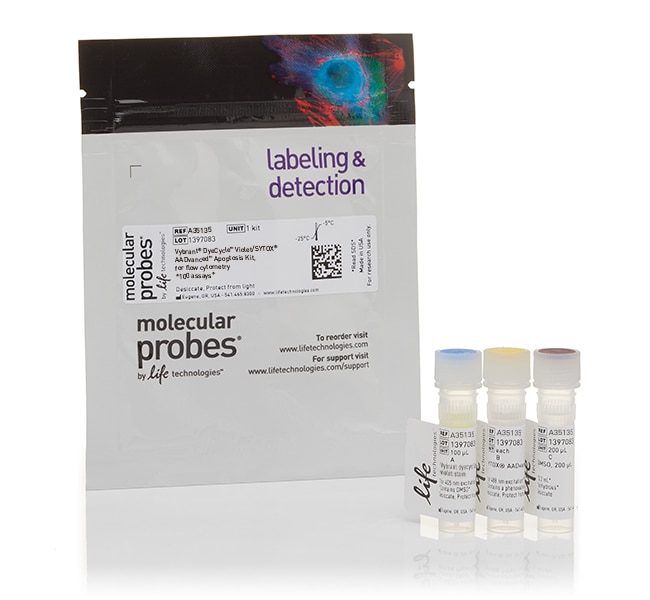
Vybrant™ DyeCycle™ Violet/SYTOX™ AADvanced™ Apoptosis Kit, for flow cytometry
Invitrogen™

Vybrant™ DyeCycle™ Violet/SYTOX™ AADvanced™ Apoptosis Kit, for flow cytometry

Das Vybrant™ DyeCycle™ Violet/SYTOX™ AADvanced™ apoptosis kit dient zur Identifizierung apoptotischer Zellen. Dieses Kit bietet einen schnellen und praktischen Assay,Weitere Informationen
Have Questions?
KatalognummerMenge
A351351 Kit
Katalognummer A35135
Preis (EUR)
582,00
Each
Zum Warenkorb hinzufügen
Menge:
1 Kit
Preis (EUR)
582,00
Each
Zum Warenkorb hinzufügen
Das Vybrant™ DyeCycle™ Violet/SYTOX™ AADvanced™ apoptosis kit dient zur Identifizierung apoptotischer Zellen. Dieses Kit bietet einen schnellen und praktischen Assay, der auf der Fluoreszenzanalyse des verdichteten Zustands des nuklearen Chromatins in apoptotischen Zellen basiert. Das Kit enthält Lösungen des zelldurchlässigen Farbstoffs Vybrant™ DyeCycle™ Violet (Ex/Em max. ∼370/440 nm), das mit UV-Licht oder violettem Laser angeregt wird und SYTOX™ AADvanced™ (Ex/Em max. ca. 546/650 nm), das mit einem 488 nm-Laser angeregt wird. SYTOX™ AADvanced™ wird verwendet, um Veränderungen in der Permeabilität der Plasmamembran zu erkennen und somit die Identifizierung von toten Zellen zu ermöglichen. Das Färbemuster, das sich aus der gleichzeitigen Verwendung beider Farbstoffe in Kombination ergibt, ermöglicht die Unterscheidung von normalen, apoptotischen und toten Zellpopulationen durch Durchflusszytometrie.

Sehen Sie sich einen Auswahlleitfaden für alle Apoptose-Assays für die Durchflusszytometrie an.
Nur für Forschungszwecke. Nicht zur Verwendung bei diagnostischen Verfahren.
Specifications
Anregung/EmissionSYTOX™ AADvanced™: 546⁄647, Vybrant™ DyeCycle™ Violet: 369⁄437
Durchflusszytometer-Laserlinien405, 488
Zur Verwendung mit (Anwendung)Durchflusszytometrie
Zur Verwendung mit (Geräte)Durchflusszytometer
MarkertypAndere Labels oder Farbstoffe
Marker oder FarbstoffVybrant DyeCycle Violet, SYTOX AADvanced Totzellen-Farbstoff
Anzahl Reaktionen200
ProduktlinieVybrant
ProdukttypApoptose-Kit
Menge1 Kit
VersandbedingungRaumtemperatur
NachweisverfahrenFluoreszenz
FormatRörchen
Unit SizeEach
Inhalt und Lagerung
Enthält 1 Fläschchen Vybrant™ DyeCycle™ Violet (50 μl, 5 mM Lösung in Wasser); 1 Fläschchen SYTOX™ AADvanced™ Farbstoff (100 µg) und 1 Fläschchen DMSO (200 μl).

Bei 2 bis 6 °C lagern

Häufig gestellte Fragen (FAQ)

What cellular processes can be analyzed with a flow cytometer?

-Calcium flux: Each of the Oregon Green calcium indicators binds intracellular calcium with increasing affinity, providing a sensitivity range to match many applications. Oregon Green probes emit green fluorescence at resting levels of Ca2+ and increase their fluorescence intensity 14-fold with increasing Ca2+ concentration. The cell-permeant formulation (Cat. No. O6807) can be loaded in cell media and is compatible with flow cytometry.
-Rhodamine-based calcium indicators comprise a range of probes for large or small changes in Ca2+ concentration. They exhibit a 50-fold increase in fluorescence upon calcium binding and offer a range of wavelengths that can be used in conjunction with GFP or green-fluorescent dyes for multiplexing. Rhod-2, AM (Cat. No. R1245MP), in particular, localizes to mitochondria and can be used with flow cytometry.
-Membrane potential: A distinctive feature of the early stages of apoptosis is the disruption of the mitochondria, including changes in membrane and redox potential. We offer a range of products specifically designed to assay mitochondrial membrane potential in live cells by flow cytometry, with minimal disruption of cellular function. The MitoProbe family of mitochondrial stains (Cat. Nos. M34150, M34151, and M34152) provide quick, easy, and reliable flow cytometric detection of the loss of mitochondrial membrane potential that occurs during apoptosis. MitoTracker dyes (Cat. Nos. M7510 and M7512) are membrane potential-dependent probes for staining mitochondria in live cells. The staining pattern of MitoTracker dyes is retained throughout subsequent flow cytometry immunocytochemistry, DNA end labeling, in situ hybridization, or counterstaining steps. The Mitochondrial Permeability Transition Pore Assay (Cat. No. M34153) provides a more direct method of measuring mitochondrial permeability transition pore opening than assays relying on mitochondrial membrane potential alone. The mitochondrial permeability transition pore (MPTP) is a non-specific channel formed by components from the inner and outer mitochondrial membranes, and appears to be involved in the release of mitochondrial components during cell death.
-Phagocytosis: In phagocytosis, cells internalize particulate matter such as microorganisms, and this process is important for immune responses and during the clearance of apoptotic cells. Probes for studying phagocytosis include BioParticles indicators—bacteria and yeast labeled with fluorescent dyes.
-Tracking phagocytosis using a quench/wash-based assay can report on simple uptake, or a pH indicator can be used to monitor stages in the pathway. We have no-wash assays labeled with pHrodo Red or Green (Cat. Nos. A10010, P35361, P35364, P35365, P35366, and P35367) and no-wash assays for whole blood (Cat. Nos. A10025, A10026, P35381, and P35382), all suitable for flow cytometry.
-pH changes: Sensitive pH determinations can be made in a physiological range using either fluorescent intensity or ratiometric measurements. pHrodo dyes (Cat. Nos. P35373 and P35372) provide signal intensity modulation from pH 2 to pH 9 and with a choice of fluorescent wavelengths. Tracking internalization of fluorescent dextran is a routine method for analyzing pH changes in cellular compartments. Dextran conjugates of pHrodo dyes (Cat. Nos. P35368 and P10361) provide the most complete solution by allowing discrimination of vesicles from early endosomes to lysosomes, with no quench or wash required.
-Reactive oxygen species: Cells that are environmentally stressed usually contain greatly increased levels of reactive oxygen species (ROS). CellROX reagents are fluorogenic probes developed for the detection and quantitation of ROS in live cells. These cell-permeant reagents are non-fluorescent or very weakly fluorescent in the reduced state; however, when oxidized, they become brightly fluorescent and remain localized within the cell. We offer CellROX Green (Cat. No. C10492), CellROX Orange (Cat. No. C10493), and CellROX Deep Red (Cat. No. C10491) Assay Kits validated for flow cytometry.

Find additional tips, troubleshooting help, and resources within our Cell Analysis Support Center.