Search

Invitrogen™
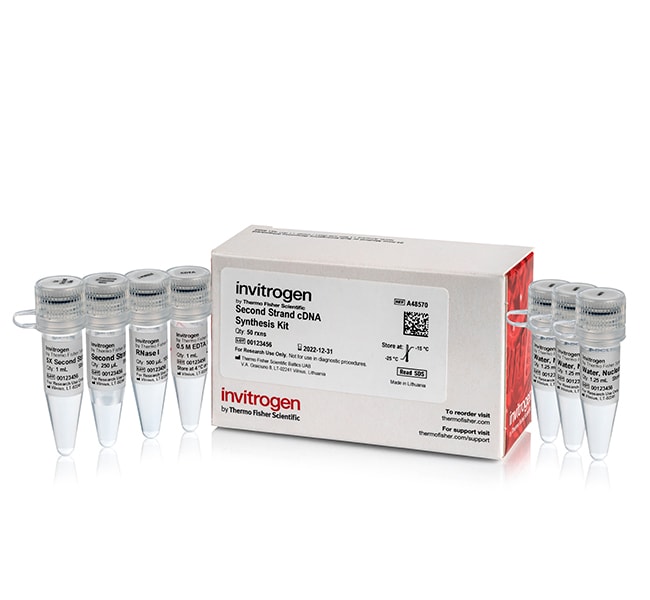
Second Strand cDNA Synthesis Kit
Invitrogen Second Strand cDNA Synthesis Kit is designed to produce double-stranded cDNA from the first-strand reaction without the need forRead more
Have Questions?
Change view

| Catalog Number | No. of Reactions |
|---|---|
| A48570 | 50 Reactions |
| A48571 | 200 Reactions |
Catalog number A48570
Price (USD)
1,223.65
Online exclusive
1,302.00Save 78.35
Each
No. of Reactions:
50 Reactions
Price (USD)
1,223.65
Online exclusive
1,302.00Save 78.35
Each
Invitrogen Second Strand cDNA Synthesis Kit is designed to produce double-stranded cDNA from the first-strand reaction without the need for intermediate organic extraction or ethanol precipitation steps. The convenient single-tube format speeds up the synthesis procedure and maximizes cDNA recovery. The kit contains premixed components to reduce the number of pipetting steps necessary to complete the procedure.
Features of the Second Strand cDNA Synthesis Kit include:
• Efficient synthesis of full-length double-stranded cDNA
• Fast—procedure completed in 1 hour
• Convenient—pre-mixed components
• Complete—includes residual RNA removal reagents
Applications
• Full-length double-stranded blunt-end cDNA synthesis for cloning
• Double-stranded cDNA library construction
Features of the Second Strand cDNA Synthesis Kit include:
• Efficient synthesis of full-length double-stranded cDNA
• Fast—procedure completed in 1 hour
• Convenient—pre-mixed components
• Complete—includes residual RNA removal reagents
Applications
• Full-length double-stranded blunt-end cDNA synthesis for cloning
• Double-stranded cDNA library construction
WARNING: Cancer and Reproductive Harm – www.P65Warnings.ca.gov
Specifications
Final Product TypeDouble Stranded cDNA
Format50 reactions
No. of Reactions50 Reactions
Product TypecDNA Synthesis Kit
Quantity50 reaction
Reaction FormatSeparate Components
For Use With (Application)Cloning
Unit SizeEach
Contents & Storage
Contents:
• Second Strand Enzyme Mix, 1 mL
• 5X Second Strand Reaction Mix, 250 μL
• 0.5 M EDTA, pH 8.0, 1 mL
• RNase I, 10 U/μL, 500 μL
• Water, nuclease-free, 3 x 1.25 mL
Storage: -15 to -25°C
• Second Strand Enzyme Mix, 1 mL
• 5X Second Strand Reaction Mix, 250 μL
• 0.5 M EDTA, pH 8.0, 1 mL
• RNase I, 10 U/μL, 500 μL
• Water, nuclease-free, 3 x 1.25 mL
Storage: -15 to -25°C