Search
 項目搜尋
項目搜尋 結構搜尋
結構搜尋


Thermo Scientific Chemicals
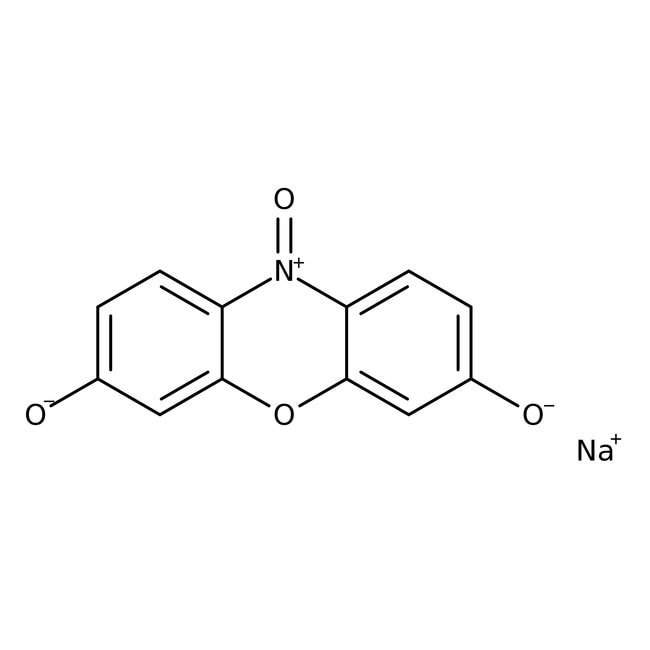
Resazurin sodium salt
As indicator pH 3.8 (orange) to 6.5 (dark violet) | CAS: 62758-13-8 | C12H6NNaO4 | 251.173 g/mol
Have Questions?
變更視圖


化學識別
CAS62758-13-8
IUPAC Namesodium 10-oxo-10H-10λ⁵-phenoxazin-10-ylium-3,7-bis(olate)
Molecular FormulaC12H6NNaO4
InChI KeyOPVDVVJXMPZWLP-UHFFFAOYSA-M
SMILES[Na+].[O-]C1=CC=C2C(OC3=CC([O-])=CC=C3[N+]2=O)=C1
檢視更多
規格 規格表
規格表
規格表FormPowder
Color ChangeFrom pH 3.5: red/orange
Color ChangeTo pH 6.5: blue/violet
Appearance (Color)Green to black
Assay from Suppliers CofADye content: ≥70%
檢視更多
As indicator pH 3.8 (orange) to 6.5 (dark violet)Resazurin sodium salt acts as a blue non-fluorescent dye used especially in oxidation-reduction indicator of resazurin test for bacteria. It is employed as a fluorogenic oxidation-reduction indicator in a variety of cells, yeast and eukaryotes by flow cytometry, fluorescence microscopy and high-throughput screening. Further, it is used to characterize the metabolic activity of mitochnodria. It is also used to assay L-Glutamate and to measure the aerobic biodegradation of organic matter exists in effluents. In addition to this, it acts as an indicator for cell viability in mammalian cell cultures.
This Thermo Scientific Chemicals brand product was originally part of the Alfa Aesar product portfolio. Some documentation and label information may refer to the legacy brand. The original Alfa Aesar product / item code or SKU reference has not changed as a part of the brand transition to Thermo Scientific Chemicals.
Applications
As indicator pH 3.8 (orange) to 6.5 (dark violet)Resazurin sodium salt acts as a blue non-fluorescent dye used especially in oxidation-reduction indicator of resazurin test for bacteria. It is employed as a fluorogenic oxidation-reduction indicator in a variety of cells, yeast and eukaryotes by flow cytometry, fluorescence microscopy and high-throughput screening. Further, it is used to characterize the metabolic activity of mitochnodria. It is also used to assay L-Glutamate and to measure the aerobic biodegradation of organic matter exists in effluents. In addition to this, it acts as an indicator for cell viability in mammalian cell cultures.
Solubility
Soluble in water, dimethylsulfoxide and ammonium hydroxide.
Notes
Incompatible with strong oxidizing agents. Store in a cool place.
As indicator pH 3.8 (orange) to 6.5 (dark violet)Resazurin sodium salt acts as a blue non-fluorescent dye used especially in oxidation-reduction indicator of resazurin test for bacteria. It is employed as a fluorogenic oxidation-reduction indicator in a variety of cells, yeast and eukaryotes by flow cytometry, fluorescence microscopy and high-throughput screening. Further, it is used to characterize the metabolic activity of mitochnodria. It is also used to assay L-Glutamate and to measure the aerobic biodegradation of organic matter exists in effluents. In addition to this, it acts as an indicator for cell viability in mammalian cell cultures.
Solubility
Soluble in water, dimethylsulfoxide and ammonium hydroxide.
Notes
Incompatible with strong oxidizing agents. Store in a cool place.
RUO – Research Use Only
General References:
- Yang, G.; Zhu, W.; Kim, K.; Byun, S. Y.; Choi, G.; Wang, K.; Cha, J. S.; Cho, H. S.; Oldfield, E.; No, J. H. In Vitro and In Vivo Investigation of the Inhibition of Trypanosoma brucei Cell Growth by Lipophilic Bisphosphonates. Antimicrob. Agents Chemother. 2015, 59 (12), 7530-7539.
- Mealy, J.; O'Kelly, K. Cell response to hydroxyapatite surface topography modulated by sintering temperature. J. Biomed. Mater. Res. A 2015, 103 (11), 3533-3538.