Search


Citations & References (32)
Invitrogen™
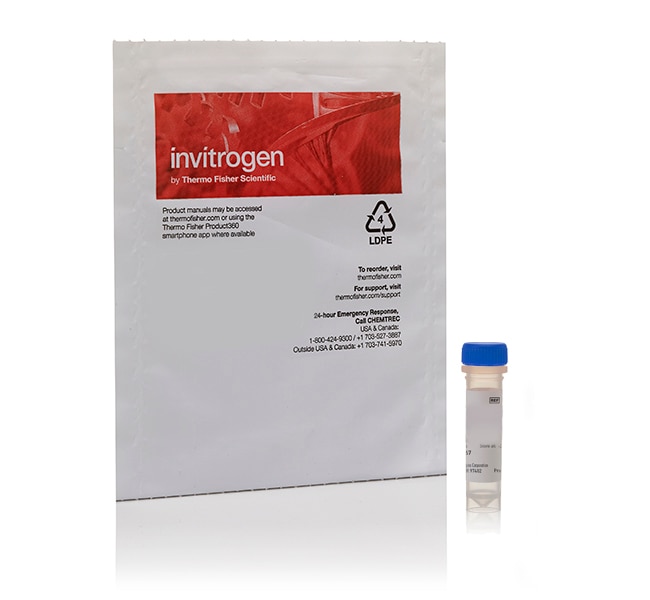
BODIPY™ FL C5-Lactosylceramide complexed to BSA
The green-fluorescent BODIPY™ FL C5 lactosylceramide complexed to BSA can be used in sphingolipid transport and metabolism mechanisms.
| Catalog Number | Quantity |
|---|---|
| B34402 | 1 mg |
Catalog number B34402
Price (CLP)
493.416
Each
Quantity:
1 mg
Price (CLP)
493.416
Each
The green-fluorescent BODIPY™ FL C5 lactosylceramide complexed to BSA can be used in sphingolipid transport and metabolism mechanisms. Complexing fluorescent lipids with bovine serum albuin (BSA) facilitates cell labeling by eliminating the need for organic solvents to dissolve the lipophilic probe—the BSA-complexed probe can be directly dissolved in water.
Consult user Manual for solubility instructions.
For Research Use Only. Not for use in diagnostic procedures.
Specifications
Chemical Name or MaterialSphingolipids
Excitation/Emission505/511 nm
Recommended StorageStore in freezer (-5°C to -30°C) and protect from light.
Physical FormSolid
Product LineBODIPY
Quantity1 mg
Unit SizeEach
Citations & References (32)
Citations & References
Abstract
Inhibition of caveolar uptake, SV40 infection, and beta1-integrin signaling by a nonnatural glycosphingolipid stereoisomer.
Journal:J Cell Biol
PubMed ID:17371832
'Caveolar endocytosis is an important mechanism for the uptake of certain pathogens and toxins and also plays a role in the internalization of some plasma membrane (PM) lipids and proteins. However, the regulation of caveolar endocytosis is not well understood. We previously demonstrated that caveolar endocytosis and beta1-integrin signaling are
Regulation of caveolar endocytosis by syntaxin 6-dependent delivery of membrane components to the cell surface.
Journal:Nat Cell Biol
PubMed ID:16565709
'Caveolar endocytosis has an important function in the cellular uptake of some bacterial toxins, viruses and circulating proteins. However, the molecular machinery involved in regulating caveolar uptake is poorly defined. Here, we demonstrate that caveolar endocytosis is regulated by syntaxin 6, a target membrane soluble N-ethylmaleimide attachment protein receptor (t-SNARE)
Selective caveolin-1-dependent endocytosis of glycosphingolipids.
Journal:Mol Biol Cell
PubMed ID:12925761
'We studied the endocytosis of fluorescent glycosphingolipid (GSL) analogs in various cell types using pathway-specific inhibitors and colocalization studies with endocytic markers and DsRed caveolin-1 (cav-1). Based on inhibitor studies, all GSLs tested were internalized predominantly (>80%) by a clathrin-independent, caveolar-related mechanism, regardless of cell type. In addition, fluorescent lactosylceramide
A fluorescent glycolipid-binding peptide probe traces cholesterol dependent microdomain-derived trafficking pathways.
Journal:PLoS ONE
PubMed ID:18716682
'BACKGROUND: The uptake and intracellular trafficking of sphingolipids, which self-associate into plasma membrane microdomains, is associated with many pathological conditions, including viral and toxin infection, lipid storage disease, and neurodegenerative disease. However, the means available to label the trafficking pathways of sphingolipids in live cells are extremely limited. In order
Rab proteins mediate Golgi transport of caveola-internalized glycosphingolipids and correct lipid trafficking in Niemann-Pick C cells.
Journal:J Clin Invest
PubMed ID:12070301
'We recently showed that human skin fibroblasts internalize fluorescent analogues of the glycosphingolipids lactosylceramide and globoside almost exclusively by a clathrin-independent mechanism involving caveolae. In contrast, a sphingomyelin analogue is internalized approximately equally via clathrin-dependent and caveolar routes. Here, we further characterized the caveolar pathway for glycosphingolipids, showing that Golgi