Search


Citations & References (10)
Invitrogen™
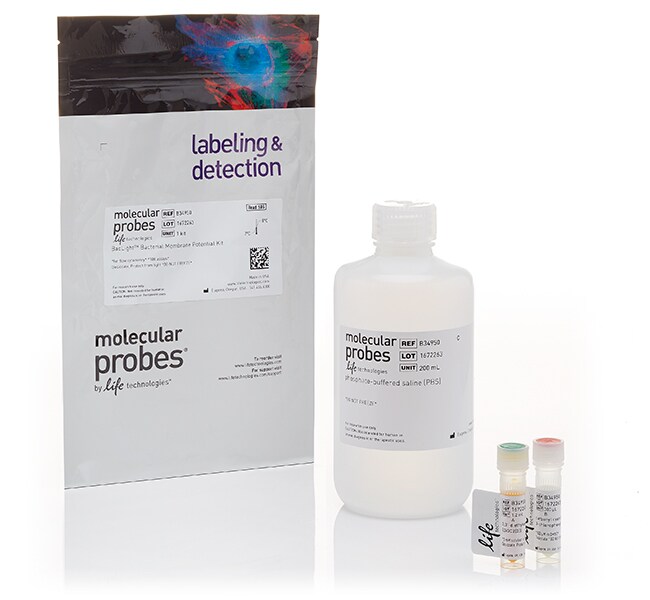
BacLight™ Bacterial Membrane Potential Kit
The BacLight™ Bacterial Membrane Potential Kit provides the fluorescent membrane-potential indicator dye, DiOC2(3), along with a proton ionophore (CCCP) andRead more
| Catalog Number | Quantity |
|---|---|
| B34950 | 1 kit |
Catalog number B34950
Price (USD)
378.00
Each
Quantity:
1 kit
Price (USD)
378.00
Each
The BacLight™ Bacterial Membrane Potential Kit provides the fluorescent membrane-potential indicator dye, DiOC2(3), along with a proton ionophore (CCCP) and premixed buffer. DiOC2(3) at low concentrations exhibits green fluorescence in all bacterial cells, but it becomes more concentrated in healthy cells that are maintaining a membrane potential, causing the dye to self-associate and the fluorescence emission to shift to red. The red- and green-fluorescent bacterial populations are easily distinguished using a flow cytometer. CCCP is included in the kit for use as a control because it eradicates the proton gradient, eliminating bacterial membrane potential.
View additional information about all microbiology assays for flow cytometry.
View additional information about all microbiology assays for flow cytometry.
For Research Use Only. Not for use in diagnostic procedures.
Specifications
Detection MethodFluorescence
Dye TypeMembrane Potential Probes
Emission Wavelength482/497
FormatTube(s)
Quantity1 kit
Shipping ConditionWet Ice
For Use With (Application)Membrane Potential Assay
For Use With (Equipment)Flow Cytometer
Product LineBacLight
Product TypeBacterial Membrane Potential Kit
Unit SizeEach
Contents & Storage
Contains DiOC2(3) (1.2 mL of 3 mM solution in DMSO), CCCP (300 μL of 500 μM solution in DMSO), and PBS (200 mL). Store in refrigerator (2–8°C) and protect from light.
Frequently asked questions (FAQs)
What bacterial parameters can I look at by flow cytometry?
Can I look at bacteria and yeast on a flow cytometer?
Citations & References (10)
Citations & References
Abstract
Membrane disruption by antimicrobial fatty acids releases low-molecular-weight proteins from Staphylococcus aureus.
Journal:J Bacteriol
PubMed ID:22843840
The skin represents an important barrier for pathogens and is known to produce fatty acids that are toxic toward gram-positive bacteria. A screen of fatty acids as growth inhibitors of Staphylococcus aureus revealed structure-specific antibacterial activity. Fatty acids like oleate (18:1?9) were nontoxic, whereas palmitoleate (16:1?9) was a potent growth
Comparative analysis of antimicrobial activities of valinomycin and cereulide, the Bacillus cereus emetic toxin.
Journal:Appl Environ Microbiol
PubMed ID:21357430
'Cereulide and valinomycin are highly similar cyclic dodecadepsipeptides with potassium ionophoric properties. Cereulide, produced by members of the Bacillus cereus group, is known mostly as emetic toxin, and no ecological function has been assigned. A comparative analysis of the antimicrobial activity of valinomycin produced by Streptomyces spp. and cereulide was
Two heme-dependent terminal oxidases power Staphylococcus aureus organ-specific colonization of the vertebrate host.
Journal:
PubMed ID:23900169
'Staphylococcus aureus is a significant cause of infections worldwide and is able to utilize aerobic respiration, anaerobic respiration, or fermentation as the means by which it generates the energy needed for proliferation. Aerobic respiration is supported by heme-dependent terminal oxidases that catalyze the final step of aerobic respiration, the reduction
The biocide chlorine dioxide stimulates biofilm formation in Bacillus subtilis by activation of the histidine kinase KinC.
Journal:J Bacteriol
PubMed ID:20971918
'Bacillus subtilis forms biofilms in response to signals that remain poorly defined. We report that biofilm formation is stimulated by sublethal doses of chlorine dioxide (ClO(2)), an extremely effective and fast-acting biocide. ClO(2) accelerated biofilm formation in B. subtilis as well as in other bacteria, suggesting that biofilm formation is
Fullerene water suspension (nC60) exerts antibacterial effects via ROS-independent protein oxidation.
Journal:Environ Sci Technol
PubMed ID:19031913
Buckminsterfullerene (C60) can form water suspensions (nC60) that exert toxic effects. While reactive oxygen species (ROS) generation has been implicated as the mechanism for mammalian cytotoxicity, we propose that nC60 exerts ROS-independent oxidative stress in bacteria, with evidence of protein oxidation, changes in cell membrane potential, and interruption of cellular