Search


Citas y referencias (1)
Invitrogen™
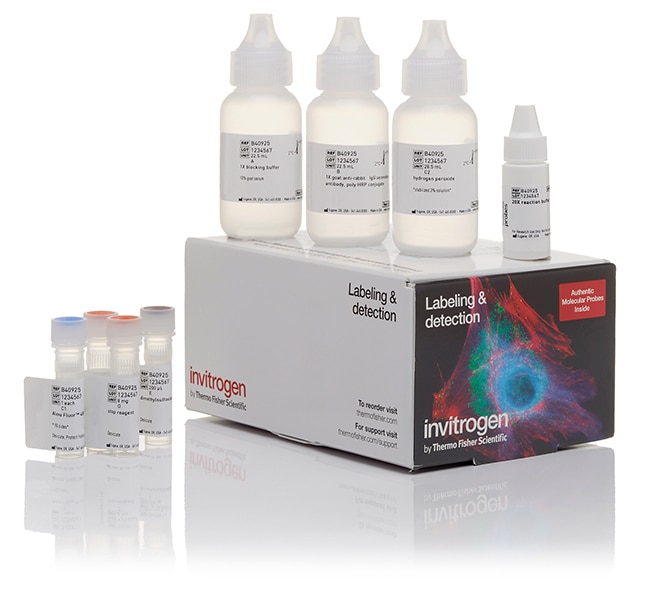
Alexa Fluor™ 594 Tyramide SuperBoost™ Kit, goat anti-rabbit IgG
La amplificación de la señal de tiramida SuperBoost™ es el método más sensible para la detección de objetivos de bajaMás información
Have Questions?
Cambiar vista

| Número de catálogo | Cantidad | Tipo de producto |
|---|---|---|
| B40925 | Suficiente para 150 portaobjetos | Kit de tiramida |
| B40944 | Suficiente para 50 portaobjetos | Kit SuperBoost Tyramide |
Número de catálogo B40925
Precio (MXN)
-
Cantidad:
Suficiente para 150 portaobjetos
Tipo de producto:
Kit de tiramida
La amplificación de la señal de tiramida SuperBoost™ es el método más sensible para la detección de objetivos de baja abundancia en inmunocitoquímica (ICC) fluorescente multiplexable, inmunohistoquímica (IHC) e hibridación in situ (ISH). Los kits SuperBoost combinan el brillo de los colorantes AlexaFluor™ con la amplificación de señal superior de una reacción de etiquetado de tiramida mediada por poli-HRP para producir una sensibilidad 10-200 veces mayor que los métodos estándar. La sensibilidad del kit SuperBoost también es de 2 a 10 veces mayor que las técnicas de amplificación habituales de tiramida, como la TSA™. Según investigaciones destacadas, los kits SuperBoost mejoran los resultados para obtener una visibilidad clara de las áreas críticas que los métodos de obtención de imágenes estándar no revelan.
Los kits SuperBoost son fáciles de usar y se adaptan fácilmente a los protocolos experimentales estándar ICC, IHC o FISH, utilizando cualquier tipo de célula o tejido. Las células etiquetadas con un kit SuperBoost se pueden analizar con cualquier tipo de microscopio para obtener imágenes multiplexadas de alta resolución. Este kit en particular presenta tiramida AlexaFluor 594 (591/617 ex/em), detectado usando un cubo de filtro estándar Rojo / Texas Red™. Este kit también incluye un anticuerpo secundario IgG de cabra anti-conejo, combinado con poli-HRP.
Las características de los kits SuperBoost incluyen:
• Sensibilidad superior para la detección de objetivos de bajo nivel o difíciles de detectar mediante imágenes fluorescentes
• Protocolo simple y detección mediante filtros estándar
• Adecuados para imágenes multiplexadas de alta resolución: etiquetado conjunto con DAPI, anticuerpos secundarios y otros kits SuperBoost
• Requiere 10-100 veces menos anticuerpo primario que los experimentos ICC/IHC/ISH estándar
Los kits SuperBoost se basan en el sistema de amplificación de señal de tiramida, que utiliza la actividad catalítica de la peroxidasa de rábano picante (HRP) para generar un etiquetado de alta densidad de una proteína diana o secuencia de ácido nucleico «in situ». Un experimento típico de ICC/IHC/ISH con un kit SuperBoost requiere entre 10 y 100 veces menos cantidad de anticuerpo primario que los experimentos estándar de ICC/IHC/ISH. Los kits SuperBoost ofrecen una intensidad de señal específica superior sobre el fondo, por lo que el protocolo se optimiza fácilmente para detectar señales específicas en muestras en las que se observa una alta autofluorescencia endógena.
Ventajas de los kits SuperBoost
Mejora de la señal con tiramidas Alexa Fluor: Los kits SuperBoost utilizan tiramidas Alexa Fluor, que reaccionan con el HRP para depositar en última instancia el colorante brillante y fotoestable Alexa Fluor en las proteínas circundantes y otras moléculas similares. Los kits SuperBoost son los únicos que combinan el brillo de los colorantes Alexa Fluor con la mejora de la amplificación de la señal de tiramida para producir una señal superior.
Mejora de poli-HRP: A diferencia del TSA, los kits SuperBoost emplean anticuerpos secundarios conjugados con poli-HRP. En estos sistemas, varias enzimas HRP se conjugan con polímeros cortos, lo que multiplica y mejora la señal sobre los sistemas HRP regulares. El poli-HRP está estructurado de tal manera que los anticuerpos penetran en células o tejidos con la misma eficiencia que los anticuerpos secundarios conjugados con HRP regulares. La relación molar enzima /proteína de anticuerpo tiene un valor promedio de 4.
Solución de interrupción de la reacción: Al igual que ocurre con cualquier sistema de etiquetado basado en enzimas, es posible desarrollar la señal en exceso. Los kits SuperBoost incluyen una solución de parada de HRP para detener la reacción de HRP. La solución de parada de HRP se puede utilizar para obtener la señal máxima, sin aumento de la señal de fondo. Las imágenes producidas con tiempos de reacción de HRP optimizados son tan nítidas como las imágenes producidas con métodos ICC/IHC/ISH estándar, pero con 10-200 veces más sensibilidad.
Reducción del fondo: Los kits SuperBoost incluyen bloqueadores para la eliminación o reducción de la peroxidasa endógena y las señales de fondo fluorescentes. Estos bloqueadores ayudan a garantizar que solo se mejoran las señales específicas mientras se mantienen las señales no específicas/de fondo bajo control.
Los kits SuperBoost son fáciles de usar y se adaptan fácilmente a los protocolos experimentales estándar ICC, IHC o FISH, utilizando cualquier tipo de célula o tejido. Las células etiquetadas con un kit SuperBoost se pueden analizar con cualquier tipo de microscopio para obtener imágenes multiplexadas de alta resolución. Este kit en particular presenta tiramida AlexaFluor 594 (591/617 ex/em), detectado usando un cubo de filtro estándar Rojo / Texas Red™. Este kit también incluye un anticuerpo secundario IgG de cabra anti-conejo, combinado con poli-HRP.
Las características de los kits SuperBoost incluyen:
• Sensibilidad superior para la detección de objetivos de bajo nivel o difíciles de detectar mediante imágenes fluorescentes
• Protocolo simple y detección mediante filtros estándar
• Adecuados para imágenes multiplexadas de alta resolución: etiquetado conjunto con DAPI, anticuerpos secundarios y otros kits SuperBoost
• Requiere 10-100 veces menos anticuerpo primario que los experimentos ICC/IHC/ISH estándar
Los kits SuperBoost se basan en el sistema de amplificación de señal de tiramida, que utiliza la actividad catalítica de la peroxidasa de rábano picante (HRP) para generar un etiquetado de alta densidad de una proteína diana o secuencia de ácido nucleico «in situ». Un experimento típico de ICC/IHC/ISH con un kit SuperBoost requiere entre 10 y 100 veces menos cantidad de anticuerpo primario que los experimentos estándar de ICC/IHC/ISH. Los kits SuperBoost ofrecen una intensidad de señal específica superior sobre el fondo, por lo que el protocolo se optimiza fácilmente para detectar señales específicas en muestras en las que se observa una alta autofluorescencia endógena.
Ventajas de los kits SuperBoost
Mejora de la señal con tiramidas Alexa Fluor: Los kits SuperBoost utilizan tiramidas Alexa Fluor, que reaccionan con el HRP para depositar en última instancia el colorante brillante y fotoestable Alexa Fluor en las proteínas circundantes y otras moléculas similares. Los kits SuperBoost son los únicos que combinan el brillo de los colorantes Alexa Fluor con la mejora de la amplificación de la señal de tiramida para producir una señal superior.
Mejora de poli-HRP: A diferencia del TSA, los kits SuperBoost emplean anticuerpos secundarios conjugados con poli-HRP. En estos sistemas, varias enzimas HRP se conjugan con polímeros cortos, lo que multiplica y mejora la señal sobre los sistemas HRP regulares. El poli-HRP está estructurado de tal manera que los anticuerpos penetran en células o tejidos con la misma eficiencia que los anticuerpos secundarios conjugados con HRP regulares. La relación molar enzima /proteína de anticuerpo tiene un valor promedio de 4.
Solución de interrupción de la reacción: Al igual que ocurre con cualquier sistema de etiquetado basado en enzimas, es posible desarrollar la señal en exceso. Los kits SuperBoost incluyen una solución de parada de HRP para detener la reacción de HRP. La solución de parada de HRP se puede utilizar para obtener la señal máxima, sin aumento de la señal de fondo. Las imágenes producidas con tiempos de reacción de HRP optimizados son tan nítidas como las imágenes producidas con métodos ICC/IHC/ISH estándar, pero con 10-200 veces más sensibilidad.
Reducción del fondo: Los kits SuperBoost incluyen bloqueadores para la eliminación o reducción de la peroxidasa endógena y las señales de fondo fluorescentes. Estos bloqueadores ayudan a garantizar que solo se mejoran las señales específicas mientras se mantienen las señales no específicas/de fondo bajo control.
Para uso exclusivo en investigación. No apto para uso en procedimientos diagnósticos.
Especificaciones
Tipo de productoKit de tiramida
CantidadSuficiente para 150 portaobjetos
Duración de almacenamiento6 meses
Condiciones de envíoAprobado para su envío a temperatura ambiente o en hielo húmedo
ConjugadoAlexa Fluor 594
Línea de productosSuperBoost
Unit SizeEach
Contenido y almacenamiento
- 1 kit es suficiente para 150 portaobjetos de microscopio (18 x 18 mm), que contiene:
Preguntas frecuentes
With a SuperBoost tyramide kit, I got excessive and non-specific labeling. What can I do to limit background and acquire a more localized labeling?
Is it possible to perform dual TSA labeling with SuperBoost tyramide kits?
How are SuperBoost tyramide kits different from the original TSA labeling kits?
I used a neuron-specific antibody to label my neurons. I can't get enough signal from my fluorescent dye conjugated primary antibody. What can I do to improve it?
I have a very low-abundance antigen. How can I amplify my signal?
Citations & References (1)
Citations & References
Abstract
Attenuation of Follicular Helper T Cell-Dependent B Cell Hyperactivity by Abatacept Treatment in Primary Sjögren's Syndrome.
Journal:Arthritis Rheumatol
PubMed ID:28564491
'To assess the effect of abatacept (CTLA-4Ig), which limits T cell activation, on homeostasis of CD4+ T cell subsets and T cell-dependent B cell hyperactivity in patients with primary Sjögren''s syndrome (SS). Fifteen patients with primary SS treated with abatacept were included. Circulating CD4+ T cell and B cell subsets