Search


Citas y referencias (4)
Invitrogen™
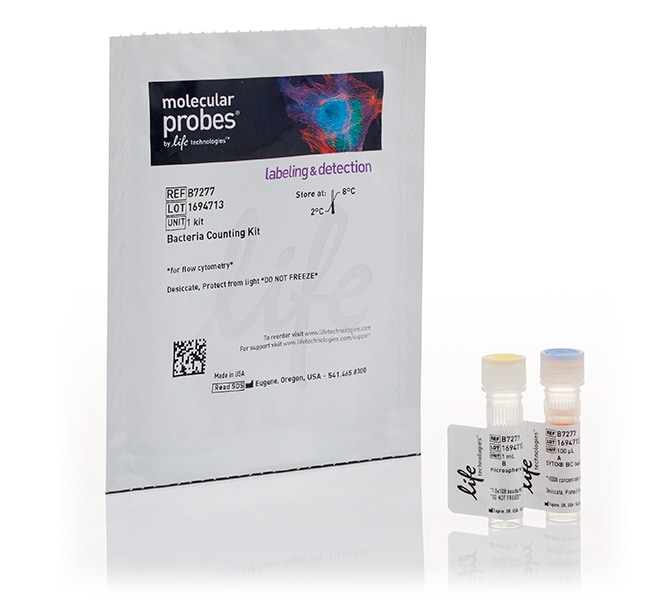
Kit de recuento de bacterias, para citometría de flujo
El kit de recuento de bacterias cuenta bacterias con exactitud mediante citometría de flujo. El kit incluye el colorante SYTO™Más información
| Número de catálogo | Cantidad |
|---|---|
| B7277 | 1 kit |
Número de catálogo B7277
Precio (MXN)
-
Cantidad:
1 kit
El kit de recuento de bacterias cuenta bacterias con exactitud mediante citometría de flujo. El kit incluye el colorante SYTO™ BC, que también está disponible por separado (n.º de cat. S34855), una tinción de ácidos nucleicos de alta afinidad que penetra fácilmente tanto en bacterias gramnegativas como grampositivas, generando una señal fluorescente verde excepcionalmente brillante. El kit también incluye una suspensión calibrada de microesferas de poliestireno. Las señales, tanto de las bacterias teñidas como de las microesferas, se detectan fácilmente en el canal de fluorescencia verde y pueden distinguirse en un gráfico de dispersión frontal frente a fluorescencia. La densidad de las bacterias en la muestra se puede determinar a partir de la relación entre las señales procedentes de las bacterias y las señales procedentes de las microesferas en el citograma.
Consulte información adicional sobre todos los ensayos de microbiología para citometría de flujo.
Consulte información adicional sobre todos los ensayos de microbiología para citometría de flujo.
Para uso exclusivo en investigación. No apto para uso en procedimientos diagnósticos.
Especificaciones
Método de detecciónFluorescente
Diámetro del gránulo (métrico)6 µm
Para utilizar con (aplicación)Citometría de flujo
Para utilizar con (equipo)Citómetro de flujo
IncluyeTinción bacteriana BC, estándar de microesferas
Cantidad1 kit
Tipo de muestraBacteria
Condiciones de envíoTemperatura ambiente
Tipo de productoKit de recuento de bacterias
Unit SizeEach
Contenido y almacenamiento
Contiene 1 vial de tinción bacteriana SYTO™ BC (100 µl, 1000x en DMSO), 1 vial de microesfera estándar (1 ml, 6 µm).
Almacenar en el refrigerador (2–8 °C) y proteger de la luz.
Almacenar en el refrigerador (2–8 °C) y proteger de la luz.
Preguntas frecuentes
Is the SYTO BC bacteria stain from the Bacteria Counting Kit available as a standalone product?
When using the Live/Dead BacLight Bacterial Viability and Counting Kit, for flow cytometry, some cells seem to have both red and green signal. Are these cells dead or alive or dying?
How can I count my bacteria by flow cytometry?
What bacterial parameters can I look at by flow cytometry?
I am using counting beads to count cells, but I cannot find the beads on my scatter plots. What do I do?
Citations & References (4)
Citations & References
Abstract
Comparison of blue nucleic acid dyes for flow cytometric enumeration of bacteria in aquatic systems.
Journal:Appl Environ Microbiol
PubMed ID:9572943
'Seven blue nucleic acid dyes from Molecular Probes Inc. (SYTO-9, SYTO-11, SYTO-13, SYTO-16, SYTO-BC, SYBR-I and SYBR-II) were compared with the DAPI (4'',6-diamidino-2-phenylindole) method for flow cytometric enumeration of live and fixed bacteria in aquatic systems. It was shown that SYBR-II and SYTO-9 are the most appropriate dyes for bacterial
The beta-catenin--TCF-1 pathway ensures CD4(+)CD8(+) thymocyte survival.
Journal:Nat Immunol
PubMed ID:11477404
The association of trans-acting T cell factors (TCFs) or lymphoid enhancer factor 1 (LEF-1) with their coactivator beta-catenin mediates transient transcriptional responses to extracellular Wnt signals. We show here that T cell maturation depends on the presence of the beta-catenin--binding domain in TCF-1. This domain is necessary to mediate the
Fluorescence staining and flow cytometry for monitoring microbial cells.
Journal:J Immunol Methods
PubMed ID:10986415
Large numbers of microbiological samples are analysed annually using traditional culture-based techniques. These techniques take hours to days to yield a result, are tedious and are not suitable for non-culturable microorganisms. Further, culture-based techniques do not provide real-time information on the physiological status of the organism in situ which is
Flow cytometry and cell sorting of heterogeneous microbial populations: the importance of single-cell analyses.
Journal:Microbiol Rev
PubMed ID:8987359
The most fundamental questions such as whether a cell is alive, in the sense of being able to divide or to form a colony, may sometimes be very hard to answer, since even axenic microbial cultures are extremely heterogeneous. Analyses that seek to correlate such things as viability, which is