Search


引用資料與參考文獻 (4)
Invitrogen™
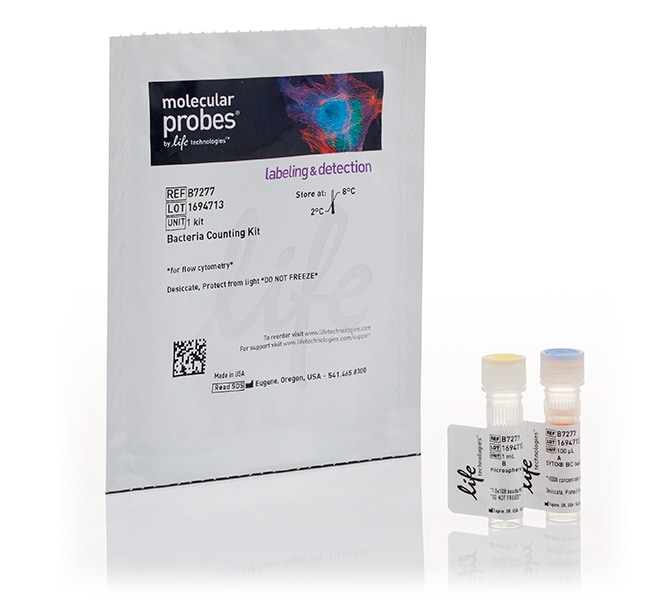
Bacteria Counting Kit, for flow cytometry
The Bacteria Counting Kit accurately enumerates bacteria by flow cytometry. The kit includes the SYTO™ BC dye, which is also深入閱讀
| 產品號碼 | Quantity |
|---|---|
| B7277 | 1 kit |
產品號碼 B7277
價格 (HKD)
2,840.00
Each
Quantity:
1 kit
價格 (HKD)
2,840.00
Each
The Bacteria Counting Kit accurately enumerates bacteria by flow cytometry. The kit includes the SYTO™ BC dye, which is also available separately (Cat No. S34855), a high-affinity nucleic acid stain that easily penetrates both gram-negative and gram-positive bacteria, producing an exceptionally bright green-fluorescent signal. The kit also includes a calibrated suspension of polystyrene microspheres. Signals from both the stained bacteria and the beads are easily detected in the green fluorescence channel and can be distinguished on a plot of forward scatter versus fluorescence. The density of the bacteria in the sample can be determined from the ratio of bacterial signals to microsphere signals in the cytogram.
Any physiological buffer between pH 7.0–8.0, including PBS, can be used to dilute the SYTO dyes for the staining solution.
View additional information about all microbiology assays for flow cytometry.
For Research Use Only. Not for use in diagnostic procedures.
規格
Detection MethodFluorescence
Diameter (Metric) Bead6 μm
For Use With (Application)Flow Cytometry
For Use With (Equipment)Flow Cytometer
IncludesBC Bacterial Stain, Microsphere Standard
Quantity1 kit
Sample TypeBacteria
Shipping ConditionRoom Temperature
Product TypeBacteria Counting Kit
Unit SizeEach
內容物與存放
Contains 1 vial of SYTO™ BC bacterial stain (100 μL, 1000x in DMSO), 1 vial microsphere standard (1 mL, 6 μm).
Store in refrigerator (2–8°C) and protect from light.
Store in refrigerator (2–8°C) and protect from light.
常見問答集 (常見問題)
Is the SYTO BC bacteria stain from the Bacteria Counting Kit available as a standalone product?
When using the Live/Dead BacLight Bacterial Viability and Counting Kit, for flow cytometry, some cells seem to have both red and green signal. Are these cells dead or alive or dying?
How can I count my bacteria by flow cytometry?
What bacterial parameters can I look at by flow cytometry?
I am using counting beads to count cells, but I cannot find the beads on my scatter plots. What do I do?
引用資料與參考文獻 (4)
引用資料與參考文獻
Abstract
Comparison of blue nucleic acid dyes for flow cytometric enumeration of bacteria in aquatic systems.
Journal:Appl Environ Microbiol
PubMed ID:9572943
'Seven blue nucleic acid dyes from Molecular Probes Inc. (SYTO-9, SYTO-11, SYTO-13, SYTO-16, SYTO-BC, SYBR-I and SYBR-II) were compared with the DAPI (4'',6-diamidino-2-phenylindole) method for flow cytometric enumeration of live and fixed bacteria in aquatic systems. It was shown that SYBR-II and SYTO-9 are the most appropriate dyes for bacterial
The beta-catenin--TCF-1 pathway ensures CD4(+)CD8(+) thymocyte survival.
Journal:Nat Immunol
PubMed ID:11477404
The association of trans-acting T cell factors (TCFs) or lymphoid enhancer factor 1 (LEF-1) with their coactivator beta-catenin mediates transient transcriptional responses to extracellular Wnt signals. We show here that T cell maturation depends on the presence of the beta-catenin--binding domain in TCF-1. This domain is necessary to mediate the
Fluorescence staining and flow cytometry for monitoring microbial cells.
Journal:J Immunol Methods
PubMed ID:10986415
Large numbers of microbiological samples are analysed annually using traditional culture-based techniques. These techniques take hours to days to yield a result, are tedious and are not suitable for non-culturable microorganisms. Further, culture-based techniques do not provide real-time information on the physiological status of the organism in situ which is
Flow cytometry and cell sorting of heterogeneous microbial populations: the importance of single-cell analyses.
Journal:Microbiol Rev
PubMed ID:8987359
The most fundamental questions such as whether a cell is alive, in the sense of being able to divide or to form a colony, may sometimes be very hard to answer, since even axenic microbial cultures are extremely heterogeneous. Analyses that seek to correlate such things as viability, which is